Read on for our detailed analysis of each website builder for portfolios
Creating a new website is a lot easier than it used to be – rather than learning HTML and CSS, you can just click and drag with your mouse and have something very professional-looking on the internet in minutes, and portfolio website builders are no different.
The increased use of this software online means you've got a selection of the website builders for portfolios to choose from. However, with so many great selection of tools to choose from, it can be difficult to pick out the best portfolio website builders from a crowd of so many.
To help you narrow down your choice, we've picked five portfolio website builders that offer a good balance of price points and features.
All of these website builders for portfolios offer simple ways of customizing your pages once they're online, so you can regularly change the look of your work, and make sure your talents are always being well promoted on the web.
Here then are what we think are the best portfolio website builders.
Top 3 website builder services
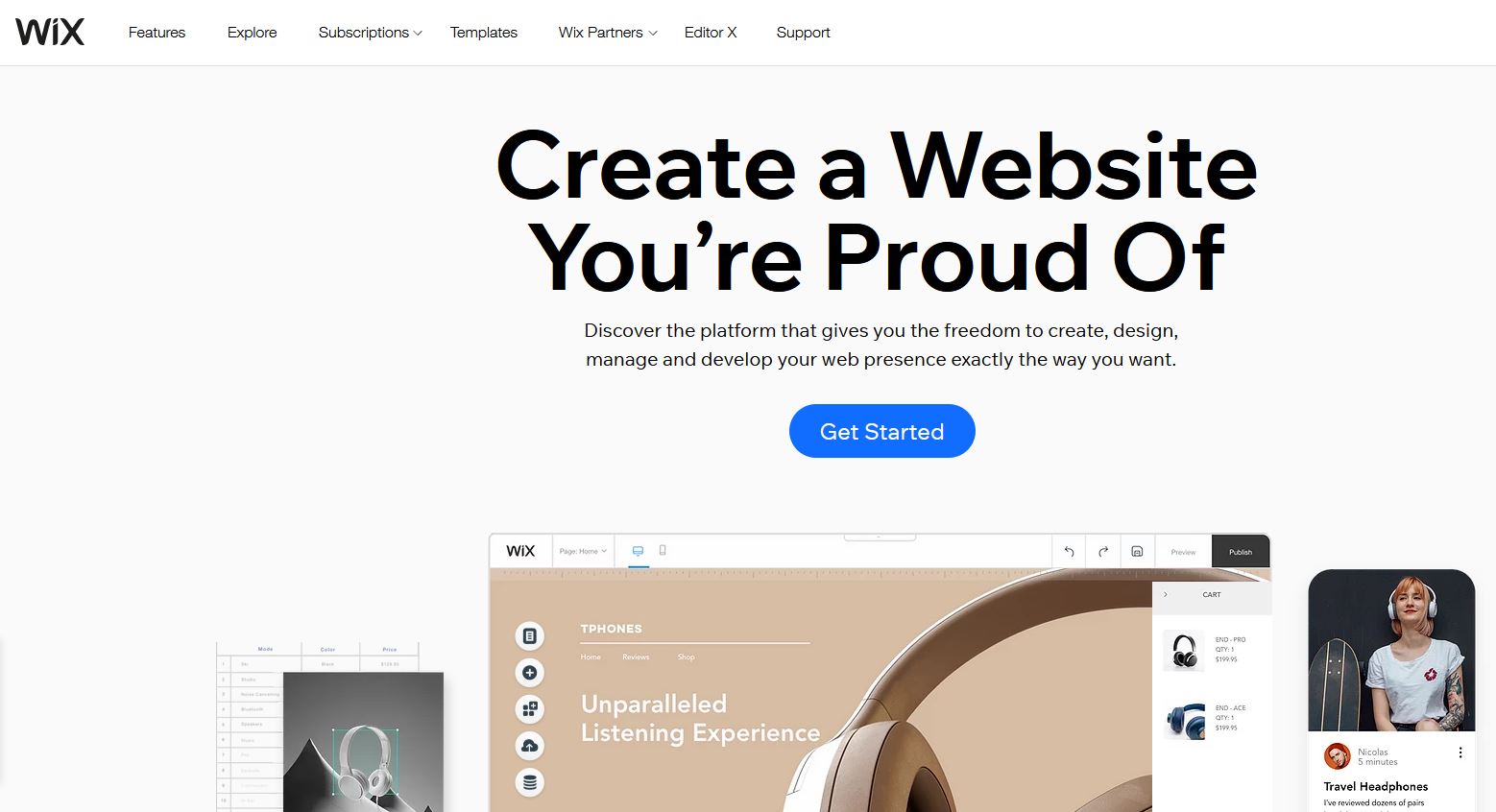
1.Wix - a top-notch website builder that's great value Wix is top dog when it comes to free website builders, but it also offers some powerful paid plans. These start from as little as $8.50 per month for the Combo plan (over three years) which removes the adverts from your site, as well as giving you 3GB of storage space, a free domain and free SSL certificate.
2.Gator is a great website builder service Gator Site Builder from Hostgator has a superbly cheap Starter package which comes with free hosting and a domain name included, plus a free SSL certificate. You get constantly available customer support, too, and the benefit of website analytics to boot: all with 50% off meaning you pay just $3.84 per month.
3.Zyro - a serious, high-quality site builder Hostinger-owned Zyro offers a website builder that is very easy-to-use and ideal for novices, allowing anyone to get their site up swiftly. You’ll pay very little for the privilege too and even the premium "Unleashed" plan costs just $3.90 monthly.
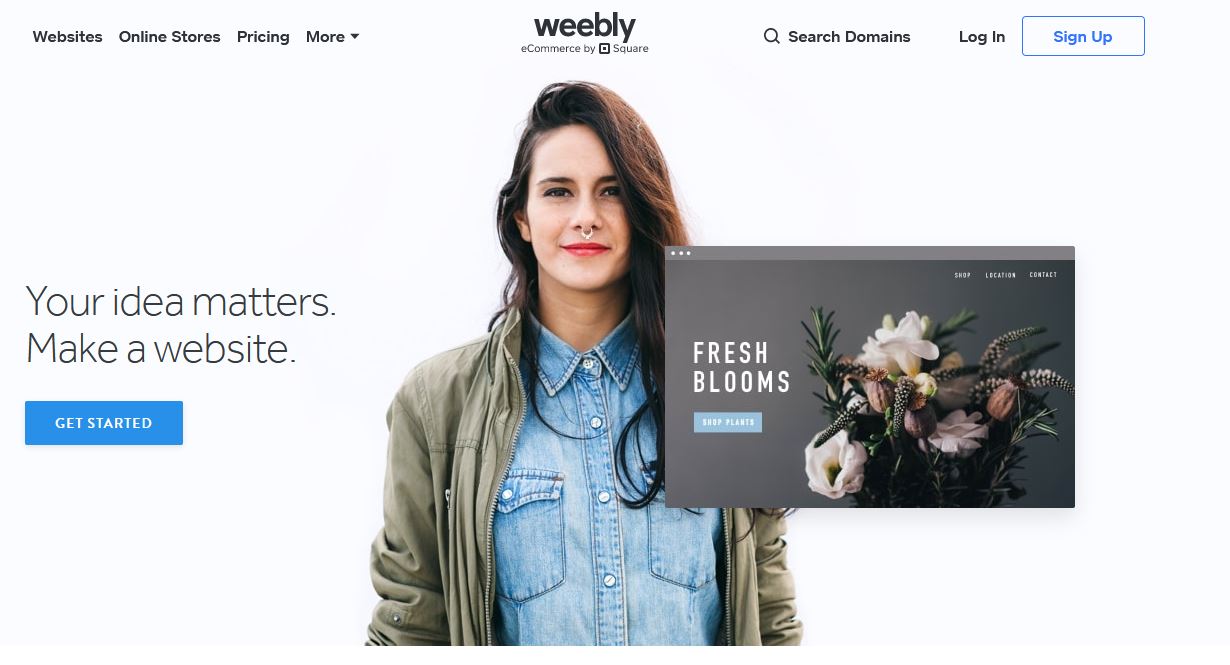
Weebly was first set up with the intention of making it easy to set up a portfolio of work online, and those origins stand it in good stead today, even as it has broadened its horizons to become more of a general website builder. If you don't mind a Weebly subdomain, some ads on your site, and a limit of 500MB storage, you can actually use it for free.
While the choice of themes is relatively small, they're all fully customizable, and they all work on any size of screen, automatically reformatting to suit the display dimensions. Weebly has one of the most elegant and user-friendly website editor interfaces we've seen, so you can tweak your portfolio in exactly the way you want.
One of the many areas where Weebly excels is in the way it calmly handles a lot of technical stuff quietly in the background: it gives you enhanced SSL security by default, and (on the paid options) advanced analytics for your website, plus the option to transfer over a domain name.
If you want to get up and running quickly, would like to spend some – but not a lot – of time customizing your site, and need something that's going to be reliable and comprehensive, Weebly fits the bill. The fact that you can get started for free to see if you like it is an added bonus.
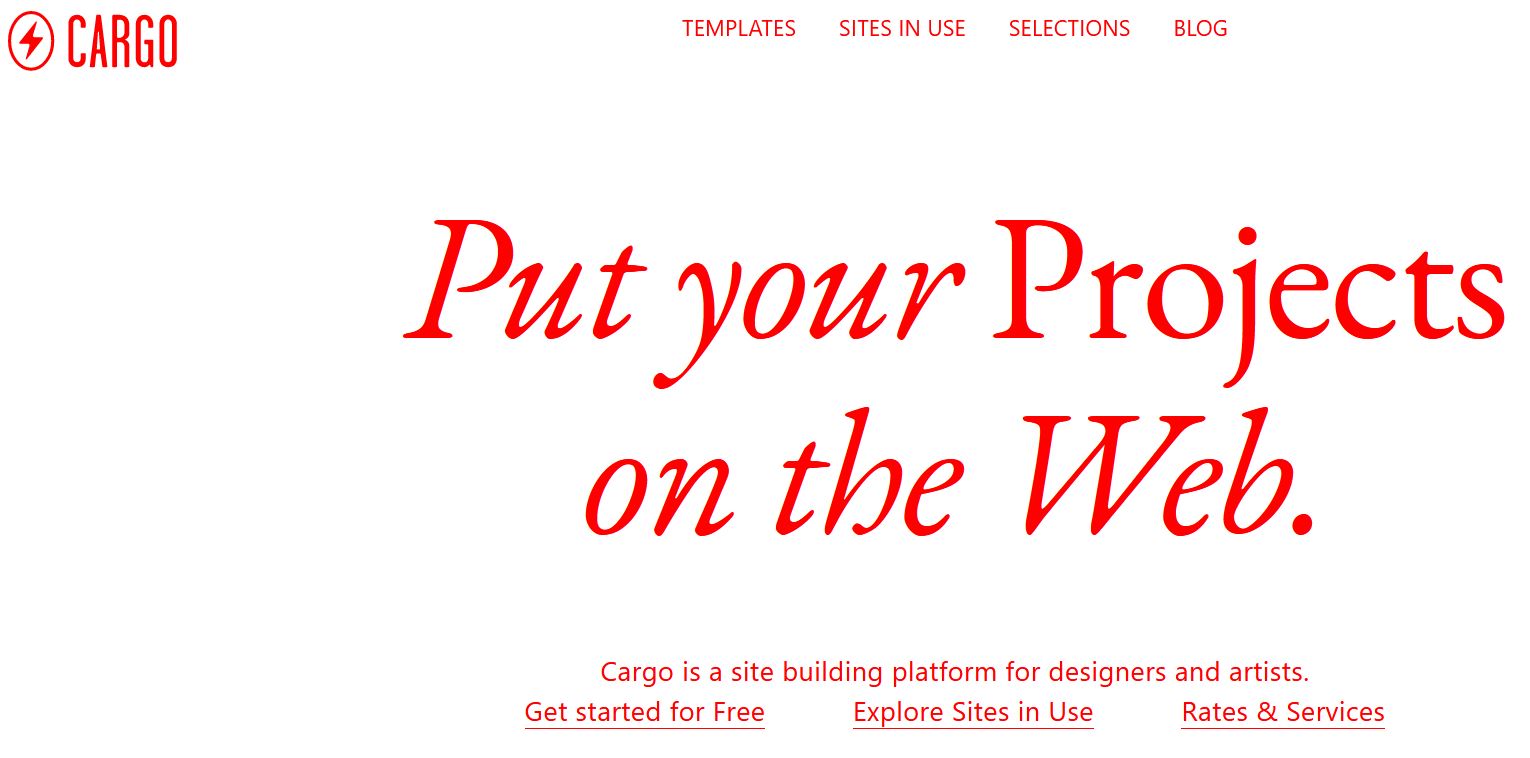
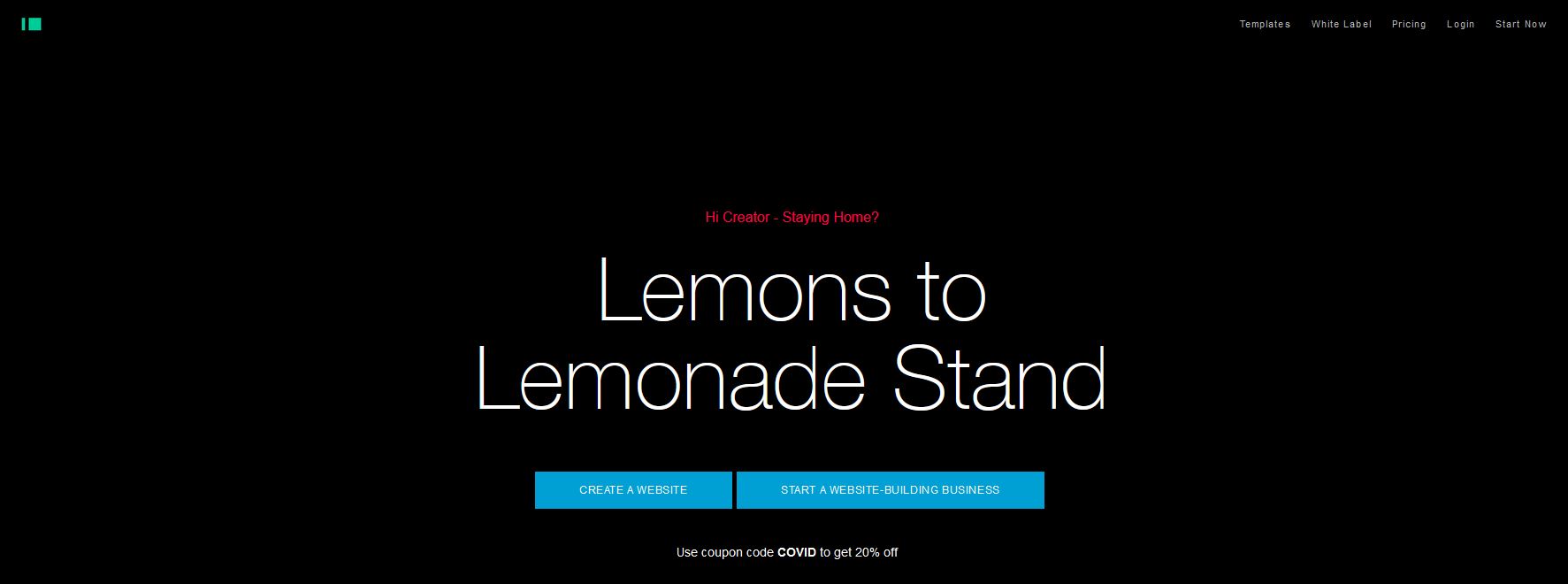
There's a lot that appeals to us about the website builder Cargo: the unconventional and varied choice of templates, the intuitive page tweaking interface you can edit them with, and the way that you can build up an entire site without paying a penny (you won't be charged until the site goes live).
It's certainly got more of an edge than other comparable website builders, which might be good or bad depending on what you're looking for. The templates available are all eye-catching and bold, and will work best for people wanting to stand out from the crowd, whether that's with photography or writing.
Every template is responsive and works on a variety of screens, while Cargo also offers some cool animated image effects you can play around with too. On top of that, the site builder is to be commended for its wide choice of fonts as well, plus, even more fonts are being added from time to time.
Besides all of the features on the surface – including an online template editor that hits a nice balance between simplicity and customization – you get 6GB of image cloud storage, unlimited pages, unlimited bandwidth, the option to transfer over a domain name if you need to, and a ton of help and support (including tutorial videos).
Built on the latest HTML5 technology and with useful extras like e-commerce and domain name support included, IM Creator is going to be too advanced and in-depth for some, but will suit other portfolio builders perfectly. That's not to say it's difficult to use – there's just more going on.
You don't need to know a shred of code to get started, there are plenty of different themes and looks to choose from, and we like the way the themes are already pre-populated with content. That means you can just edit the sample material that's already there rather than starting from scratch, which can be more daunting.
If you want to go deeper into your website building and customizations, then IM Creator makes this possible. The site editor includes a variety of gallery and slideshow options, plus image effects to drop over your uploaded pictures, and the option to change everything from the fonts used to the page margins.
We'd recommend IM Creator if you're looking to stand out from the pack – it has a wide choice of templates and some detailed editing options too. On the other hand, it does need a bit more of a time and effort investment than other site builders.
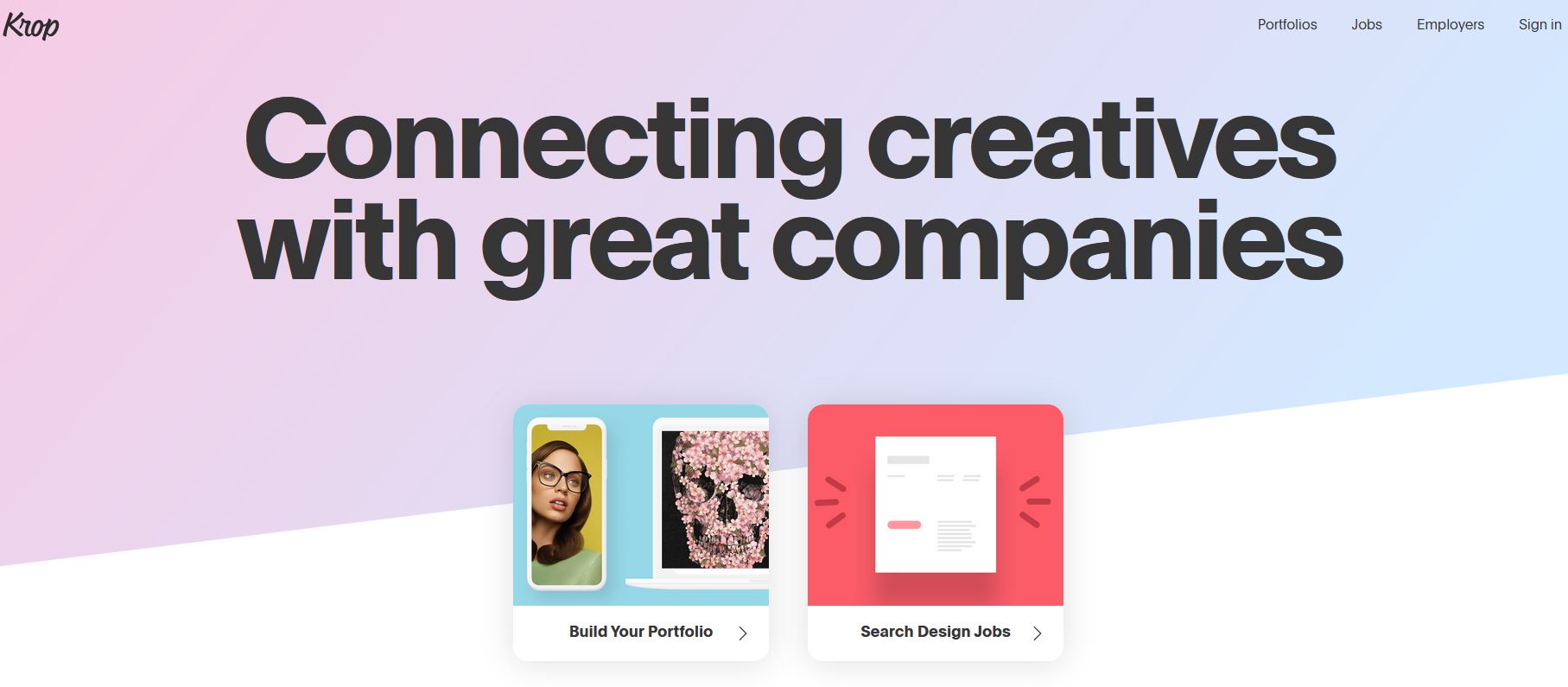
Krop is a creative jobs site and a portfolio builder rolled into one, so you know that its services are trusted by people in the same industry as you (or the same industry that you're trying to break into). What's more, its template options are some of the most well-designed that we've seen.
The website builder ticks all of the boxes that you should be looking for. Setting a site up is quick and easy, you can register a custom domain if you want to, and making tweaks to the design and layout of your pages is very straightforward too. On top of that, you get neat extras like Dropbox and Instagram syncing, and Google Analytics integration.
If you do know some CSS, then you can take more control over the way your site is designed. If not, you can just use the simple site editor instead – picking colors and fonts is as easy as clicking on a side panel.
Those of you who are looking to get a gig at the same time as building your website can of course switch straight over to the job section of the Krop site to find work – there are some big-name employers on the portal. You can try out the service with a free 14-day trial.
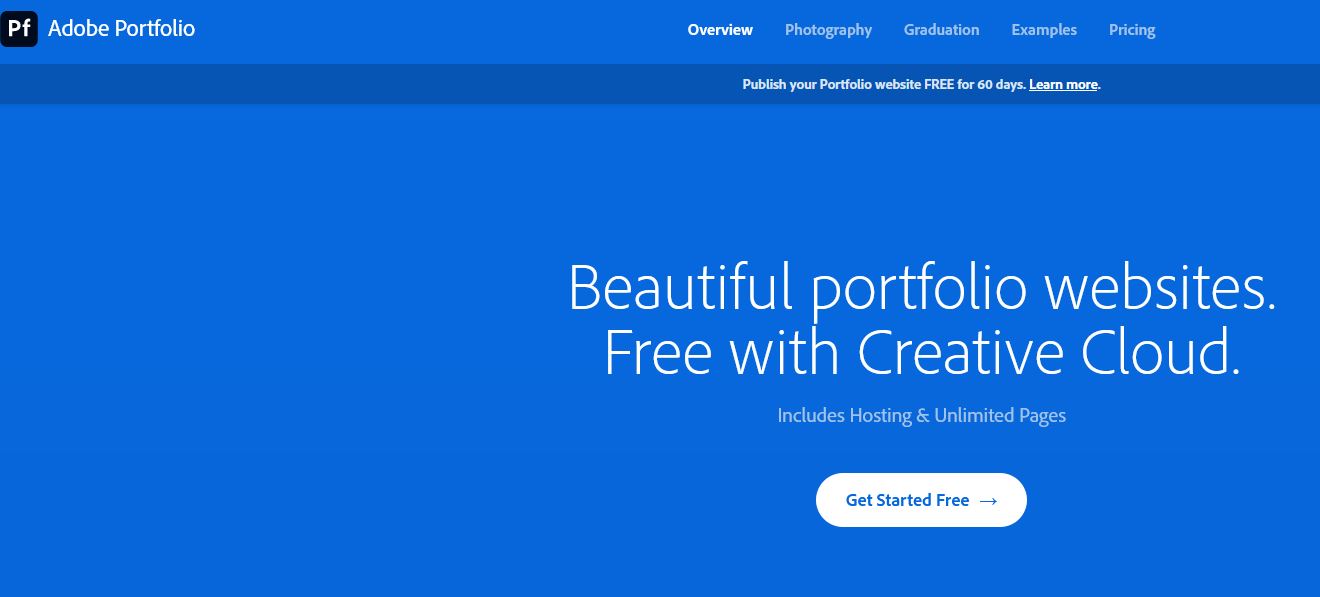
Considering Adobe makes some of the best creative software in the business, you would hope it knows what it's doing in terms of displaying portfolios on the web – and we're glad to report that is indeed the case.
This is slightly different to the other services we've mentioned here, because it's a free add-on to the Creative Cloud suite developed by Adobe. If you don't already pay for the programs then Portfolio is unlikely to tempt you to part with your cash, but if you are a CC subscriber, it's worth looking at this before venturing anywhere else. Worth noting that college graduates can get Adobe Portfolio free for 1 year.
While it doesn't offer as many customization and layout options as some of the other site builders we've mentioned here (although, the popular feature request - video backgrounds, has been added), Adobe Portfolio does make the process of getting your work online simple and fun. Of course there's also the tight integration with Adobe's apps, so you can easily share your work straight from Lightroom to the web. You can also purchase and connect a domain if you wish.
Pages are optimized for any device and certain ones can be password-protected if needed, and there's also the option to bring over a domain name you already own. For a simple portfolio maker that plugs right into the apps you already use (assuming that's the case), it's ideal.
A host of different services will now let you put a website online, quickly and easily, no coding skills required – but if you're looking for something to show off your talents as a musician then you need a more specific set of features.
Primarily, a way of uploading and sharing your tunes in a simple and secure way, even if it's just snippets of songs rather than whole tracks or indeed albums.
If you're a musician for hire then it can be useful to have some kind of booking system in place as well, or at least a contact form. On top of that, there are all the extras you might be interested in, like support for your own domain name or gallery pages to show just how many people came to your last gig.
Here are our picks for the best website builder for musicians to create a presence online.
Top 3 website builder services
1.Wix - a top-notch website builder that's great value Wix is top dog when it comes to free website builders, but it also offers some powerful paid plans. These start from as little as $8.50 per month for the Combo plan (over three years) which removes the adverts from your site, as well as giving you 3GB of storage space, a free domain and free SSL certificate.
2.Gator is a great website builder service Gator Site Builder from Hostgator has a superbly cheap Starter package which comes with free hosting and a domain name included, plus a free SSL certificate. You get constantly available customer support, too, and the benefit of website analytics to boot: all with 50% off meaning you pay just $3.84 per month.
3.Zyro - a serious, high-quality site builder Hostinger-owned Zyro offers a website builder that is very easy-to-use and ideal for novices, allowing anyone to get their site up swiftly. You’ll pay very little for the privilege too and even the premium "Unleashed" plan costs just $3.90 monthly.
Website builder designed specifically for musicians
Sell music, tickets and merch
Plug in all your social accounts
Not the most flexible theme editor
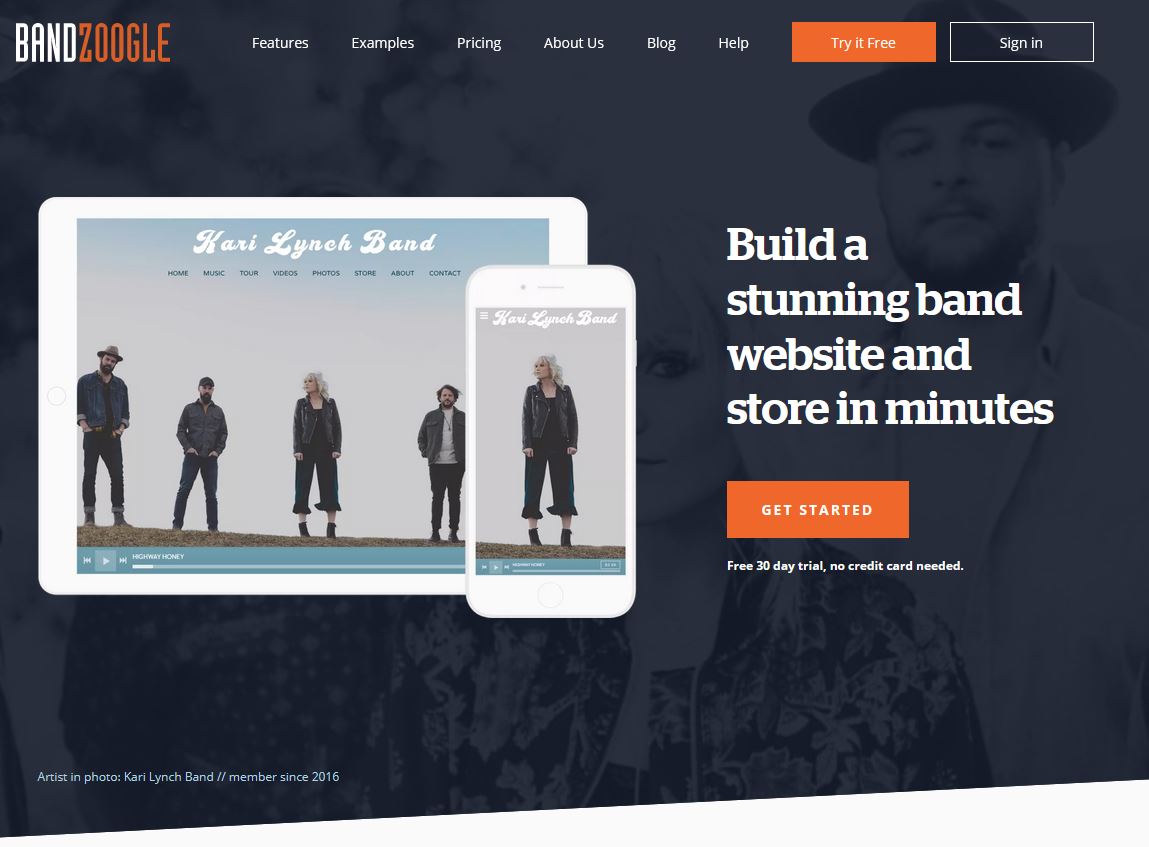
You won't find too many website builder services aimed specifically at musicians, but Bandzoogle gleefully jumps in to provide a bespoke service specifically for bands and artists. While it lacks some of the polish of the big names, because it focuses on the musician niche in particular, it has everything you should need.
That includes, of course, the ability to upload your own tracks and let visitors stream them from your website. You can get tracks organized into entire albums if you really want to go to town, or just share (or even sell) single tracks. And then, as well as that, you've got simple ways to post gig dates, blog updates, and so on.
Whether you need to build a contact form or a video diary, Bandzoogle makes it easy, no coding required – you can really make a site that's as simple or as complex as you like, and the end result is something that looks like you hired a specialist.
You've got over 100 themes to choose from (there is even one for crowdfunding), they're all straightforward to edit and tweak, and connecting up social accounts (including the likes of SoundCloud and Bandcamp) only takes a few clicks as well. As an added bonus, you can sell fan subscription, merchandise and tickets right through Bandzoogle as well.
This all makes, in our opinion, Bandzoogle the best overall website builder for musicians.
Check out any list of website builders for any purpose and Wix is likely to feature on it, but not only does this service earn that high reputation, it also has some useful tools for musicians – not least the ability to upload your own tracks so visitors to your website can listen to them without any extra software or browser extensions.
Platforms that you're probably already using, like Bandsintown and Songkick, can plug directly into your Wix site: you can set up integrations like these in just a few clicks. What's more, you can add on an e-commerce portal to your site, for the purposes of shifting albums, T-shirts, or whatever else you need to sell.
Wix has a very solid selection of templates, with more than 500 to choose from, and if you delve into the music section you'll see there are options for solo artists, bands, DJs, producers, or anyone else connected to the industry. Have a click around these templates to see the kind of sites it's possible to create.
After that you've got all the features Wix has become known for: a site editor that's a breeze to use whether or not you know what CSS stands for, custom domain name support, easy blogging and simple social media support, and a free tier that lets you work out whether Wix is for you before you part with any cash.
Overall, Wix offers a great website builder, and especially a website builder for musicians.
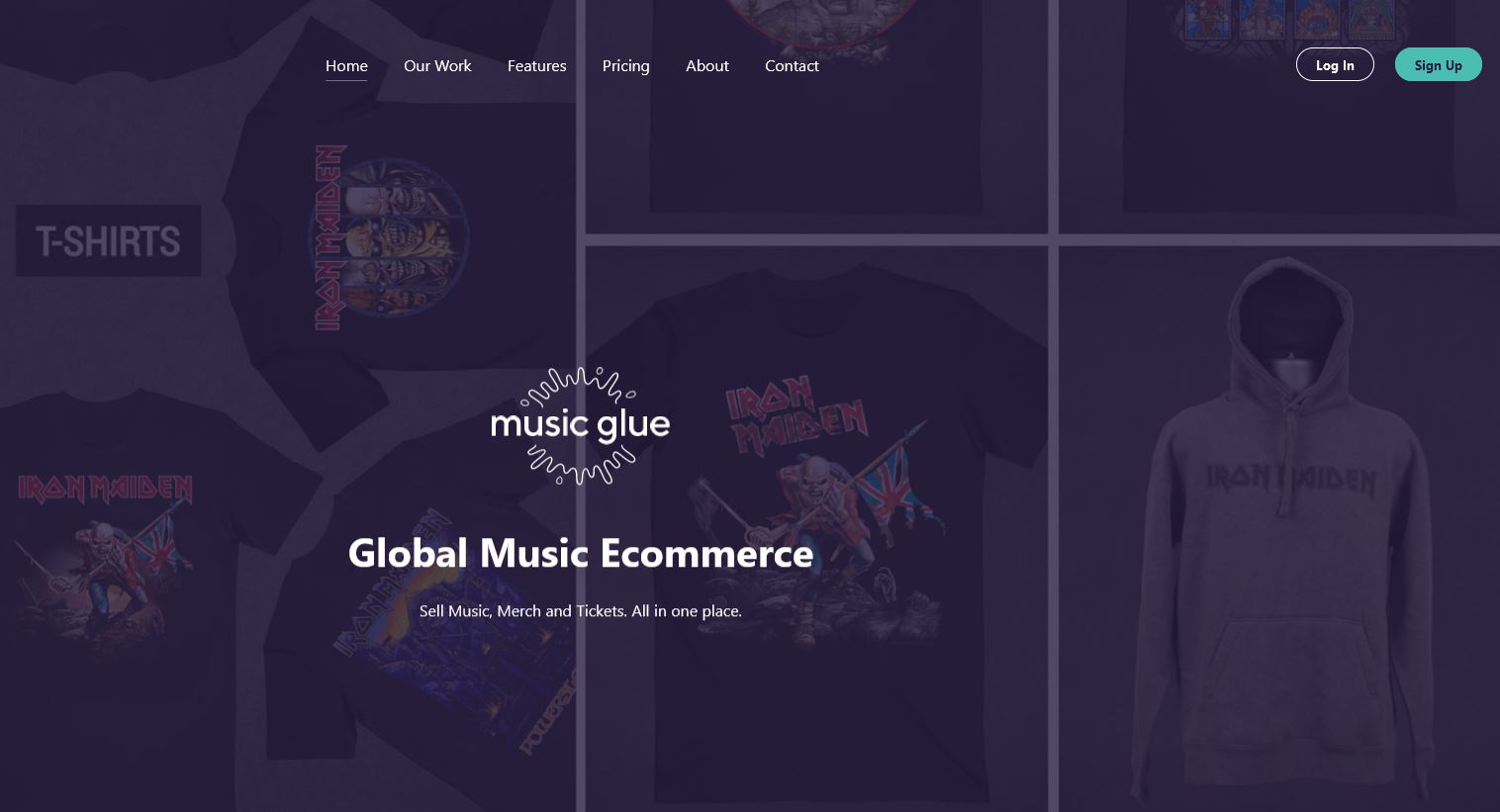
Music Glue is a little different to the other website builder services we've featured here: it focuses first and foremost on the merchandise and ticketing aspects of the music business, and indeed powers the online stores for some of the biggest names in the industry. Its pricing system is unusual too, taking a 10% cut of whatever you sell rather than a flat fee.
That does at least mean you won't be out of pocket if your online marketplace doesn't attract much attention to begin with. There are no additional fees for payment processing, and customers can rock up with debit or credit cards, or PayPal.
Music Glue is less impressive on the website building side, although you do get the basics – a choice of themes for the site attached to your online shop, the option to bring over your own custom domain name, tools for tweaking the code and layout of your site, and so on. It's possible to plug in social media accounts and even set up a mailing list.
If your priority is the mechanics of selling music and tickets to your audience, then Music Glue is a good bet, and has some very famous clients on its books, as we mentioned. If you don't really have anything to sell right now and want to spend more time fiddling with a site design and layout, then maybe look elsewhere.
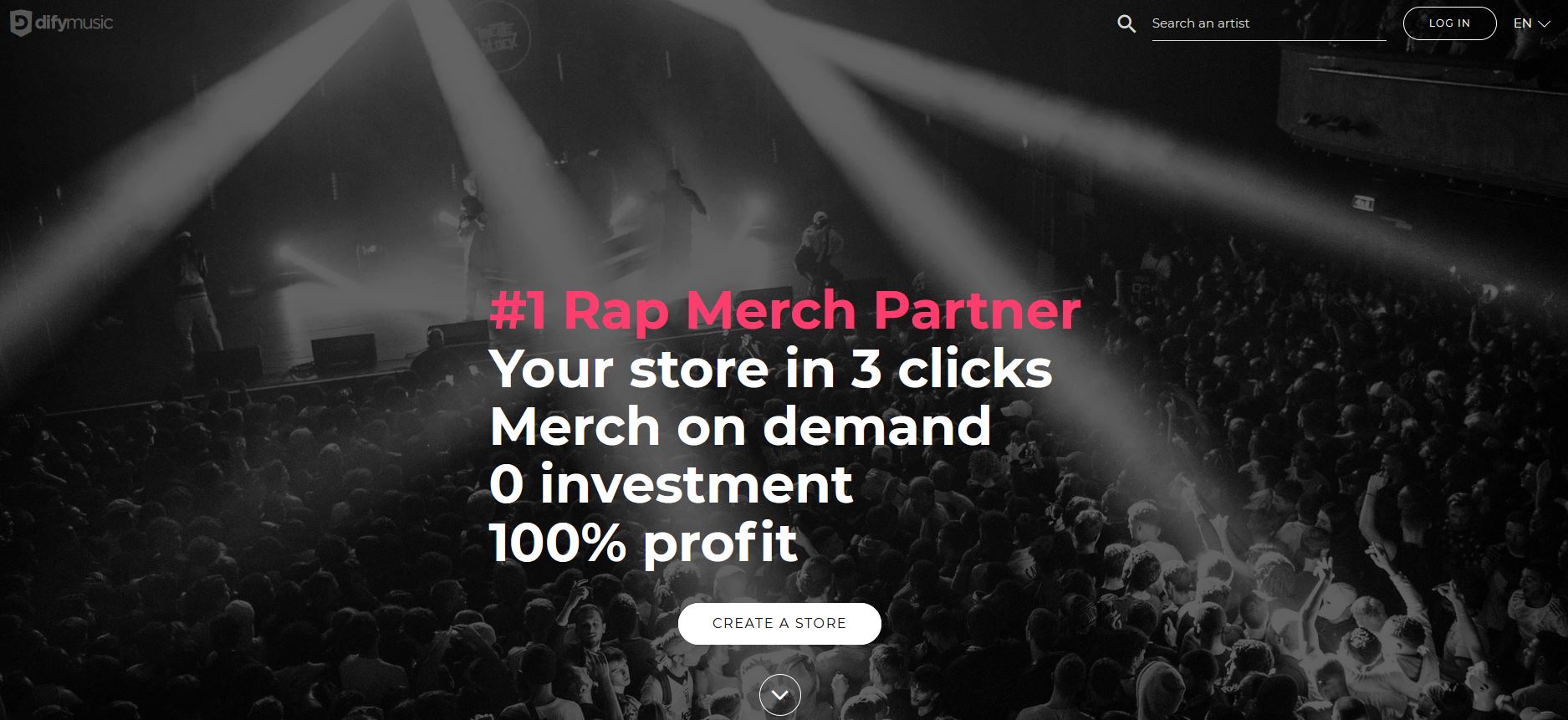
French website Difyd2c isn't the most well-known website builder for musicians out there, and it doesn't have the same breadth of tools and features as some of the big names – but where it really comes into its own is in getting your music online quickly and easily.
If you'd rather just get your stuff up quickly with a few pictures and links, rather than spend ages choosing a theme and editing HTML, Difymusic could be for you. It relies on plug-ins – like Spotify or SoundCloud for getting your music up, for example – but it supports an awful lot of them, so you're bound to find something that works.
If you want to sell merch and tickets, then you can pay to add that on your main site, with a one-time €9.99 setup fee (about £9 or $12) and then 5% commission based on sales, but the basics are free. Connect up your Facebook page and your YouTube channel and you're good to go in just a few minutes.
Admittedly the choice of templates and editing options aren't very strong, but the designs you can play around with are decent enough, and certainly won't put anyone off your music. Difyd2c lets you get started quickly, and scale up as required.
Tumblr isn't a website builder in the conventional sense – it's more of a half blogging, half social media platform – but if you take a longer look at what Tumblr has to offer, it's actual very appealing for musicians. For one thing, it's completely free to use, plus it already attracts a busy community of creatives.
You can post up to one 10MB MP3 file every day, as well as links, text posts, videos, photos and more. Those MP3s appear as streamable files for visitors to your site – they can listen to the tunes in their browser, no plug-ins or extra software required, so it's a great way of showcasing your talents without paying anything.
If Tumblr was simply a blogging platform and that was it, we probably wouldn't recommend the service, but it also supports pages alongside your blog (for a gallery or a contact form), custom domain names (so you can pay extra for whatever URL name you like), and posting from mobile apps too.
On top of all that there are a host of themes to choose from, some of which cost money, but many are free, and a lot of them would suit a musician's portfolio. If the theme isn't exactly to your liking, you can tweak it with the integrated options or your own CSS, and switching between themes whenever you like is simple, too.
Read on for our detailed analysis of each provider
In the middle ages, the Knights Templar established the key processes for the modern system of notary services, banking, loans, and mortgages that we have today. During that era, Knights carried with them documentation that proved their identity, created by a notary, often embossed with official wax seals.
The importance of these documents was enhanced by a Papal declaration in 1139 that allowed the Knights Templar to pass freely through any border, pay no taxes, and be granted total freedom from every authority other than the Vatican.
Without the documents created by a notary, anyone could impersonate a Knight, and avoid the laws that applied to ordinary citizens throughout the rest of Europe.
And when it comes to the worldwide web today, we can draw a parallel with a similar document of authority: the SSL certificate. SSL Certification (or TLS to be more accurate) is a means to verify the source of web pages, domains, and open the door to information exchanges and electronic financial transactions.
But how do you pick a good SSL provider? Simple – read on and find out. First of all, we’ve got a list of 10 of our favored SSL certificate providers, although everyone’s needs vary, so following our list, we will engage in an in-depth discussion of all the criteria you should consider when picking the right company for you.
We’ve also rounded up the best overall website hosting services
Below are the best SSL certificate providers of 2021:
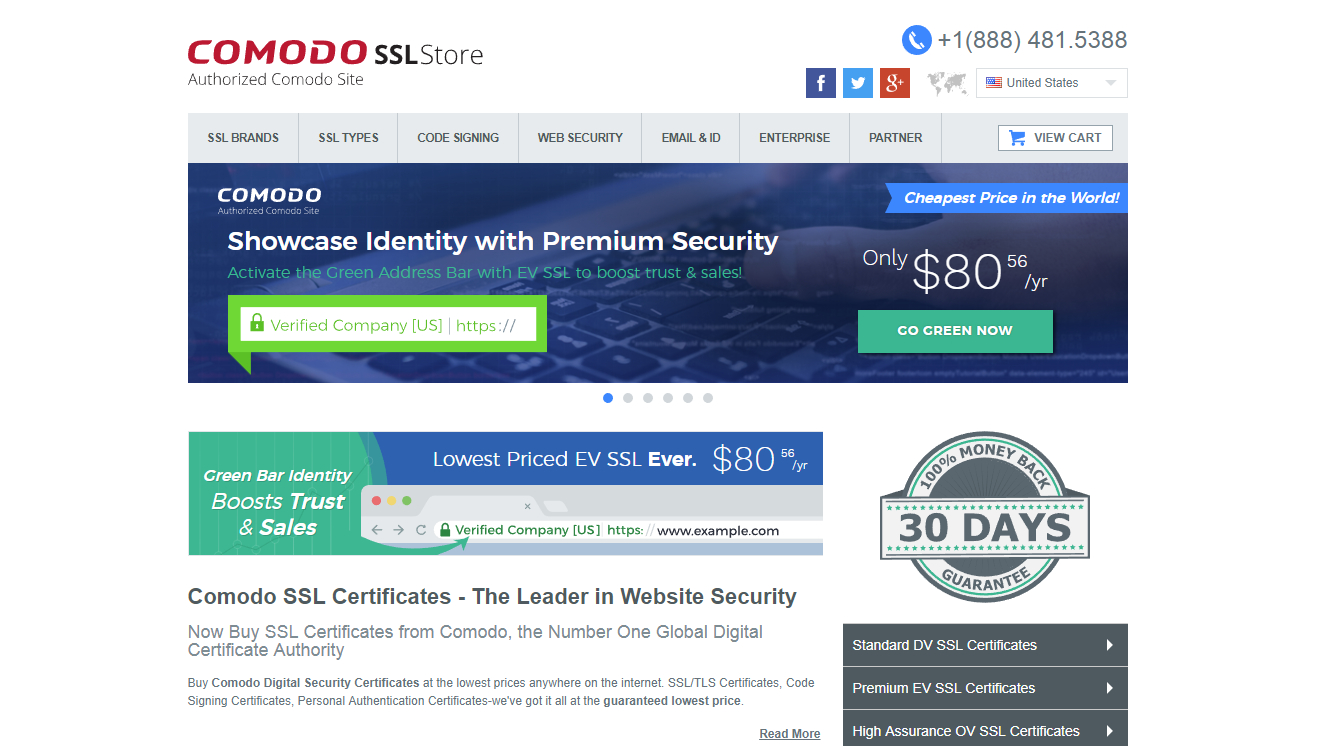
As a highly affordable provider of SSL services, Comodo SSL has made some significant headway in the past few years.
Much of that success has been the result of very aggressive pricing, with a DV level ‘Positive SSL’ Certification costing just $7.02 (£5.5) currently for five-year coverage.
A ‘Premium’ SSL solution only costs $54.09 (£42.6) for five years. That package includes a fully validated certificate, 256-bit encryption and a $250,000 (£189,000) relying party warranty.
But be warned, validation can take some time if the information required for Comodo SSL to complete the checking process isn’t available online. On the plus side, the company has excellent support people should you have installation or browser issues.
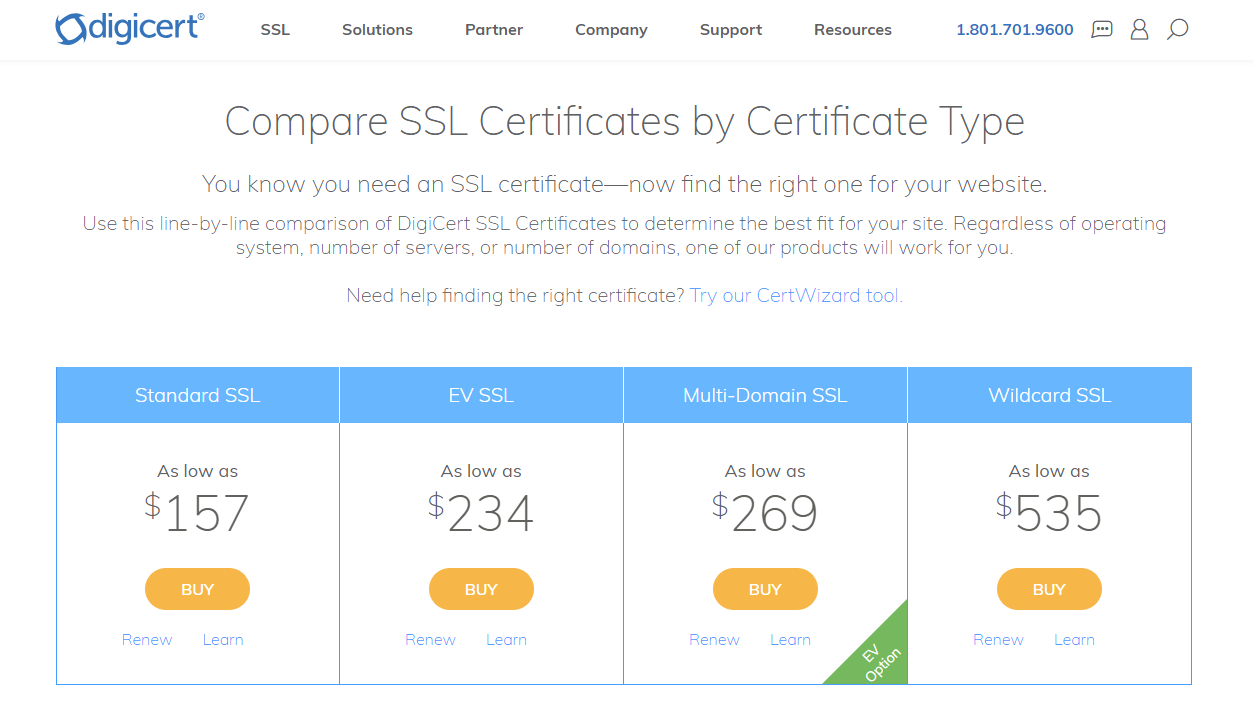
Having operated independently for some years, in 2017, DigiCert has completed an acquisition of Norton's website security and related PKI (Public Key Infrastructure) solutions. The motivation for this buyout was that Norton managed to convince 90% of Fortune 500 companies to pay for the Norton Secured Seal.
These are now DigiCert’s customers, and the company has implemented a plan to transition those using Symantec products on to DigiCert when appropriate.
The starting price for an SSL Certificate is $238 (£171) per year, although you might be able to better that with a two-year deal. You can add Wildcard SANs, with pricing starting at $788 per SAN.
A slick company run by experts in the security field
Impressive reputation as swift operators
Ability to manage numerous certificates
Not the most affordable service
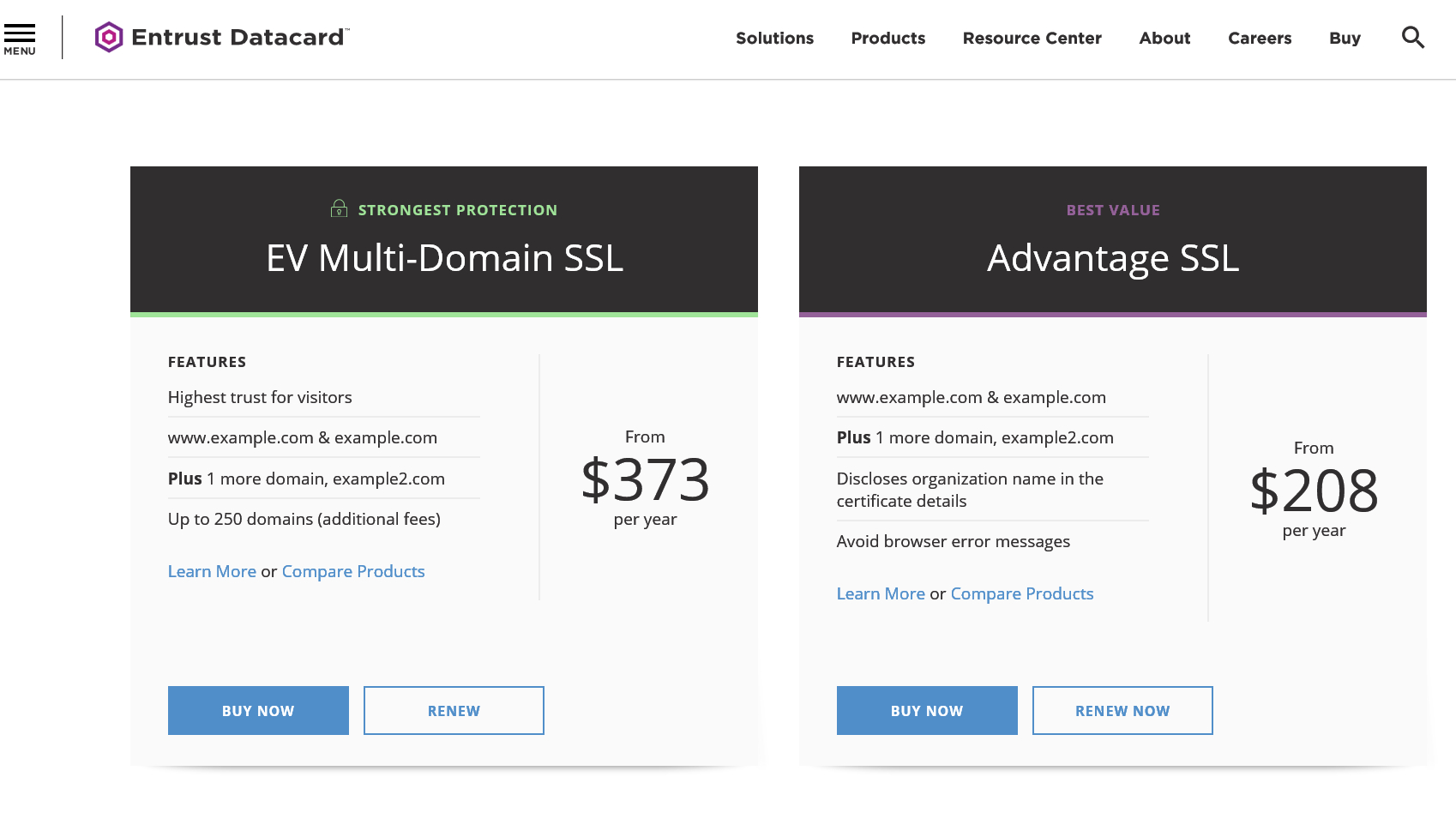
Based in the US, Entrust has been in business since 1994 and has garnered a reputation as a well-oiled machine for generating certification quickly and smoothly.
Entrust was built around a wide selection of security products: ID card printers, authentication systems, credit card printers and a PKI are all among its product lines.
With so much invested in secure systems, SSL certificates are considered one of its strongest offerings. Customers especially like the ability to manage numerous certificates across multiple domains from a management console.
Prices start at $199 (£154.1) per year for its Standard SSL single site product, climbing to $699 (£541) for a Wildcard SSL covering unlimited servers and subdomains. From what we’ve seen, most customers seem delighted with the service at all levels, seemingly justifying the extra cost over cheaper options.
Boasts a comprehensive selection of SSL certificates
Great value at the high-end
Enterprise solutions can be tailored
Validation may be time-consuming
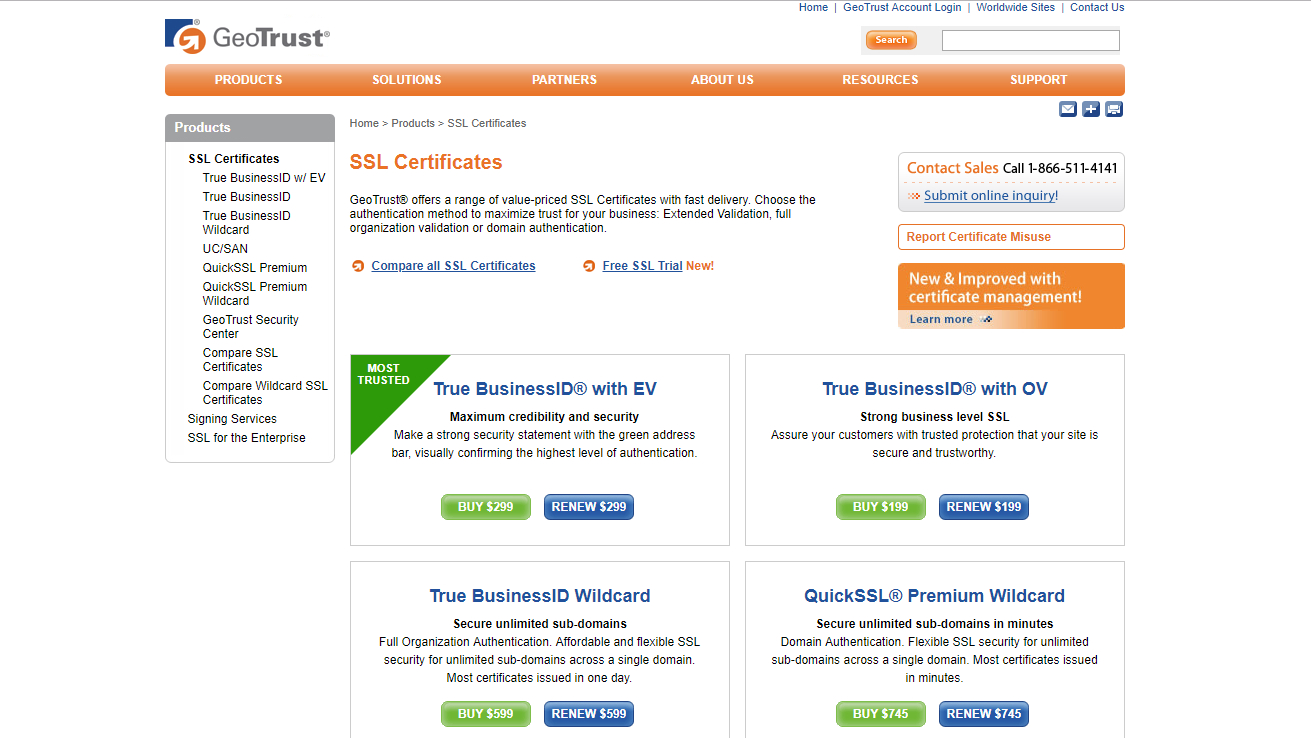
GeoTrust was once owned by VeriSign and then Norton, and due to the sale of the latter operation, it might also be part of DigiCert by now. The business covers three main areas: SSL certificates, Signing Services and SSL for enterprise services.
Those looking for SSL certification will find that GeoTrust offers a comprehensive selection starting with domain-level and progressing up to its True BusinessID with EV level certification.
Pricing is more competitive at the higher end, so those wanting a single site certificate might want to avoid GeoTrust, but those needing EV or OV level products should take a look.
Enterprise solutions specifically tailored to government organizations, healthcare businesses and financial institutions are part of the GeoTrust range. Be prepared for identity checks to take longer than others, but the thoroughness of these checks has enhanced GeoTrust’s status.
You get what you pay for here, with top-notch support
Excellent choice for enterprise customers
Scalable and flexible solutions
Not cheap
Where some operations have a wide client base, GlobalSign is very focused on enterprise customers, especially those who are looking to deploy highly scalable PKI solutions.
By taking this route, an enterprise customer can have all the rules, policies, and procedures for using SSL certificates, and their subsequent creation, distribution and revocation are all handled for them. But if you only want SSL certificates, GlobalSign can do that too.
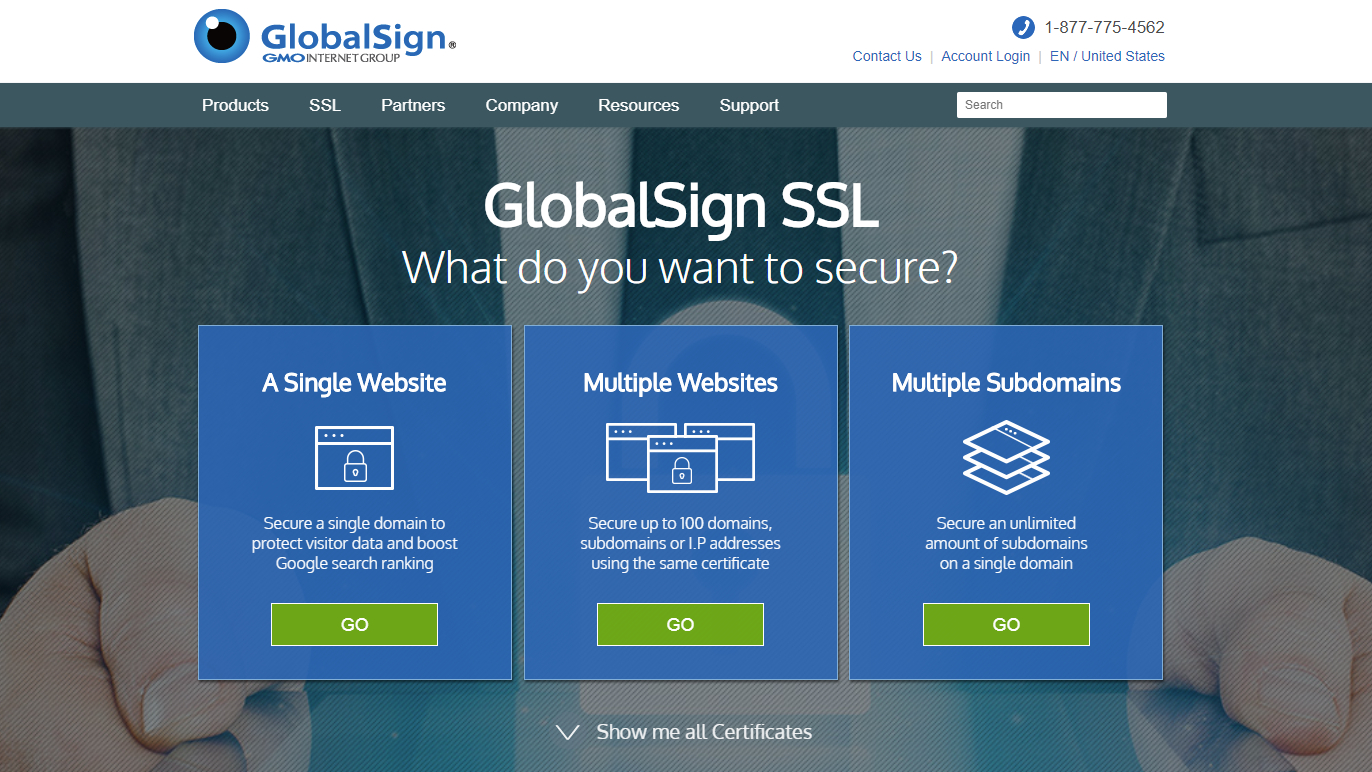
Having the level of support and organization that GlobalSign delivers doesn’t come cheap, and even for a single site with only DV level certification, prices start at $249 (£189). For those wanting the full EV certification, expect to pay $599 (£455) per year for a single site.
Web hosting giant also does SSL with an interesting spin
Pricing structure will work well for some
Excellent on the security front
Watch out for renewal prices
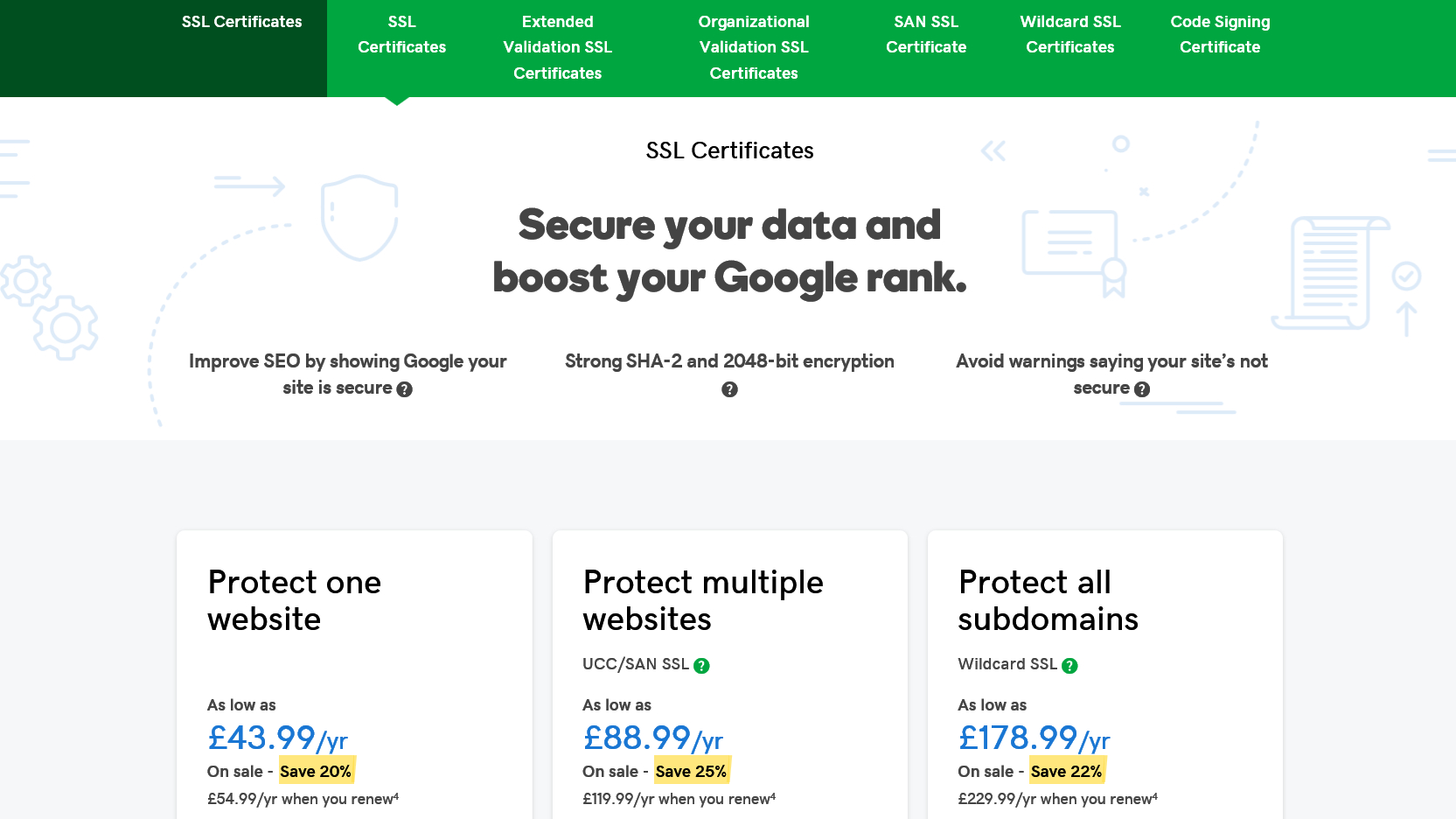
GoDaddy might be better known for its web hosting plans, but it’s also a big provider of SSL services.
Instead of offering DV, OV and EV certification at different prices, they all cost the same relatively low price. The pricing structure is instead based on a single site, multiple sites, or a domain with full subdomain cover.
Currently a single site, (DV, OV or EV level) costs $95.88 (£69) per year ($63.99 for the first term), and the all level domain solution is only $449.99 (£322.5) per year ($295.99 for the first term). The return on that investment is the best SHA2 and 2048-bit encryption, and the trust seal provided by McAfee Secure.
One quirk of GoDaddy’s offering is that while the fresh installation is relatively cheap, renewal can be more expensive. If you can be organized enough to do fresh installs each year, you can save yourself a little money over simply renewing.
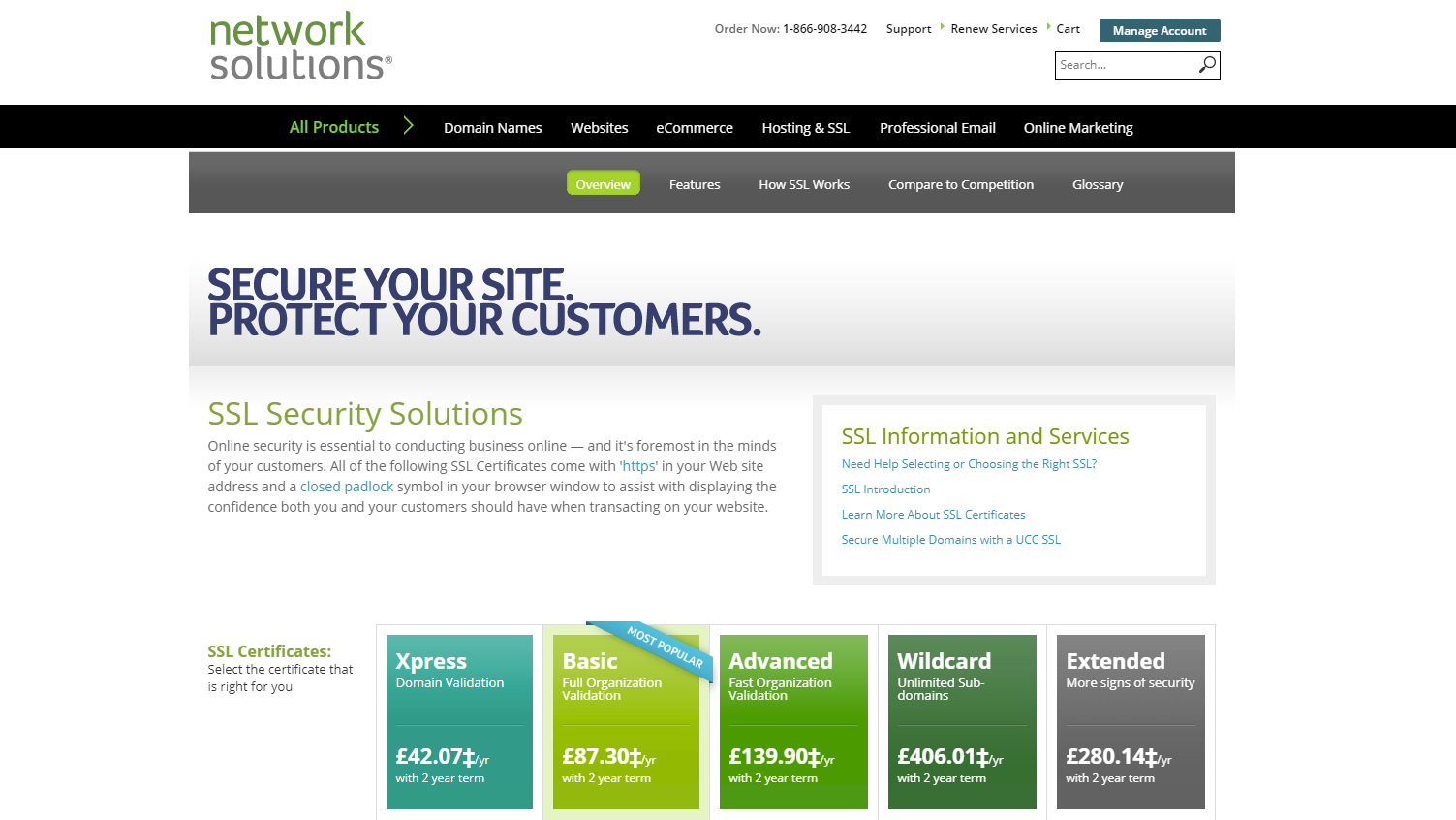
In some respects, Network Solutions is a little like GoDaddy, in that they both offer a wide range of web-related services, like domain names and e-commerce solutions, and SSL certification isn’t their sole focus.
What might attract customers is this firm’s pricing, with a base cost that starts at $59.99 (£45.5) with a 2-year term for a single site, rising to $399.5 (£309) for an EV level certificate that should be issued within five working days.
The weakness of this offering would seem to be the support team, which has been described in less than glowing terms by some customers. So given that, if you understand the details of installing certificates, then this might be for you, but anyone wanting extensive technical support may want to look elsewhere.
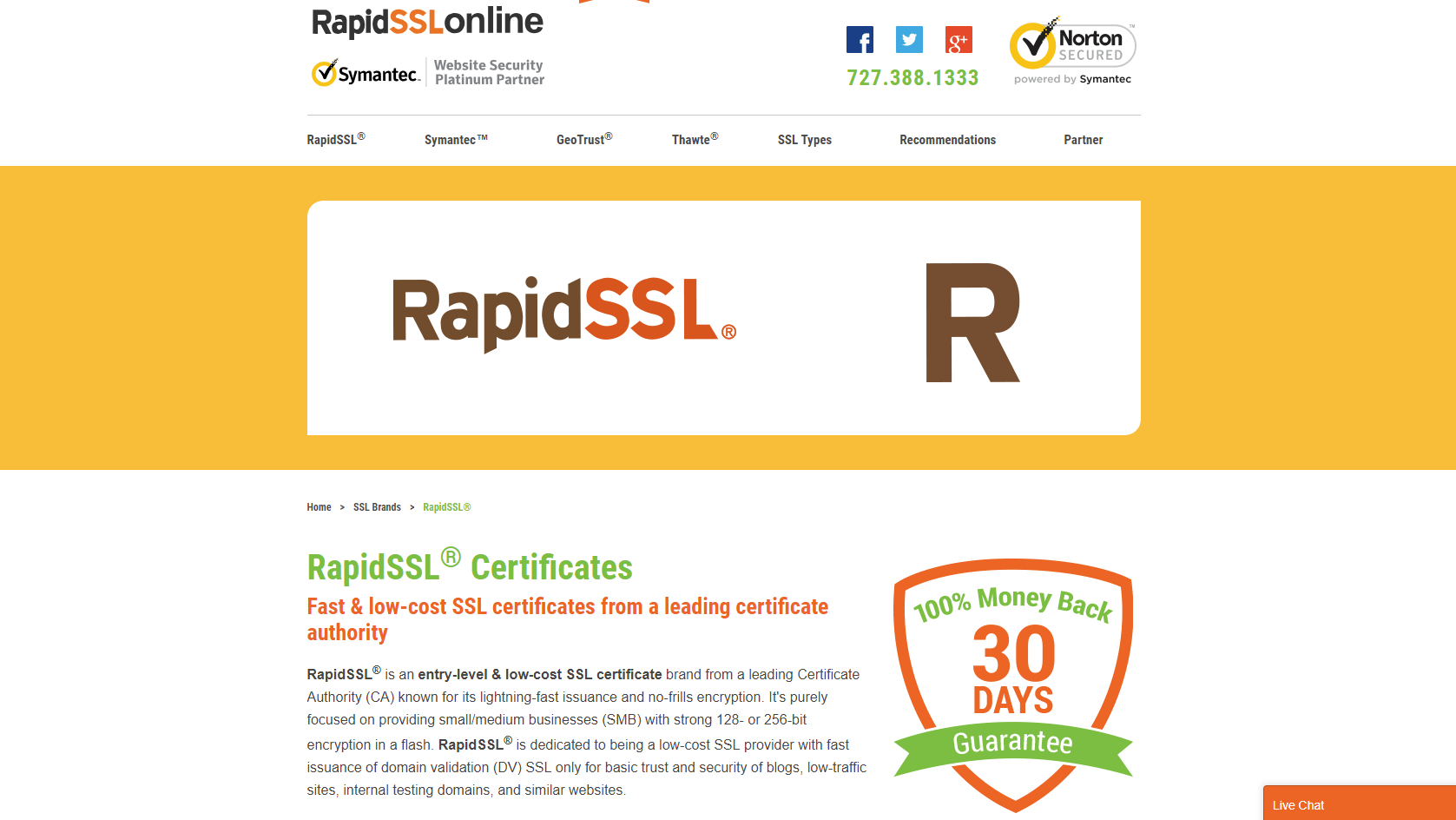
RapidSSL is owned by GeoTrust, another SSL provider we’ve already mentioned in this list. The business logic behind this is that whereas GeoTrust focuses on corporate giants, RapidSSL targets smaller businesses that are more cost-sensitive.
For just $17.95 (£13.6) per year, RapidSSL will provide a single domain certificate with 128/256-bit encryption with a browser recognition that exceeds 99%. A wildcard certificate that covers unlimited subdomains is $149 (£113) per year, plus it includes a $10,000 (£7,500) warranty and a 30-day money-back guarantee.
Free support is provided 24/7 by web and email, and installation tools are part of the package at no extra cost. And, even at this low price, the service is built on the same GeoTrust global infrastructure as the corporate customers benefit from.
Temptingly low prices are the star attraction here
Very affordably priced
Strong customer service
Need longer-term plans to get best prices
If the most important metric of this sector is customer approval, then SSL.com is delivering the type of SSL service that wins friends and returning customers. Part of that equation is strong customer services and support teams, and the other element is competitive pricing which values those willing to commit for longer periods than a year.
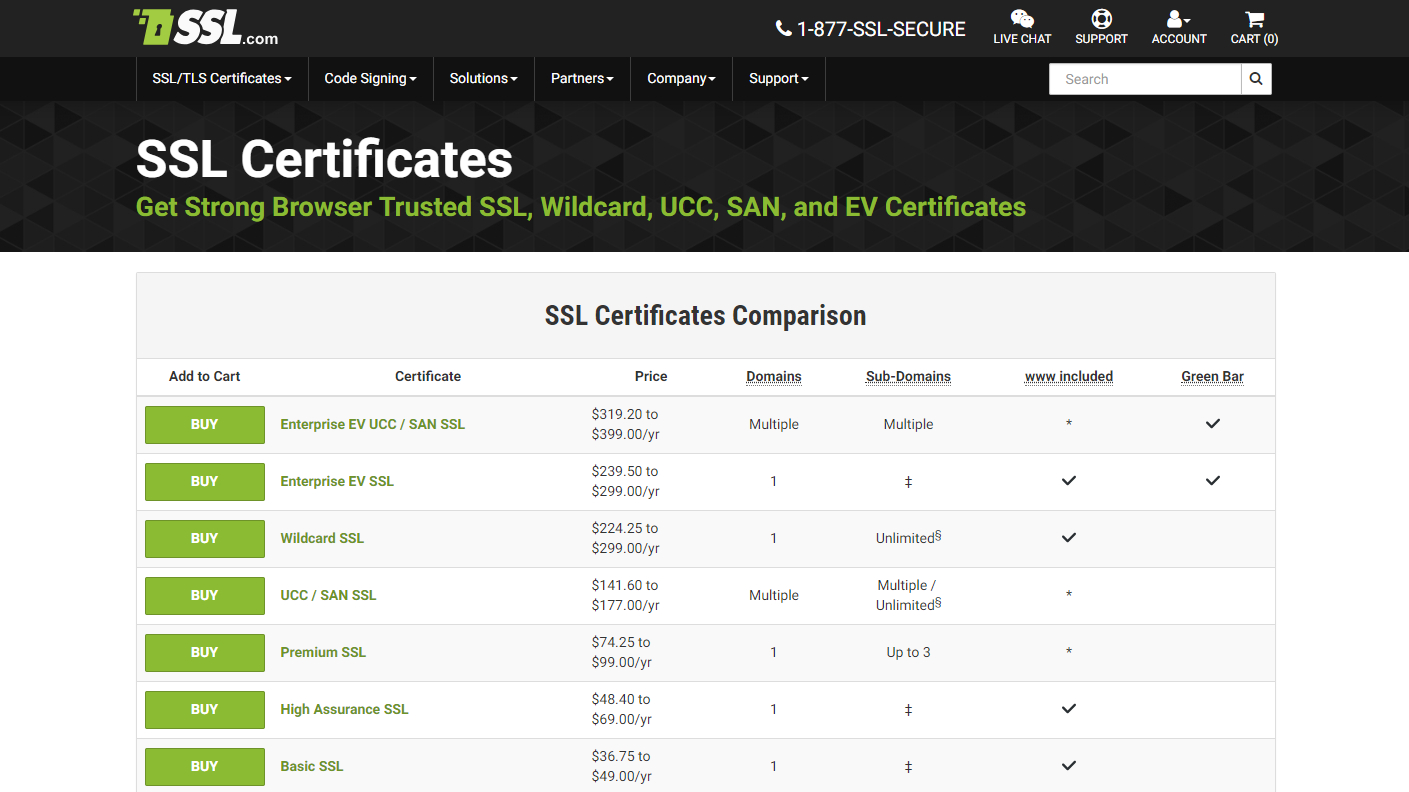
A single domain level certificate starts at $49 (£36) per year but can be as low as $36.75 (£28) per annum if bought for five years. If you’re a smaller business looking for certification, SSL.com might be a good place to start.
The company is hardly a household name, but Thawte has managed to corral more than 40% of the global market for SSL certificates. So far it has issued nearly a billion certificates in 240 countries worldwide.
What’s helped the firm establish this position is the strength of its offerings, and selling points include impressive browser compatibility, excellent certificate management tools, and up to 256-bit encryption.
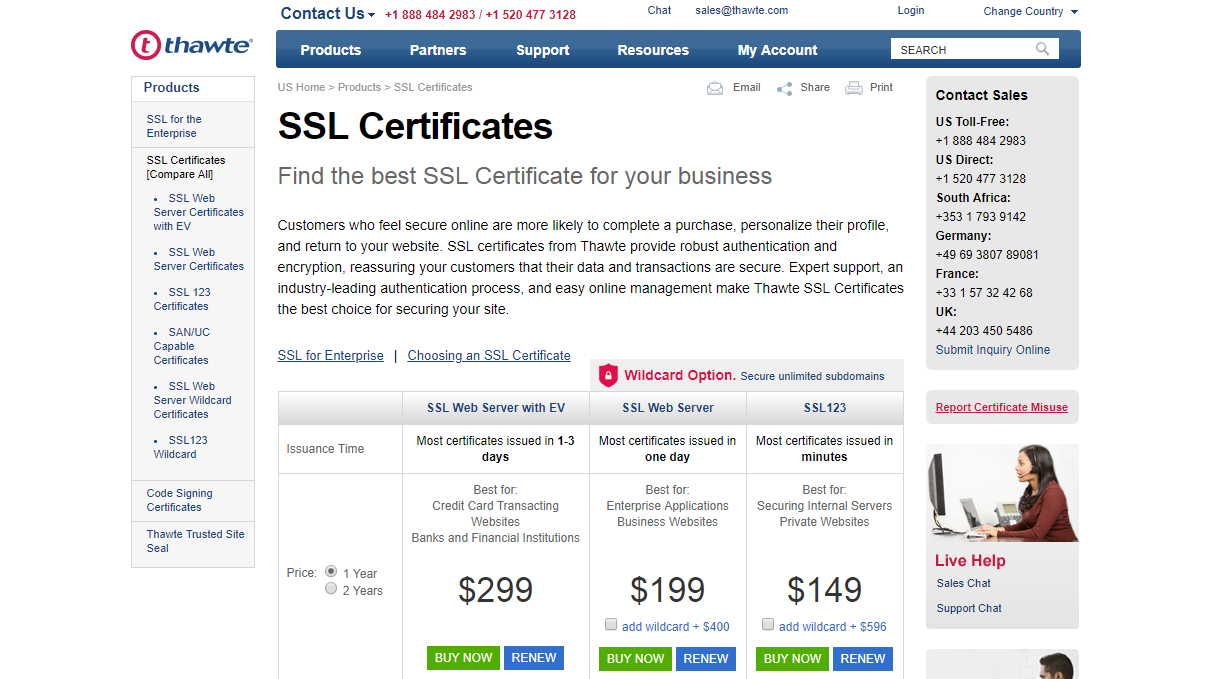
For those who need EV level certification, the price is $141.71 (6-year plan), and that comes with a promise to complete the background checks in one to three days maximum. The success that Thawte has had seems well grounded in a strong combination of customer satisfaction and affordable pricing.
The mechanism of SSL certification has two important functions: authentication and encryption.
As a means to authorize a connection, the SSL certificate holds information about the business, website or person you are connecting to, and is also a means to verify that identity through a third-party.
If you wish to see this in action, look at the URL of this web page in the address bar of your browser, and alongside the text, just on the left, you should see a small green padlock that identifies that this is a secure SSL-certificated site.
Clicking on the padlock will tell you that the connection is secure and allow you to reveal what information the certificate has. That will include the users of the certificate, and the SSL provider that bestowed authorization.
In addition to authority and verification, the SSL certificate also includes a means to encrypt traffic between the user’s computer and the website. Without this encryption, sensitive information like passwords could potentially be compromised by a nefarious party intercepting the data traffic flowing between the client computer and the web server.
The security of this system is underpinned by another independent third-party, the trusted Certificate Authority (CA), which issues the SSL certificate under strict guidelines.
Very much mirroring the phrase ‘my word is my bond’, the support of a CA with an SSL certificate is a declaration of trust in a person, company or website. And the CA is in turn verified by a Root certificate holder, proving that they are trusted to issue certificates and revoke them where necessary.
Should these trusted relationships fail, the SSL certificates become invalid. In that case, anyone visiting a location covered by one such certificate would immediately be warned that it has no valid SSL certificate, and that their connection may no longer be secure.
As you can imagine, the impact that a revoked certificate would have on a live business would be very serious. So it’s vital that you get your SSL certificate from the right source, backed by the most respected CA.
Having inherent trust where identity is concerned is necessary, but having the right level of certification for the business is also very important.
Special relationships
When people talk about SSL certificates, it is easy to assume that they’re all the same. But depending on who authorized them and how diligent the background checks were, they come with different levels of validation.
Here are the four levels of validation most commonly used:
Self-signed. At first glance, the idea of self-signed certificates seems mildly ridiculous, because looking in the mirror and confirming that the reflection is indeed you won’t work at passport control. However, if the purpose of these certificates is to control traffic on an internal corporate intranet, it works well enough, and avoids the browser repeatedly complaining about unsecured web locations.
Domain Validation (DV). The next rung up is the Domain Validated SSL certificate, which is purely a confirmation that the web pages are truly coming from the expected domain and not some other. It says nothing about the person or business in question, just that they own a domain.
Organization Validated (OV). The highest level of validation that an individual can aspire to, and high enough for many businesses. Company credentials and those of the named owners are checked against extensive databases, including those held by local governments.
Extended Validation (EV). The pinnacle of SSL issuance is the fully authenticated SSL certificate, needed for any company that wants to offer their customers secure web locations, email and financial transactions.
While self-signed and domain level certificates have their uses, it’s the OV and EV levels that businesses truly need. Because they prove that a company has domain ownership, a genuine business, and that the certificate was applied for by authorized personnel.
As it’s reasonable to expect, checks of this type take time. Therefore, applying for and being granted an authenticated SSL certificate is not something that can happen five minutes before a new web venture is about to go live.
The other element that separates one SSL certificate from another is the level of encryption that it applies, and exactly how secure that makes it.
Encryption
The model for SSL certificates allows for them to use 128 or 256-bit encryption, should the client’s browser support it. Calculations show that it would take a supercomputer 13.75 billion years to test every permutation of a 128-bit encrypted code.
And, for good measure, the initial handshake is performed using an ultra-secure 2048-bit RSA key. Once past that awkward first date, SSL communication is usually continued with 128, 192 or 256-bit, as without quantum computers these are practically uncrackable, and they put less stress on the computers encrypting and decrypting at either end.
Most providers are offering 256-bit encryption these days, but that’s only valid when the web server, client computer operating system and browser can all operate at that encryption level.
Old operating systems and browsers can force encryption levels to 40 or 56-bit, even if the certificate they’re accessing is capable of 256-bit.
While you can’t entirely control the client end, the minimum requirement for encryption should be 256-bit at the server end, period.
What makes a good SSL purchase?
There is a temptation to make choices entirely based on cost, especially if you have lots of sites to cover or a dynamic business environment.
Poor decisions can have big cost implications, and changing direction once you have a consumer-facing solution isn’t ideal.
The following factors should play a part in picking the right issuance operation for you:
Period of trial - Before anything goes live you’ll want to test it, yes?
Browser compatibility - With so many computers still running Windows 7 and even older releases, working with older browsers is still a major concern.
Issuance timeframe - When deadlines are in play, time can be critical should a new certificate suddenly be needed
Trust level type - The trick is to match the needs of the web location with the level of security and trust needed. If you don’t do financial transactions, then EV level security probably isn’t required. Not all firms offer OV level certificates and some companies try to charge for self-signed, amazingly.
Trust site seal - Providing a recognizable seal that the public can see is an easy way to let your customers know that a site is secure and that their information is safe.
Support of SSL experts - The subtle nuances of SSL and certification can befuddle even the most astute IT people, so having an SSL support team available is critical.
Refund policy - Entering a business relationship assuming it will go sideways isn’t a particularly positive viewpoint, but knowing that your money will come back if needed is a sensible precaution.
Warranty policy - Some CAs cover errors in identification, loss of documents or intentional/accidental errors. These warranties might have implications for those companies that self-insure.
You might also want to check out our hosting guides:
The website builder and web hosting solution that is WordPress is renowned for its customisability and versatility. You can design your site using free themes, but if you want the best, most up to date and intricate site, you need to venture into the Premium aisle. To help speed up your selection process, we’ve gathered five very interesting themes for you to check out.
An excellent and extremely popular theme,with a vast number of templates and huge customisability
Versatile
Easy to use
Affordable
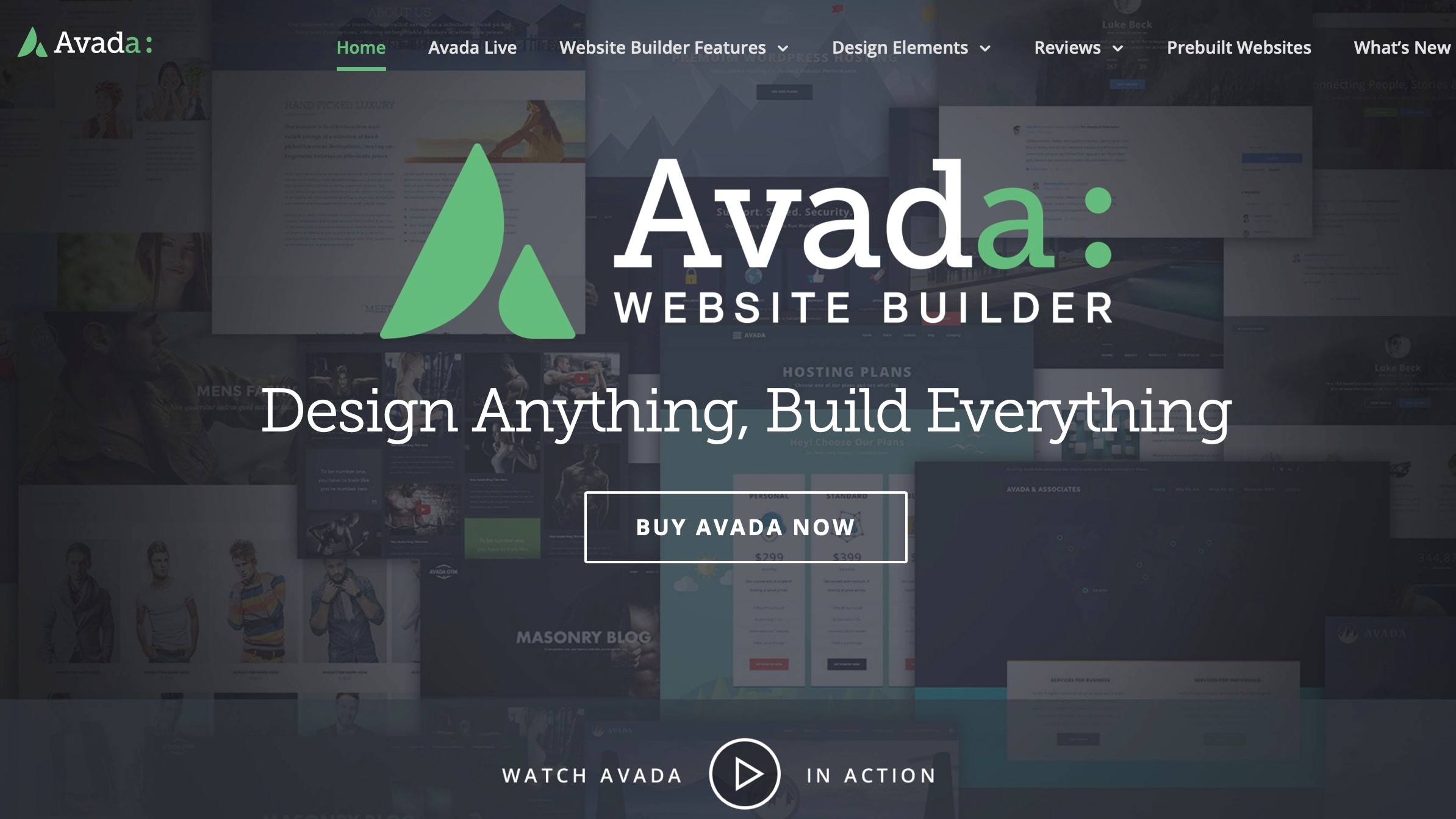
Avada is the number one bestselling WordPress theme on ThemeForest, with over 680,000 sales and an almost 5-star rating based on more than 24,000 reviews, as of this writing. And the reason for that is simple: it’s quite simply one of the best premium themes out there. Thanks to the bundled Avada Builder plugin, it allows you to build a layout fast, with impressive customisability. As you’d expect, not only is it responsive, adapting itself to the screen its viewed on, but it’s also Translation ready, with support for RTL (Right to Left).
Avada comes with 80 website templates, enabling you to have a site designed and uploaded in next to no time. It also has numerous pre-built layouts, all of which can be altered to suit your needs if you’re not happy with the standard configuration, or if you just want your site to look more unique. You can for instance, completely alter the pages’ header and footer to match your requirements, all with drag and drop ease. It’s also fully compatible with WooCommerce, should you wish to set up an online store.
The price of admission is only $60, which includes updates for life, and six months of tech support. There’s an option to extend that support by an additional six months for $18.
A fantastic and highly versatile theme with loads of features and vast customization
Very flexible
Huge customization
Drag and drop ease
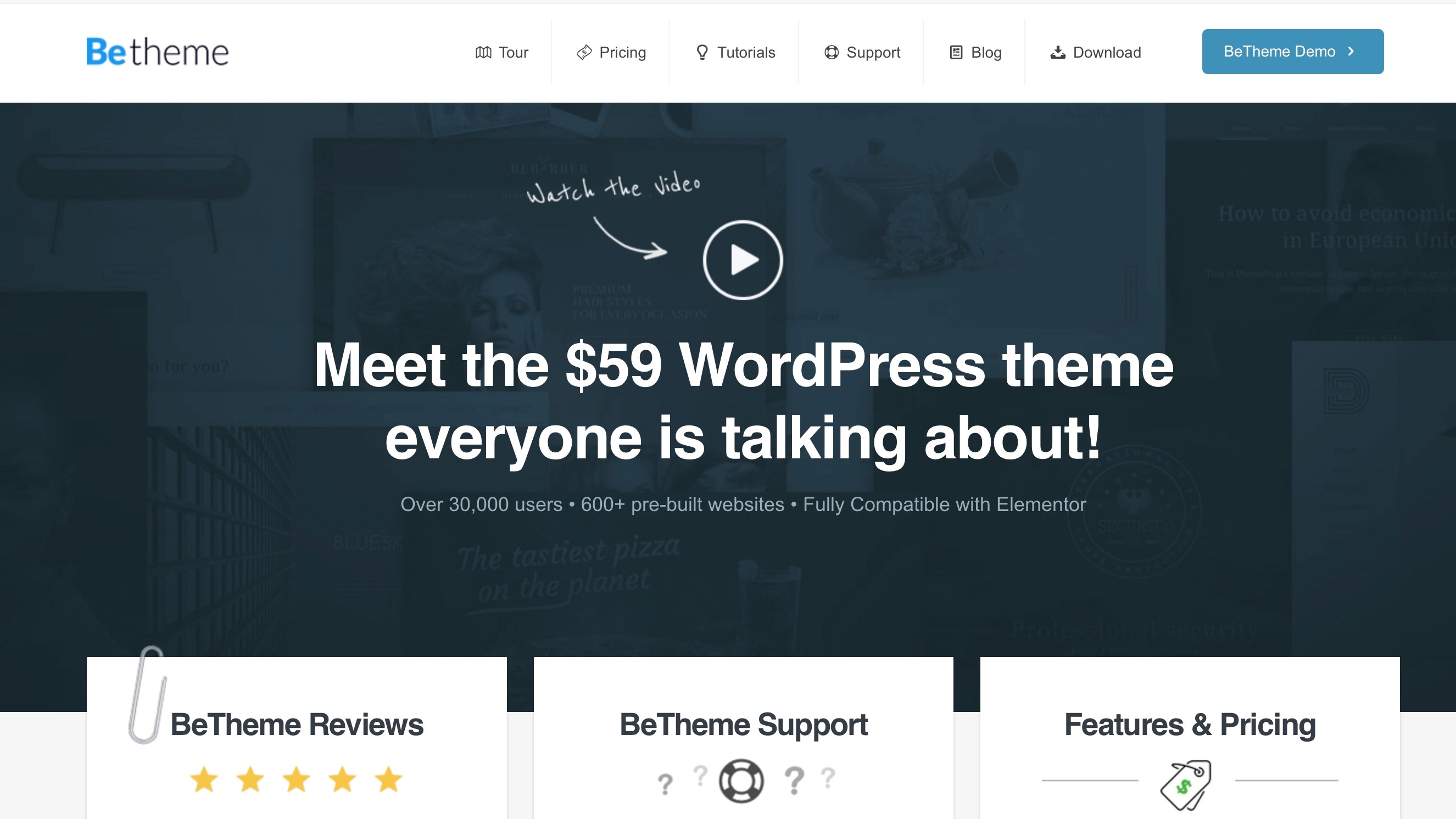
BeTheme is another popular premium WordPress theme. It comes with over 600 pre-built websites to help you hit the ground running, as you can draw inspiration from work that’s already been done, customising it with ease, to give it that unique look and feel that will draw your visitors and customers in. Those templates are subdivided into various categories, making it easy for you to find just the style that’s right for you. The theme is also flexible enough to be used for any type of site you’d care to create.
BeTheme comes with Muffin Builder, which lets you build and customise your site and pages using containers. You can also set the changes globally, which is an immense time saver, and of course, just like all advanced themes, you don’t need to know coding in order to transform the templates. This theme has many of the modern features you’ve come to expect, such as being responsive and compatible with retina displays, translation and RTL ready, and allows you to include parallax effects and video backgrounds, to name but three.
Like Avada, you can purchase BeTheme through ThemeForest for $59, which includes all future updates and six months of support (and a further six months of support can be got for $17.63).
A good theme with many options and a great drag and drop interface
Great drag and drop features
Lots of flexibility
Good number of templates
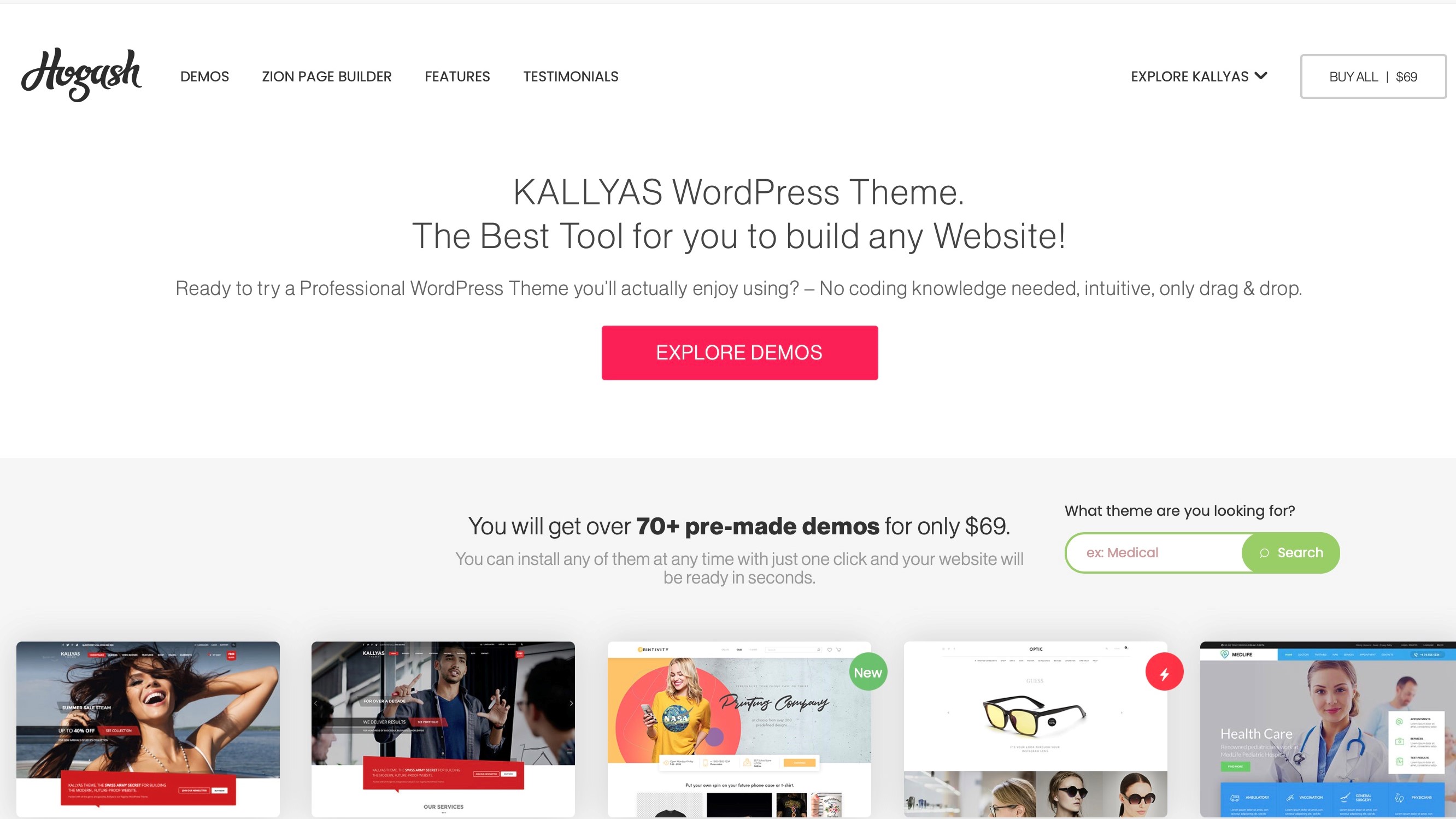
Yet another drag and drop theme is Kallyas. It doesn’t have as many templates as BeTheme - only around 70 compared to more than 600 - but frankly, how many do you really need, as long as you find the one that appeals to you? It’s worth mentioning that, as with the others, the theme is fully responsive and retina-ready, and it supports all the latest features including being translation-ready, and includes support for RTL. Kallyas comes with a live page builder which allows you to build you site and its pages with drag and drop simplicity, and can be integrated with WooCommerce so you can design your own online store with ease. Integration with MailChimp is also standard.
It comes with multiple layouts for blogs and portfolios, includes a wide variety of sliders, and offers a lifetime of free updates such as all future page designs and features as they get released. All of this can be yours for $69 ($41 at the time of writing, due to a sale).
An extensively customisable layout with a wide (and growing) number of website templates
Great customization tools
WooCommerce Integration
Included Jet plugins
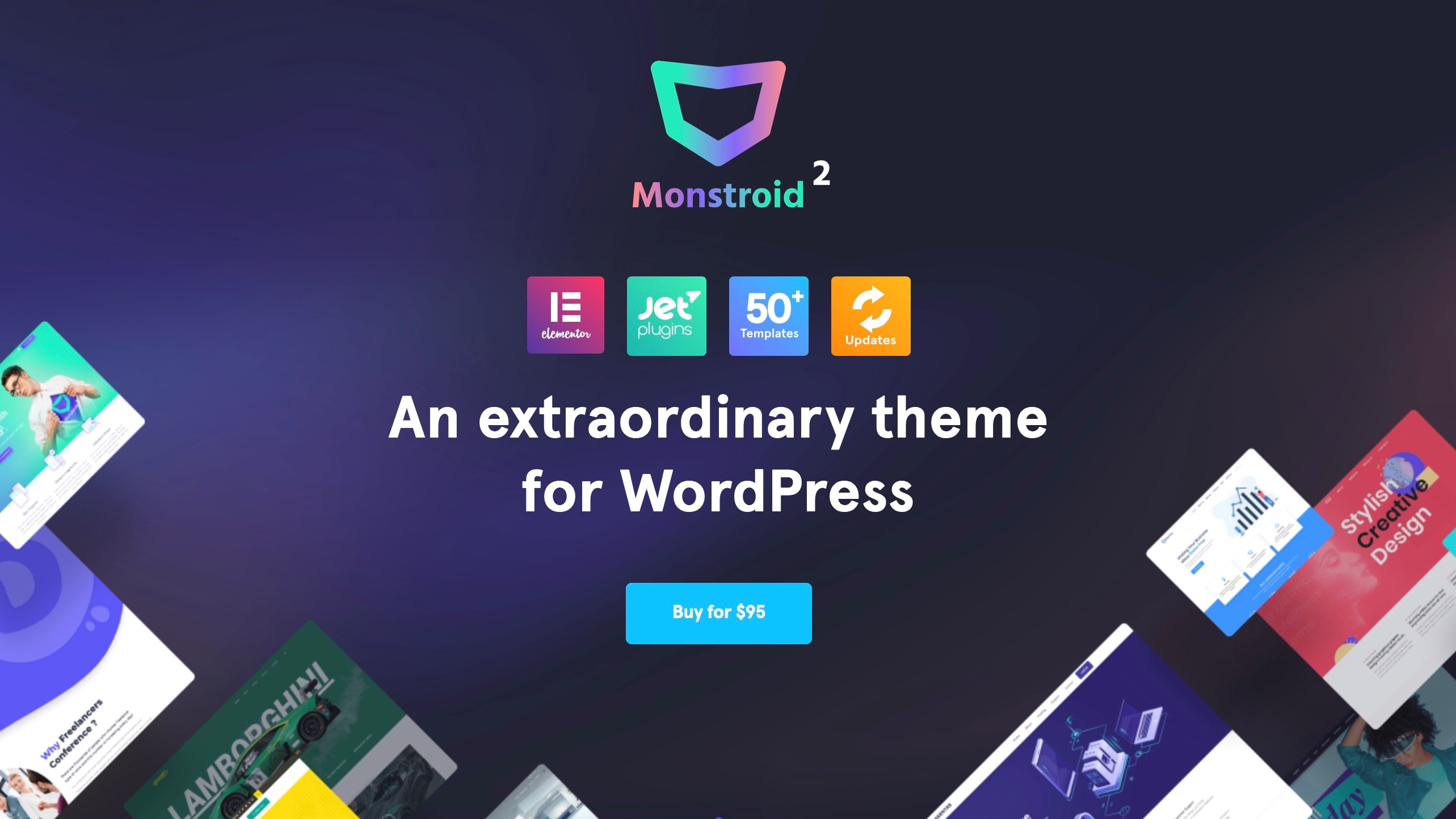
Monstroid2 comes with over 50 pre-built websites, and claims to release a new one every week, so that collection will continue to grow. It comes with a good selection of animation effects, to keep your page feeling more visually interesting than just static text, images and buttons. The customisation features are pretty extensive, and you can apply different layouts to different parts of your website, making for interesting creations. The theme comes with WooCommerce integration, and includes a series of Jet plugins as well, making the price more acceptable.
Monstroid2 will set you back $95, and the price tag also includes a lifetime of updates and support.
A great versatile theme with a particular focus on photography
Great for image-heavy sites
Good layouts and customization
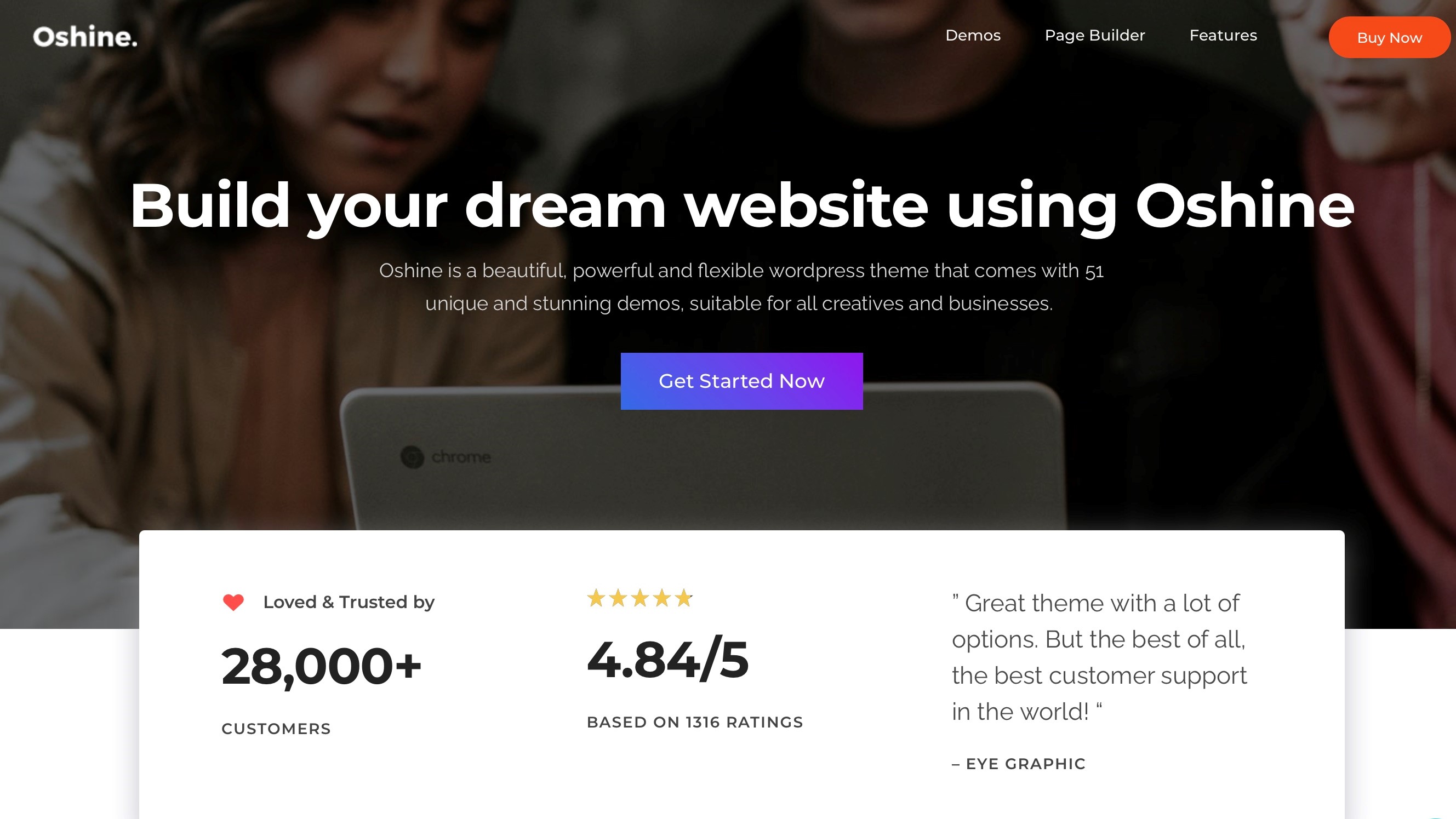
Oshine is a WordPress theme that’s great for photographers, with a focus on creating striking portfolios. But obviously that isn’t all this theme has on offer. It’s able to be integrated with the popular WooCommerce plugin to help you set up your own online business, has six different blog styles, and has support for parallax, and video backgrounds. It comes with numerous header and menu styles, including making them transparent and/or sticky, among other options. There are galleries dedicated to showcasing your Instagram and Flickr collections, and we quite liked the simple but effective black and white hover effect.
You can own Oshine for $59, and like the other themes being sold through ThemeForest, this includes a lifetime of updates and six months of support, with a further six months for an additional $17.63.
It's very likely the Samsung Galaxy Tab S8 could end up being the best Android tablet of the year – partly because it's shaping up to be a really powerful device, and partly because there just aren't that many slates running the Google-designed software.
Indeed, the Android tablet landscape is pretty sparse these days, but one company that can be relied upon to launch impressive slates is Samsung, with its Galaxy Tab S range proving to be real alternatives to an iPad. The Galaxy Tab S7 FE has now broken cover, and the Tab S8 should be out before the end of the year.
It will be the follow up to the Samsung Galaxy Tab S7 and Galaxy Tab S7 Plus, which with their big screens and stylus and keyboard accessories are a match for Apple’s best in a lot of ways. But their successors – the Samsung Galaxy Tab S8 and Samsung Galaxy Tab S8 Plus – are now in the works.
Below then you’ll find a list of the main things we want from Samsung’s next top tablets, but before that we’ve included details on the likely release date and price, along with the leaks and rumors that are starting to build up – and we'll be updating this article whenever we hear anything new, so check back regularly.
Latest news
We now have some rumored details about the Galaxy Tab S8, including three potential screen sizes for three different models: 11 inches, 12.4 inches, and a huge 14.6 inches.
Cut to the chase
What is it? The next premium Samsung tablet
When is it out? Possibly August
How much will it cost? We don't know, but it's sure to be expensive
Samsung Galaxy Tab S8 release date and price
Samsung isn’t totally consistent with when it releases new Galaxy Tab S models, but the Samsung Galaxy Tab S7 range and Samsung Galaxy Tab S6 all hit stores in August of their launch years – though while the Tab S7 range was announced in early August, the Tab S6 was unveiled in late July.
In any case though it’s likely that the Samsung Galaxy Tab S8 will land in or around August of 2021, though at the time of writing there aren’t any release date rumors, so we’re not at all certain of that.
As for the price, there’s no news there either, but the Samsung Galaxy Tab S7 started at $649.99 / £619 / AU$1,149, while the pricier Galaxy Tab S7 Plus started at $849.99 / £799 / AU$1,549, so prices may be similar for the next model. If anything though the Samsung Galaxy Tab S8 range might cost more, since the trend is for prices to rise.
Leaks and news
The first major Samsung Galaxy Tab S8 leak to get our attention reveals plenty about the upcoming slate, which will apparently be available in 11-inch, 12.4-inch and 14.6-inch variations – with that last one a huge addition to the line.
Specs-wise, the tablets are said to top out at 12GB of RAM and 512GB of storage for the largest model, while 5G variants will be available. All three models are being tipped to have dual-lens 13MP+5MP cameras on the back.
We can predict a few things about the upcoming tablets too. Based on past form, two of these three models will likely be called the Galaxy Tab S8 and Galaxy Tab S8 Plus.
The Plus model(s) will probably also have an AMOLED screen, and they will likely also both have a 120Hz refresh rate and a top-end chipset (we're expecting this to be the Snapdragon 888 from Qualcomm).
What we want to see
The Samsung Galaxy Tab S7 and particularly the Galaxy Tab S7 Plus are excellent slates, with the latter topping our best Android tablets list, but they’re not perfect. Here’s what Samsung can do to make the Tab S8 even better.
1. More ports
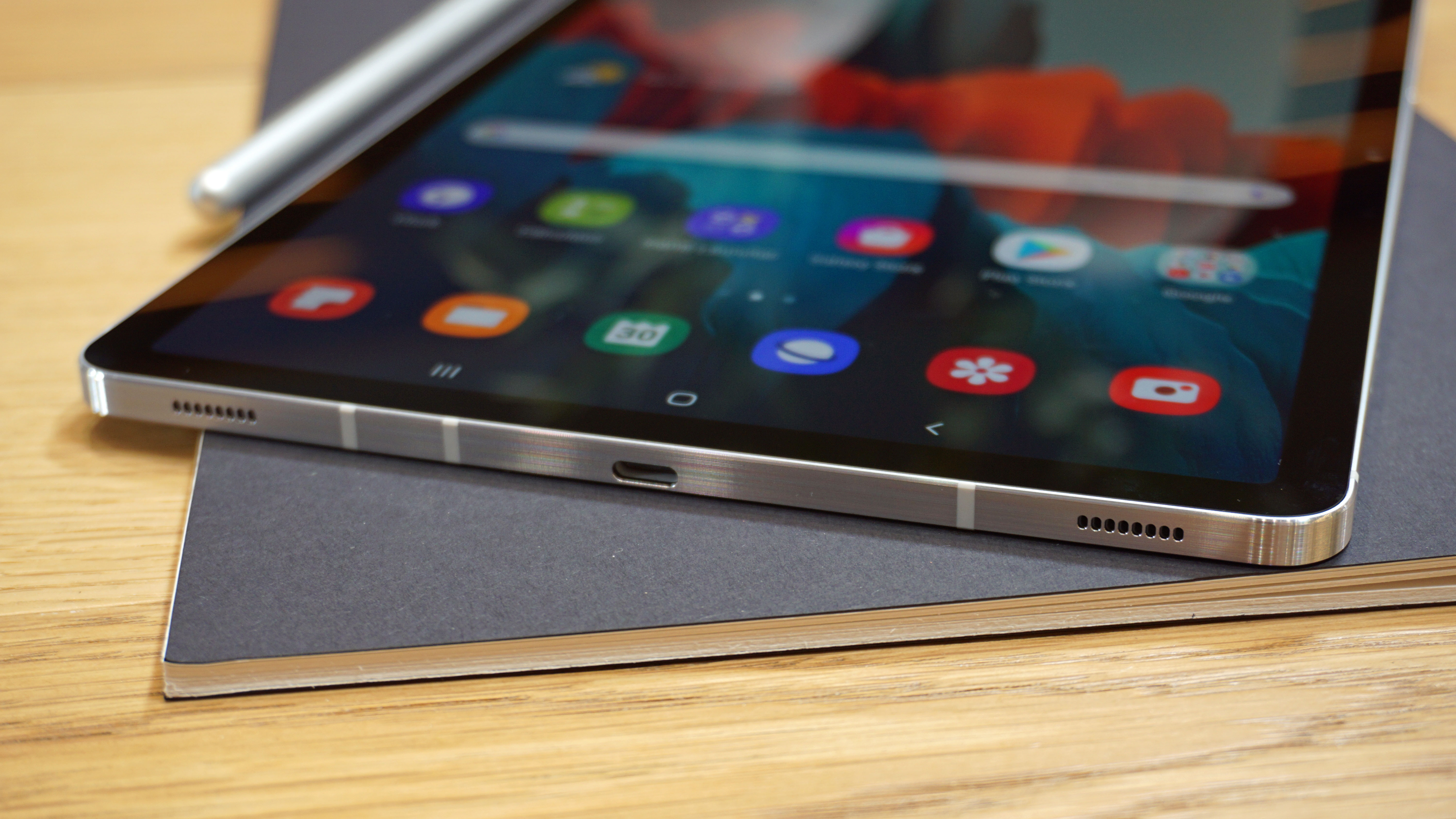
The Samsung Galaxy Tab S7 only has one port(Image credit: TechRadar)
The Samsung Galaxy Tab S7 is almost a laptop, especially once you add the optional keyboard accessory, but it has just one USB-C port, which limits its versatility a bit.
So for the Samsung Galaxy Tab S8 we’d like to see a second port added, and ideally also a 3.5mm headphone port. Tablets don’t need to be as slim and compact as phones, so we reckon the usefulness of having such a port is greater than the space saved by removing it.
2. A competitive price
The Galaxy Tab S range is positioned at the high end of the market, so these slates are always going to be expensive, but we noted in our Tab S7 review that the price is a bit too high really, so we’d like to see that addressed for the Samsung Galaxy Tab S8 range.
We’re not convinced the price will go down, but stranger things have happened, so we’ve got our fingers crossed.
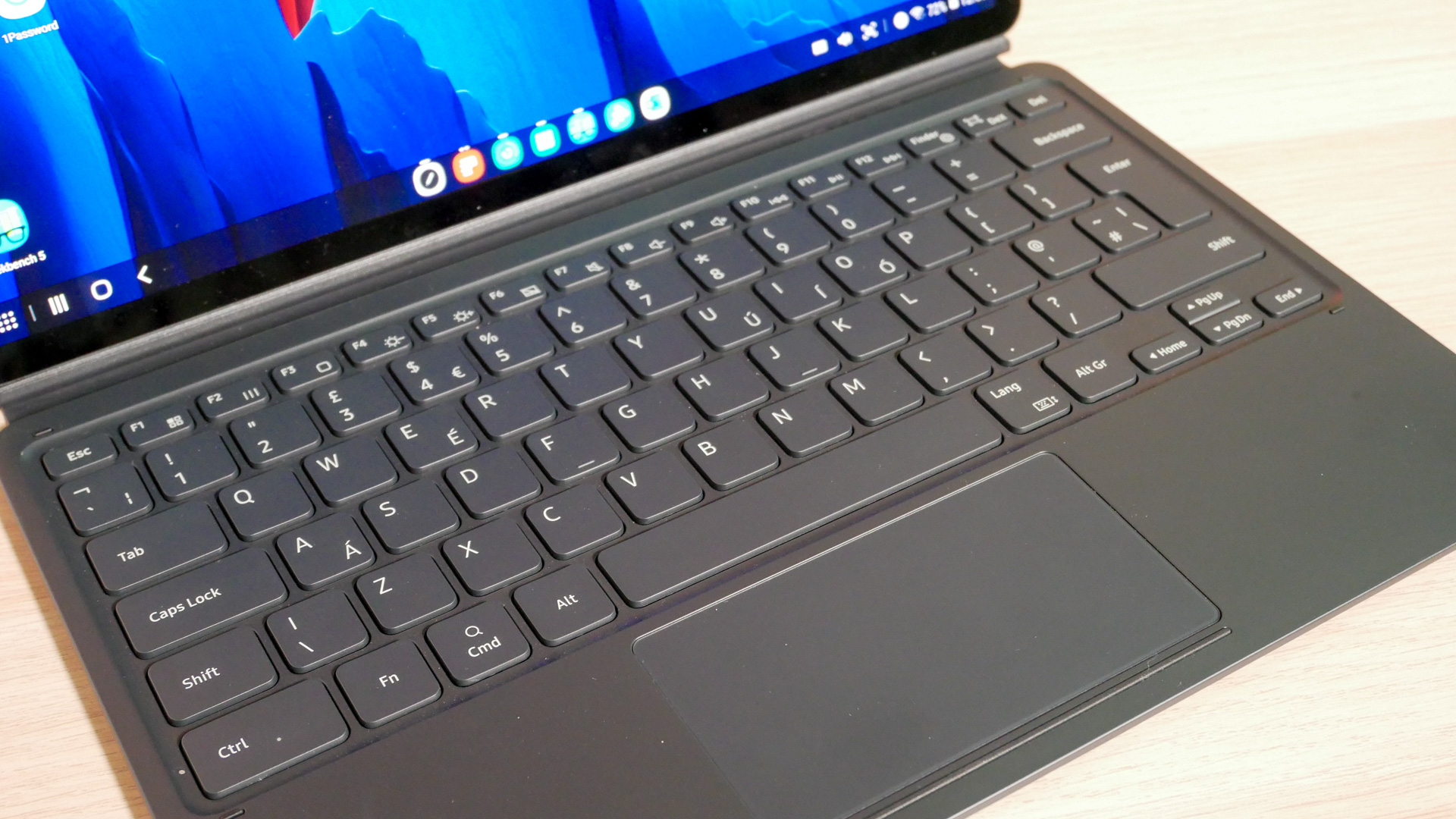
3. A backlit keyboard cover
The Samsung Galaxy Tab S7's keyboard isn't backlit(Image credit: Future)
The Samsung Galaxy Tab S7 supports an optional keyboard cover, one which is generally pretty good, but the fact that the keys aren’t backlit means it’s hard to use in the dark.
It’s a small thing but one that could make a big difference to some people, so we’d like the keyboard cover for the Galaxy Tab S8 to have backlit keys.
4. An OLED screen on all models
The Samsung Galaxy Tab S7 Plus has an OLED screen, but the basic Tab S7 is lumbered with an inferior LCD one, so for the Samsung Galaxy Tab S8 we want to see OLED on both models.
With more and more companies offering OLED screens on their devices and Apple now offering them on almost every iPhone, we think it’s reasonable for even the most basic slates in Samsung’s flagship tablet range to use OLED too.
Plus, while Apple has embraced OLED on its phones, the iPad range actually still uses LCD, so this is one way in which the Samsung Galaxy Tab S8 could stand out.
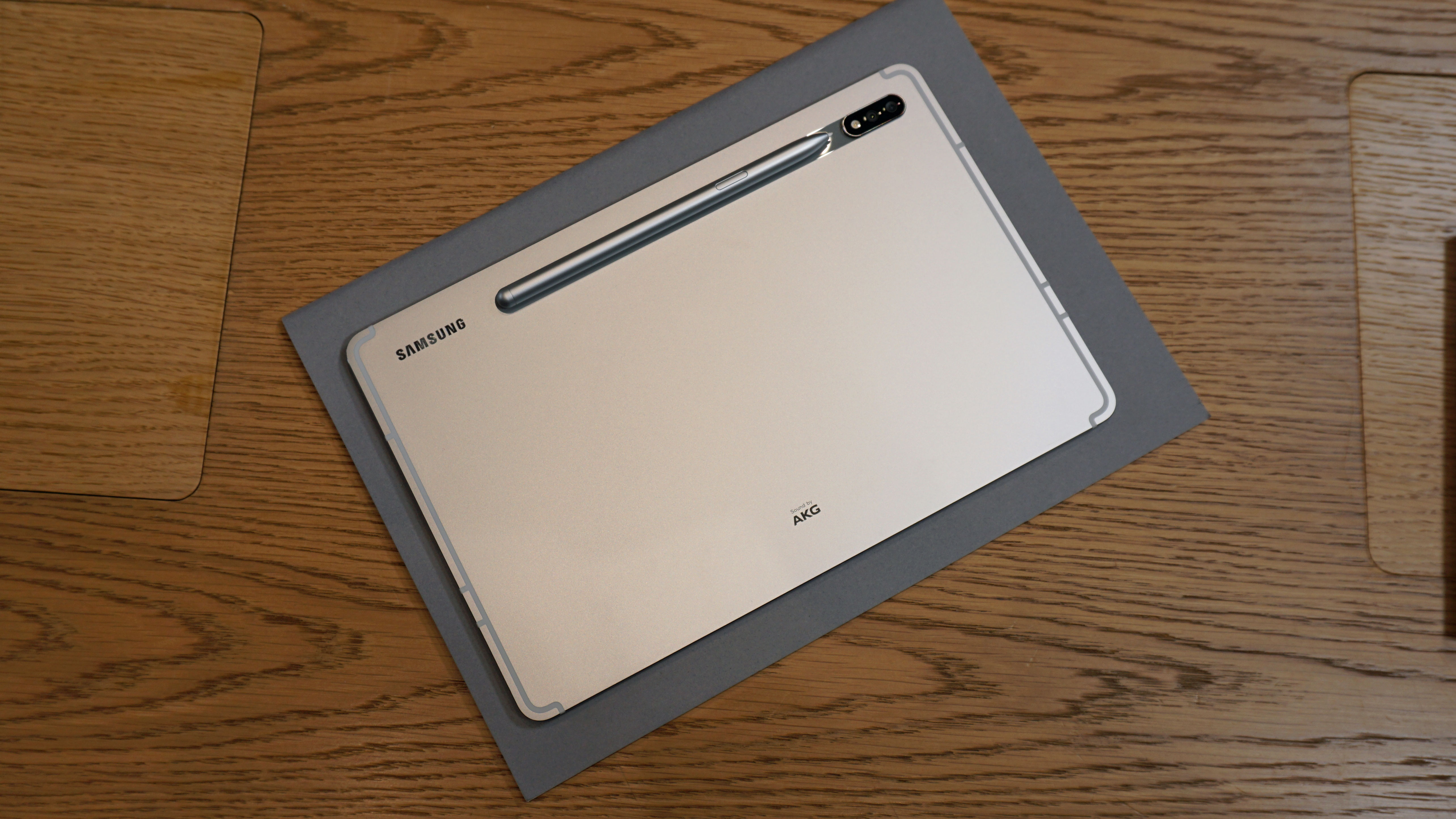
5. A fingerprint-resistant back
The Galaxy Tab S7's back is prone to picking up fingerprints(Image credit: TechRadar)
The Samsung Galaxy Tab S7 and Tab S7 Plus have an aluminum back and a premium look and feel, but one thing that spoils the look somewhat is how prone to picking up fingerprints they are, as we noted in our review.
This is a problem faced by many phones and tablets, but it’s one that we’d like Samsung to try and solve for the Galaxy Tab S8, especially as tablets don’t get covered up by cases as frequently as phones, so we want a back that stays pristine.