Friday, April 29, 2022

AirTags finally get that anti-stalking firmware update

AirTags are finally more discoverable - and that's a good thing.

Apple is rolling out firmware update 1.0.301 to AirTags that will make them louder and easier to locate.

You will need iOS version 14.5 or later to download and use this feature. If you have version 14.5 or are up to date, the firmware update should have already occurred as it downloads automatically. 

You can check if you have the right firmware by going to the Items tab in the Find My app. Tapping on AirTag will let you know if you have the new firmware. If you don’t have the AirTag change, you’ll probably get it later as Apple says the firmware update will be sent out again periodically.

Just make sure the AirTags are within 33 feet of your iPhone, which is the maximum Bluetooth signal range for the device.

A stalking problem

This firmware update is part of a series of changes coming to AirTag after it was discovered they were being used to stalk people. The purpose of the louder sound is to make finding unknown AirTags easier to locate.

The AirTags themselves are a neat device. They’re a great way to locate missing items, but some bad actors just had to ruin it for everyone. In February 2022, some modified AirTags were found being sold with their safety features disabled.

The good news is that Apple quickly discovered this glaring problem and took action. The company stated at the time that it was working with law enforcement on AirTag misuse and laid out a plan for future changes.

It took a while, but those changes are finally here.

Updates down the line

Increasing the AirTag’s volume is the first of four updates. Apple plans on bettering its unwanted tracking alert system to notify people earlier if some unknown AirTag is on their person.

If you were a part of the iOS 15.4 beta, you might have seen an inkling of this as a message would appear during AirTag setup stating misusing these devices to stalk is illegal.

There are also changes coming to Precision Finding and displays alert, but the details of these updates are still unknown. Apple has said very little other than they will be coming out later in 2022.


from TechRadar - All the latest technology news https://ift.tt/bwQMPaB
via IFTTT

Apple iPhone 13 sales power a big quarter but there may be trouble ahead

Even with supply chain constraints, Covid lockdowns in Shanghai, and a war in Ukraine, Apple managed another record quarter, earning $97.3 billion mostly on the back of an apparently very well-received iPhone 13 line.

The Cupertino, California, company released earnings numbers late Thursday and followed with an earnings call with analysts that, while painting a mostly positive picture, did outline warning signs in the supply chain, Covid, inflation, and European headwinds.

Consumers bought into virtually every product category Apple has to offer, pushing the iPhone up to a total of $50.5 billion in total sales, the Mac to $10.4 billion, wearables to $8.8 billion, and the fast-growing services category (which now has 825M paying subscribers) to $19.8 billion. 

If there was one cautionary tale among the group, it's the iPad, which fell 2% year over year to $7.6 billion. "We’re continuing to see such a strong demand for iPad even while navigating strong supply constraint," said Apple CEO Tim Cook during the earnings call.

The story on the iPad, which recently saw the release of the iPad Air with an M1 chip is not that isn't selling poorly, but that getting components to build the product (for iPad and Macs) is more challenging than ever.

The question of supply constraints and, in particular, silicon shortages came up repeatedly during the call as analysis wondered if Apple should be doing something to shore up supplies.

Cook essentially dismissed the idea. "In today’s world, not possible for us to have a buffer on silicon. [It] rolls off the fab into a final assembly very quickly."

The Mac was another bright spot for Apple, which is crediting Apple Silicon (the M1 line of chips) for much of that growth. The commitment to Apple Silicon, noted Apple CFO Luca Maestri, shows up in the results. He said they've experienced the best eight quarters ever for Macs.

Tough road ahead?

Apple, like other corporations around the world, is starting to return to normal and Cook said Apple is excited to welcome employees back to offices but added that it's "still monitoring Covid-related disruptions in China."

The subject of Covid and disruption in the Shanghai factories that assemble many of Apple's products came up repeatedly. Cook tried to paint a positive picture. "On a positive front, almost all final assembly factories have restarted. Also encouraged that the Covid case count in Shanghai has decreased in recent days," he told investors.

Still, the lockdown had little effect on this quarter and seems to be part of a darker picture in the coming months. Apple is, like everyone else, dealing with inflation across the price of components (though Cook said some component prices are falling while others rise), shipping costs, the war in Ukraine, continue silicon shortages.

Talking about global challenges that we all face, Cook said, "We are not immune to these challenges, but we have great confidence in our people strategy and teams."

When pressed about how inflation might impact consumer product prices, Cook demured but made it clear that they're keeping an eye on how inflationary pressures impact sales.

"Obviously monitoring our daily sales very closely." Cook said Apple is seeing the impacts in sales and operating costs this past quarter and is assuming it will continue in the current one.  He added, "[We're] definitely seeing some level of inflation that I think everyone is seeing."

Cook and Maestri offered not a hint in the call of what is to come. There was scarcely a mention of AR, VR, new innovations, future iPhones, or wearables. The closest anyone came to offering a whiff of what consumers can expect from Apple in the coming months is in regard to services when Maestri told analysts, “We plan to add new services and new features that we think customers will love.”


from TechRadar - All the latest technology news https://ift.tt/lJyxAF1
via IFTTT

Thursday, April 28, 2022

Elon Musk sells almost $4bn worth of Tesla shares

It comes as the electric car maker's chief executive moves ahead with his $44bn takeover of Twitter.

source https://www.bbc.co.uk/news/business-61255092?at_medium=RSS&at_campaign=KARANGA

Apple Reports Second Quarter Results

Apple today announced financial results for its fiscal 2022 second quarter ended March 26, 2022.

New LG Gram 14 could finally make me ditch the MacBook Air

Laptops are boring. There, I’ve said it. This is because back in 2020, Apple launched the best laptop ever made – the MacBook Air (M1, 2020), and even two years later, it hasn’t been beaten… until now (maybe).

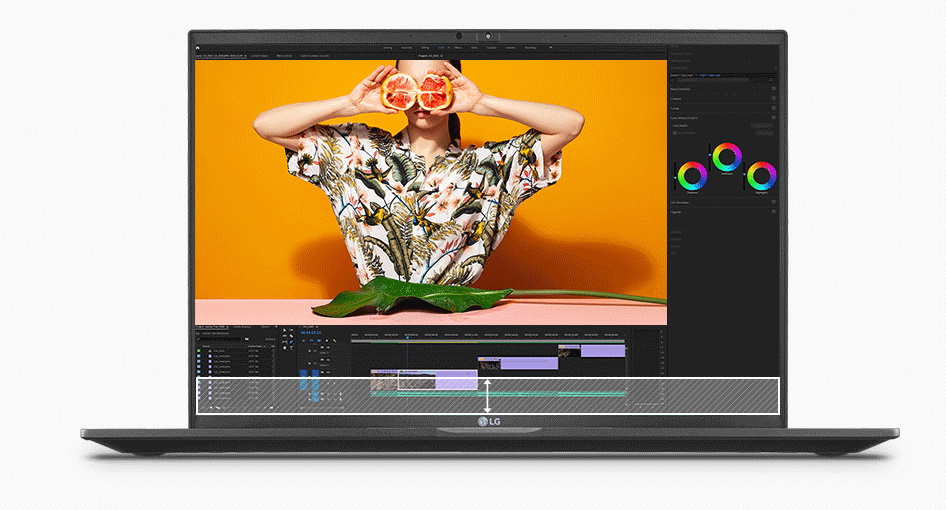
The LG Gram 14 has just been announced, and it’s the first time I’ve been excited about a laptop for a while. If LG nails it, this may be the laptop that convinces me to finally ditch the MacBook Air. I may even stop annoying everyone by telling them to buy Apple’s thin and light laptop. I never thought I’d be one of those people who bang on about Apple products, but annoyingly the fruit-themed company went and made a brilliant laptop.

So, why am I so excited about the LG Gram 14? Over the years, I’ve reviewed several LG Gram laptops, and I’ve always been impressed by how light they are. While using the LG Gram 17, I just couldn’t get my head around how a 17-inch laptop could feel so light, so every time I picked it up, I was surprised. I can’t say that about a lot of the laptops I review.

The LG Gram 14 should be even lighter (due to being smaller), and I think 14-inches is the sweet spot for the perfect laptop screen. I find 15-inch and above laptops to be too big to carry around comfortably, and trying to use one on public transport can end up being extremely frustrating.

Meanwhile, 13-inch laptops are far more portable (and are comfortable to use on trains and buses), but the screen can feel a little cramped.

But, 14-inch laptops manage to be just as portable, while offering a touch more screen real estate that makes them more comfortable to use, and 14-inch laptops are becoming ever more popular.


Analysis: Potentially the new best laptop?

LG Gram 14 thin and light laptop

(Image credit: LG)

Not only does the LG Gram 14 have the potential to be an extremely lightweight laptop that’s easy to carry around and comfortable to work on, but according to LG’s website for the new laptop, it’ll be a pretty formidable performer as well.

It comes with Windows 11, as well as new 12th generation Intel Core processors and LPDDR5 RAM. So, it should offer excellent performance, and as an Intel Evo-certified laptop, we should also expect almost instant wake-up speeds and a battery life longer than 9 hours.

If the LG Gram 14 lives up to its potential, this could finally be the laptop to knock the MacBook Air off the top of our best laptops list. We’ll hopefully get it in soon to see if Apple has anything to be worried about.


from TechRadar - All the latest technology news https://ift.tt/zspNqjo
via IFTTT

Wednesday, April 27, 2022

Tuesday, April 26, 2022

The next Amazon Kindle could be a game-changer if it gets this brand-new tech

You might not think the best Amazon Kindles have any flaws whatsoever, and admittedly they're fantastic devices for reading on the go, but some of the best ereaders have something Kindles don't: color screens.

That's right, color screens are in vogue in ereaders right now, and it's something we've seen on lots of Kindle wishlists before - but could the feature be coming to Amazon's devices? Some people think so, thanks to a new color ereader panel that's been announced.

E Ink, the company which makes screens for many ereaders, has announced a new type of E Ink panel (via Business Wire) which has both black-and-white and color modes. The latter uses cyan, magenta, yellow and white ink, which is similar to the CMYK color model used in lots of publishing except with white instead of black.

This isn't E Ink's first color screen, but it's apparently much more responsive to touch than the previous versions, offers a higher resolution, and updates much quicker too. It also supports pen input, which will be useful for ereaders that come with styli for sketching.

So why are we tying this new E Ink screen to Amazon's Kindles? Well, Kindles do use displays from E Ink, so the collaboration wouldn't be out of the question - but there are some reasons that readers might get really excited for a new color Kindle.


Analysis: why some might love a color Kindle

Despite Kindles' popularity as ereaders, they have plenty more functions than just for enjoying novels. They're great for reading business documents, and also support audiobooks, magazines and comic books.

Those three forms of media are all supported by services Amazon itself offers: Audible, Kindle Unlimited and Comixology respectively, and people who are strongly into the Amazon ecosystem (or like those forms of media) likely already have subscriptions to those services.

However, when you read a magazine or comic book on a Kindle, you've got an obvious issue: they're in black-and-white, and this can be a big problem. You'll often miss out on an artist's work or the nuanced layout and color planning of a magazine page, and sometimes it's just impossible to work out what's going on, especially in graphic novels.

So while Kindles support these publications, they're not the best device for enjoying them, and you'd be better placed buying a color ereader or simply a tablet for your consumption.

But if Amazon launched a color Kindle - like many people are asking for - the device would be the ultimate all-in-one reading device, so you could easily switch between books, the latest column or a particular comic book, and get the optimal experience for each.

Given that Amazon's ereader rivals have slowly started using color E Ink panels, it seems likely that the company will follow suit at some point too - let's just hope it comes in at a reasonable price tag.


from TechRadar - All the latest technology news https://ift.tt/H0zv6RQ
via IFTTT

Catching phish with web scraping

Phishing is, unfortunately, profitable, hard to detect, and relatively easy to engage in. With digital transformations expedited across the globe, phishing is bound to experience continued explosive growth.

According to Phishlabs, the number of phishing attempts over Q1 2021 increased by nearly 50%. There’s no reason to believe it will stop climbing either.

That means increased levels of digital harm and risk. To counteract such an uptick, new approaches to phishing detection should be tested or current ones improved. One way to improve existing approaches is to make use of web scraping.

Poking phish

Phishers would be hard-pressed to completely replicate the original website. Placing all URLs identically, replicating images, cooking the domain age, etc. would take more effort than most people would be willing to dedicate. 

Additionally, a perfect spoof would likely have a lower success rate due to the ability for the target to get lost (by clicking on an unrelated URL). Finally, just like with any other scam, duping everyone is not necessary, therefore the perfect replica would be a wasted effort in most cases.

However, those who do phishing aren’t dumb. Or at least those who are successful at it aren’t. They still do their best to make a believable replica with the least effort required. It may not be effective against those who are tech-savvy, but even a perfect replica might not be effective against the wary. In short, phishing relies on being “just good enough”.

Therefore, due to the nature of the activity, there’s always a glaring hole or two that can be discovered. Two good ways to get a head start is to either look for similarities between frequently-phished-websites (e.g. fintech, SaaS, etc.) and suspected phishing websites or to collect patterns of known attacks and work your way up from there.

Unfortunately, with the volume of phishing websites appearing daily and the intent to target less tech-savvy people, solving the issue may not be as simple as it seems at first glance. Of course, as is often the case, the answer is automation. 

Looking for phish

There have been more methods developed over the years. An overview article written in 2018 by ScienceDirect lists out URL-based detection, layout recognition, content-based detection. The former often lags behind phishers as databases are updated slower than new websites appear. Layout recognition is based on human heuristic and is thus more prone to failure. Content-based detection is computational heavy.

We will be paying slightly more attention to layout recognition and content-based detection as these are complicated processes that benefit greatly from web scraping. Back in the day, a group of researchers had created a framework for detecting phishing websites called CANTINA. It was a content-based approach which would check for data such as TF-IDF ratios, domain age, suspicious URLs, improper usage of punctuation marks, etc. However, the study had been released in 2007 when automation opportunities were limited.

Web scraping can improve the framework immensely. Instead of manually attempting to find the outliers, automated applications can breeze through websites and download the relevant content within. Important details such as the ones outlined above can be extracted from the content, parsed, and evaluated.

Building a net

CANTINA, developed by the researchers, had a drawback - it was only used to prove a hypothesis. For these purposes, a database of phishing and legitimate websites had been compiled. The status of both was known a priori.

Such methods are suitable for proving a hypothesis. They are not as good in practice where we don’t know the status of the websites ahead of time. Practical applications of projects similar to CANTINA would require a significant amount of manual effort. At some point, these applications would no longer stand as “practical”.

Theoretically, though, content-based recognition seems like a strong contender. Phishing websites have to reproduce content in a nearly identical manner to the original. Any incongruences such as misplaced images, spelling mistakes, missing pieces of texts can trigger suspicion. They can never stray too far from the original, which means metrics such as TF-IDF would have to be similar by necessity.

Content-based recognition’s drawback has been the slow and costly side of manual labor. Web scraping, however, moves most of the manual effort into complete automation. In other words, it enables us to use existing detection methods on a significantly larger scale.

First, instead of manually collecting URLs or taking them from an already existing database, scraping can create its own quickly. They can be collected through any content that has hyperlinks or links to these supposed phishing websites in any shape or form.

Second, a scraper can traverse a collection of URLs faster than any human ever could. There are benefits to manual overview such as the ability to see the structure and content of a website as it is instead of retrieving raw HTML.

Visual representations, however, have little utility if we use mathematical detection methods such as link depth and TF-IDF. They may even serve as a distraction, pulling us away from the important details due to heuristics.

Parsing also becomes an avenue for detection. Parsers frequently fall apart if any layout or design changes happen within the website. If there are some unusual parsing errors when compared to the same process performed on parent websites, these may serve as an indication of a phishing attempt.

In the end, web scraping doesn’t produce any completely new methods, at least as far as I can see, but it enables older ones. It provides an avenue for scaling methods that might otherwise be too costly to implement.

Casting a net

With the proper web scraping infrastructure, millions of websites can be checked daily. As a scraper collects the source HTML, we have all the text content stored wherever we’d like. Some parsing later, the plain text content can be used to calculate TF-IDF. A project would likely start out by collecting all the important metrics from popular phishing targets and move on to detection.

Additionally, there’s a lot of interesting information we can extract from the source. Any internal links can be visited and stored in an index to create a representation of the overall link depth.

It’s possible to detect phishing attempts by creating a website tree through indexing with a web crawler. Most phishing websites will be shallow due to the reasons outlined previously. On the other hand, phishing attempts copy websites of highly established businesses. These will have great link depths. Shallowness by itself could be an indicator for a phishing attempt.

Nevertheless, the collected data can then be used to compare the TF-IDF, keywords, link depth, domain age, etc., against the metrics of legitimate websites. A mismatch would be cause for suspicion. 

There is one caveat that has to be decided “on the go” - what margin of difference is a cause to investigate? A line in the sand has to be drawn somewhere and, at least at first, it will have to be fairly arbitrary.

Additionally, there’s an important consideration for IP addresses and locations. Some content on a phishing website might only be visible to IP addresses from a specific geographical location (or not from a specific geographical location). Getting around such issues, in regular circumstances, is challenging, but proxies provide an easy solution.

Since a proxy always has an associated location and IP address, a sufficiently large pool will provide global coverage. Whenever a geographically-based block is encountered, a simple proxy switch is all it takes to hop over the hurdle.

Finally, web scraping, by its nature, uncovers a lot of data on a specific topic. Most of it is unstructured, something usually fixed by parsing, and unlabeled, something usually fixed by humans. Structured, labeled data may serve as a great ground for machine learning models.

Terminating phish

Building an automated phish detector through web scraping produces a lot of data for evaluation. Once evaluated, the data would usually lose its value. However, like with recycling, that information may be reused with some tinkering.

Machine learning models have the drawback of requiring enormous amounts of data in order to begin making predictions of acceptable quality. Yet, if phishing detection algorithms start making use of web scraping, that amount of data would be produced naturally. Of course, labeling might be required which would take a considerable amount of manual effort.

Regardless of this, the information would already be structured in a manner that would produce acceptable results. While all machine learning models are black boxes, they’re not entirely opaque. We can predict that data structured and labeled in a certain manner will produce certain results.

For clarity, machine learning models might be thought of as the application of mathematics to physics. Certain mathematical modeling seems to fit exceptionally well with natural phenomena such as gravity. Gravitational pull can be calculated by multiplying the gravitational constant by the mass of two objects and dividing the result by the distance between them squared. However, if we knew only the data required, that would give us no understanding about gravity itself.

Machine learning models are much the same. A certain structure of data produces expected results. However, how these models arrive at their predictions will be unclear. At the same time, at all stages the rest is as predicted. Therefore, outside of fringe cases, the “black box” nature doesn’t harm the results too much.

Additionally, machine learning models seem to be among the most effective methods for phishing detection. Some automated crawlers with ML implementations could reach 99% accuracy, according to research by Springer Link.

The future of web scraping

Web scraping seems like the perfect addition to any current phishing solutions. After all, most of cybersecurity is going through vast arrays of data to make the correct protective decisions. Phishing is no different. At least through the cybersecurity lens.

There seems to be a holy trinity in cybersecurity waiting to be harnessed to its full potential - analytics, web scraping, and machine learning. There have been some attempts to combine two of three together. However, I’ve yet to see all three harnessed to their full potential. 


April 26, 2022 at 07:24PM from TechRadar - All the latest technology news https://ift.tt/mcbuKng
via IFTTT

Monday, April 25, 2022

Sunday, April 24, 2022

Saturday, April 23, 2022

Calling all bookworms: Amazon is giving away 10 Kindle ebooks for World Book Day

UNESCO's World Book Day in 2022 falls on April 23 (except in the UK, where we like to be different, as it falls in early March), and if you own the Amazon Kindle or any of the other Kindle models, or simply subscribe to Prime, you're in for a treat.

That's because Amazon is offering 10 free ebooks to celebrate the occasion, which anyone with a Kindle – or a Prime account – can download for free. So if you own one of the best Kindles, you've getting even more bang for your buck. 

The offering lasts until April 27, and covers books from a range of authors and genres – we'll list them all below. The aim is to promote literature from all over the world.

To get the books, simply head to Amazon's Read The World page to add them to your Amazon account, then download them to your ereader. You don't need a Kindle to make the most of this deal, as you can read them in a web browser or on the Kindle smartphone app, but we'd always recommend buying a Kindle if you want to read on the go.

What are the free books?

  • The Puma Years by Laura Coleman (Travel Memoir, Bolivia)

"In this rapturous memoir, writer and activist Laura Coleman shares the story of her liberating journey in the Amazon jungle, where she fell in love with a magnificent cat who changed her life." Check out the full listing here.

  • The Ardent Swarm by Yamen Manai (Literary Fiction, Tunisia)

"From an award-winning Tunisian author comes a stirring allegory about a country in the aftermath of revolution and the power of a single quest." Check out the full listing here.

  • North To Paradise by Ousman Umar (Memoir, Ghana)

"The inspiring true story of one man’s treacherous boyhood journey from a rural village in Ghana to the streets of Barcelona—and the path that led him hom" Check out the full listing here.

  • Where The Desert Meets The Sea by Werner Sonne (Historical Fiction, Israel)

"An illuminating and heart-stirring historical novel set in post-WWII Palestine, where the boundaries of love and friendship are challenged by the intractable conflicts of war." Check out the full listing here.

  • An Eye For An Eye by Carol Wyer (Thriller, England)

"A killer running rings around the police. A detective spiralling out of control." Check out the full listing here.

  • The Other Man by Farhad J. Dadyburjor (Book Club Fiction, India)

"A heartwarming and transporting romantic comedy about finding happy ever after on your own terms." Check out the full listing here.

  • The Easy Life In Kamusari by Shion Miura (Contemporary Fiction, Japan)

"From Shion Miura, the award-winning author of The Great Passage, comes a rapturous novel where the contemporary and the traditional meet amid the splendor of Japan’s mountain way of life." Check out the full listing here

  • Mother Dear by Nova Lee Maier (Psychological Thriller, Netherlands)

"There’s only one thing worse than doing the unthinkable: what you’re willing to do to hide it." Check out the full listing here.

  • To The Sky Kingdom by Tang Qi (Fantasy, China)

The listing for To The Sky Kingdoms doesn't provide a short description, but you can check out the full listing here.

  • The Caiman by María Eugenia Manrique, Ramón París (Children's Book, Venezuela)

"The unforgettable story of a man and his alligator." Check out the full listing here

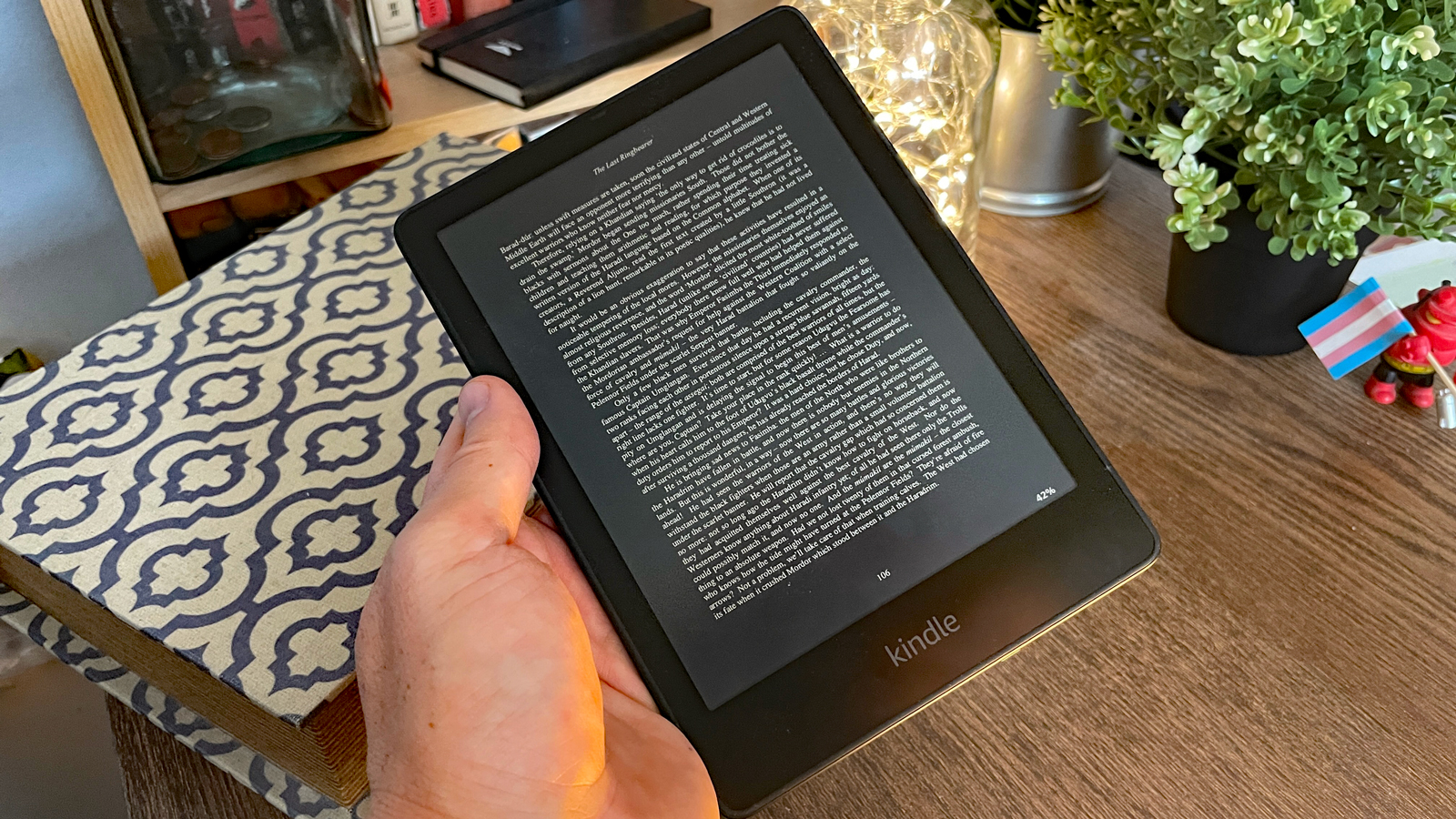
Kindle Paperwhite Signature Edition

(Image credit: Future)

A different crop of free books

If you own an Amazon Kindle, you're likely no stranger to free books - not only are there various subscription services like Prime Reading and Kindle Unlimited, but the Kindle Store has loads of free novels on it, and it's also easy to send a PDF to your Kindle for all the free classics online.

But Amazon's Read The World offering for World Book Day is a little different, as the texts cover a broader range of genres than we normally see from the heavily-genre-fiction-and-romance fare that's normally offered for nothing.

More importantly, this literature spans the whole world, so you can read from authors from Ghana, China or India, as well as other places. Again, we don't normally see this kind of diversity too much from the Kindle store.

So World Book Day will be great news for Kindle owners or Prime subscribers who like to experience the cultures of other countries... which is part of the point of it, really.


from TechRadar - All the latest technology news https://ift.tt/GtVxawg
via IFTTT

Week in Review: Try telling Netflix that sharing is caring

 Hi! I’m back! I had a lovely two weeks off, thanks, but it’s nice to be back talking back to you wonderful readers.

But it turns out that I’ve left at a time when a lot has been happening, and prepping for this newsletter has been a great chance to get back up to speed with it all and read some thoroughly interesting stories.

Mostly, if you share your Netflix password with anyone, you might want to give them a call soon and ask for a regular donation…

Netflix wants its fair share

Netflix

(Image credit: Shutterstock)

Does your father use your Netflix account, meaning you get constant emails about a new login? Does your son still watch Netflix at college and stop you from bingeing Squid Games at the exact moment you managed to carve out 45 minutes in your busy life?

If that’s the case, get ready to be even more frustrated: it’s going to cost you more to experience that annoyance in the future, as Netflix seeks to monetize password sharing.

The reason is simple: Netflix has lost 200,000 paying subscribers since the start of the year, and that decline is going to increase rapidly, according to estimates. So the platform is “taking action” to stop things like excessive password sharing, charging users for the privilege of sharing (that charge is currently $2.99 for a trial in places including Chile and Peru).

I was going to go into a rant about how this isn’t the cause of the issue, that it’s the price hikes, the increased competition, the lack of quality content… but then I read Axel Metz’s piece, and he’s done it all far more eloquently than I ever could, and he’s spoken to experts about it to. You should probably just read that…

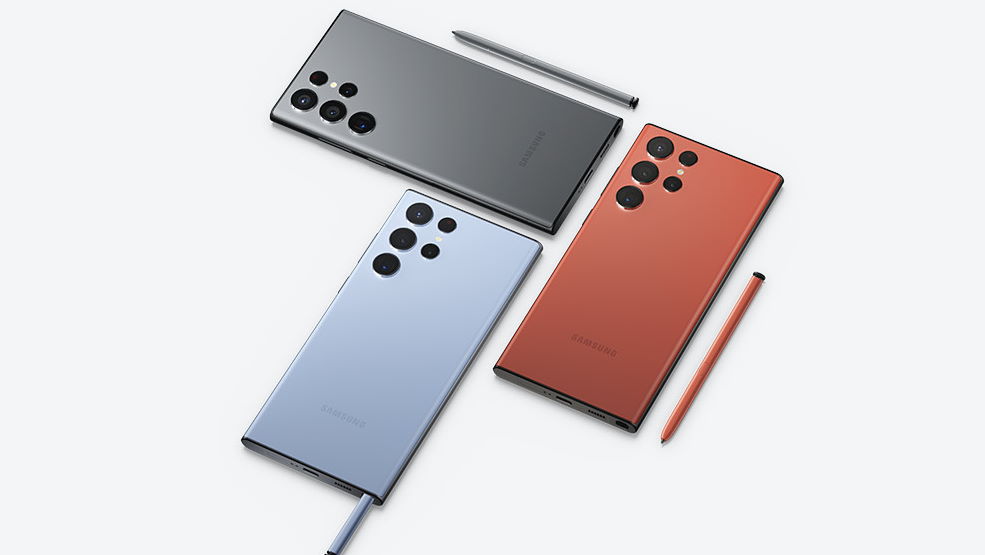
Samsung fans are seeing red over new S22 Ultra shade

Samsung Galaxy S22 Ultra

(Image credit: Samsung)

One of the quirks of being a phones journalist over the years has been the moment when a brand launches a new color variant of a recently-launched phone; it often provides a moment of simple joy in contrast to the hours spent talking about specs and materials. 

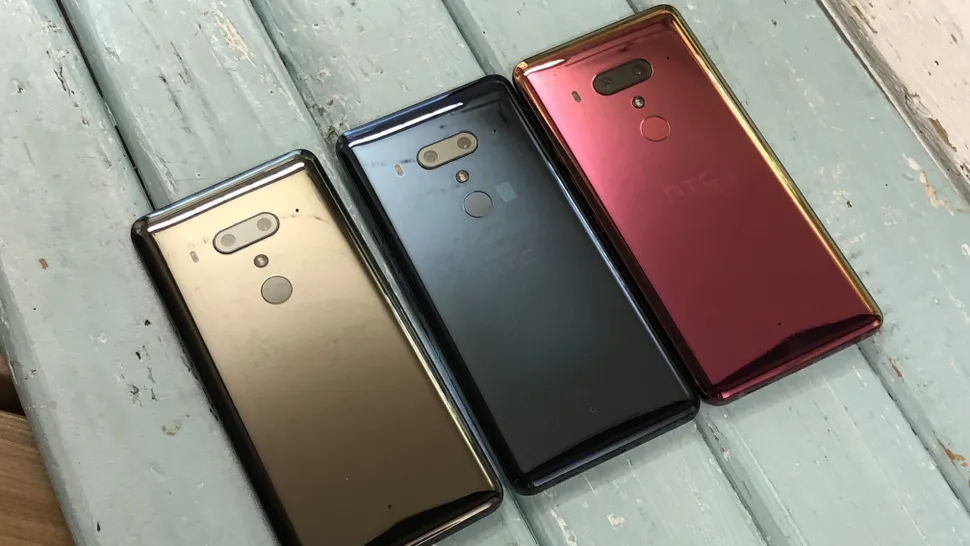
The iPhone 12 in purple made people happy. The HTC U12 in Flame Red was one of the most beautiful phones I ever saw. So when Samsung said the S22 Ultra was coming in red, our Phones Editor Tom Bedford predicted that it would be beautiful, and opined as such.

How wrong he was. It turns out that Samsung thinks ‘red’ really means ‘a sort of burned coral with a reddish hue’, and many readers have got in contact with us to say how disappointed they are.

Why not just make a lovely red phone Samsung? That’s what people want, clearly, so stop playing around with confected colors and make a proper red variant.

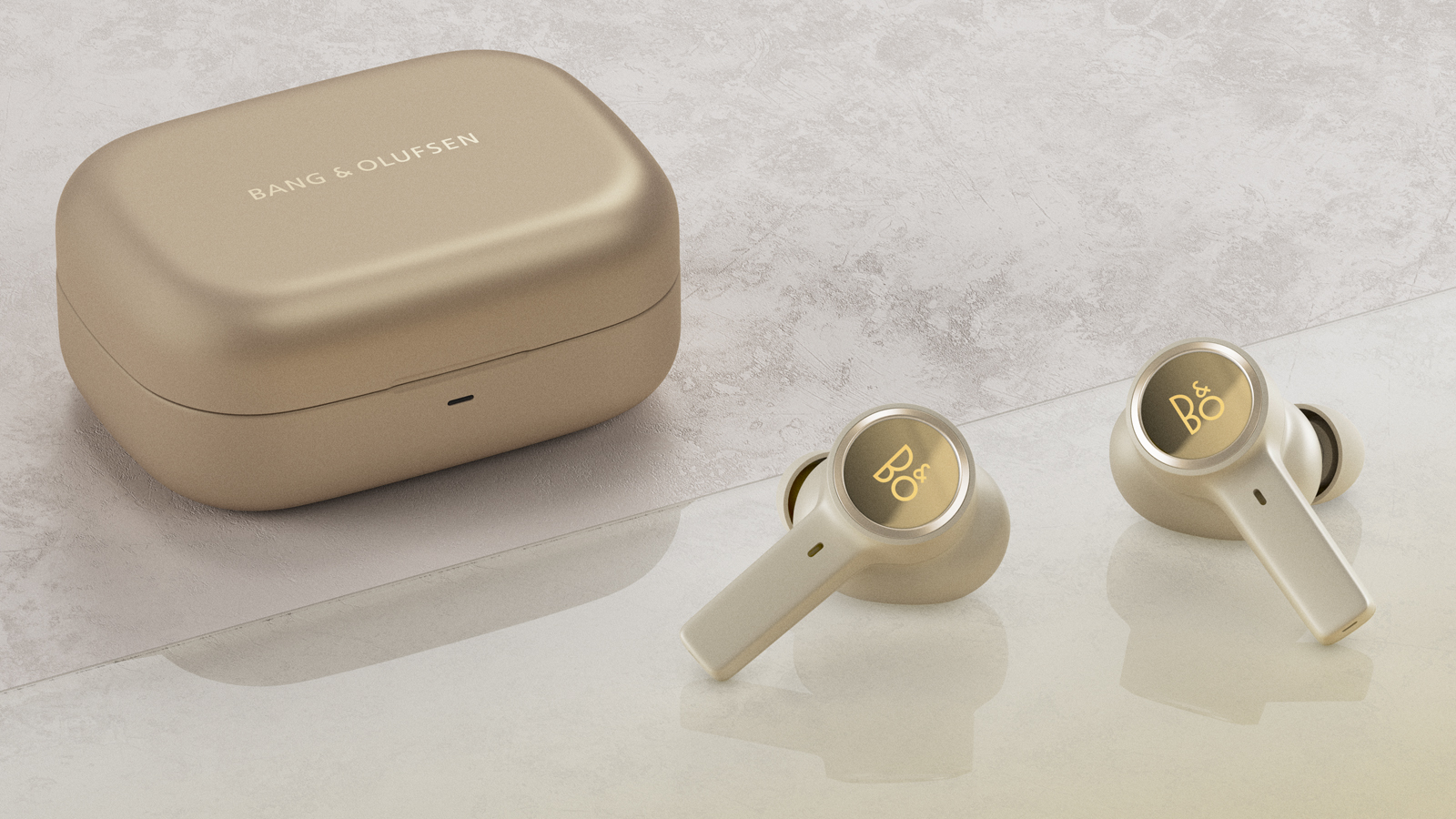
Beauty is ear deep

the bang & olufsen beoplay ex true wireless earbuds in gold

(Image credit: Bang & Olufsen)

I've been pondering which earbuds to get next, as my trusty and super-cheap Enacfire buds from Amazon are starting to irritate me just a little too much.

I could be swayed by Bang and Olufsen's new buds, the Beoplay EX, as they look a little AirPods Pro-like in their design, but not quite as Apple-y (I'm still burned from the abuse I got on Twitter when I showed off the original AirPods for the first time).

The thing that will ultimately sway me is not the audio quality, which will likely be excellent, but more whether they'll be any good for sports. I'm currently re-reviewing the Jabra Elite Active 75t, which are much cheaper than the AirPods, so I'm looking forward to getting my ears around the Beoplay EX.

And they'd better be good – $399 is a lot to pay for a pair of earbuds.

Ghostbusters game leads Meta's new VR charge

Ghostbusters VR

(Image credit: Future)

Our team was all over the Meta (formerly Oculus) Quest launch this week, with a whole raft of games making their debut at the event.

While sadly – and annoyingly – we didn’t see a new headset get announced (it’s long overdue) the games that appeared look pretty good, and show that Meta, the parent company of Facebook, is still investing heavily in this area.

The Ghostbusters game in particular looks pretty stellar – it’s almost making me want to go out and buy a dedicated headset, until I remember that I get to play on my PS4 for about 20 minutes every month, so it probably wouldn’t be worth it.

But for those of you who do have the time, these games are well worth checking out – and we’ve got all the trailers lined up nicely for you too.

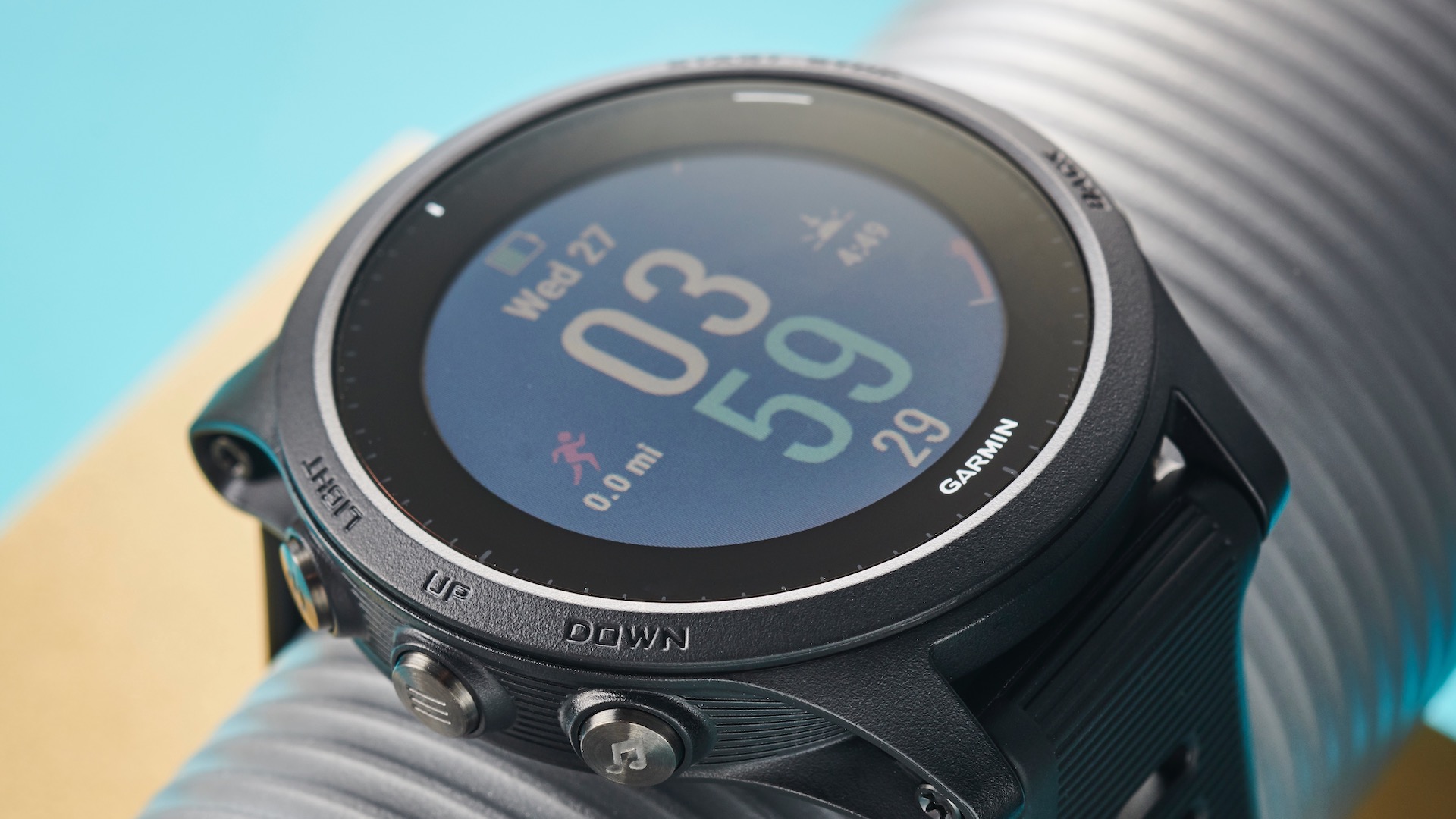
Don't do this to me, Garmin

Garmin Forerunner 945 running watch

(Image credit: Future)

I’ve known deep down that Garmin was about to launch a new running watch in the shape of the Forerunner 955, and this leak makes it almost certain. Cat Ellis has done a great job of writing up said leak, with loads of information about what Garmin is planning, and a mystery device in there too.

However, this line has upset me: “With improvements in battery tech, more efficient components, and solar charging, the Forerunner 955 could give performance more similar to the 47mm Garmin Fenix 7 Solar, which runs for up to 22 days in smartwatch mode, and 73 hours in GPS mode.”

The issue, dear reader, is that I’ve just bought the Fenix 7 Solar (and it’s brilliant – it has an actual torch on it and I love it) because I thought “yes, it’s expensive, but I’ll use it everyday. Sure, it’s a bit bulky but that’ll be fine’”.

So the notion that all the good stuff on this watch will be coming to a slimmer, cheaper, more running-focused watch doesn’t make me happy. I’m just hoping the Forerunner 955 doesn’t have a torch – then all will be well.

Congrats to the appy couple

iOS 15 Apps for wedding banner

(Image credit: TechRadar)

I’ll be honest – I’ve included this story mostly because I wanted to celebrate the fact our software writer Daryl Baxter got married this week, and he wrote a tremendously sweet piece about the five apps he used to plan the wedding.

I won’t lie: as someone who’s also planning a wedding, my stomach turns at the thought of sharing a to-do list app with my partner. 

I can see myself doing more stuff in the app than actual stuff, such as speaking to the venue and begging them to send over the menu choices and telling me where to send the deposit to and making a choice on where the tables will be stored and what if people want to just come for the evening and where is the marquee now and… okay, I need to breathe.

But I did find some nice ideas in this piece around budgeting and planning – so if you’ve got impending nuptials, give it a click.

How can we only now be discovering new body parts?

The human lungs

(Image credit: Shutterstock)

This is yet another moment where science blows my mind. How, in 2022, can we only just be discovering a part of our lungs that we didn’t know existed?

Okay, calling it a new part of the body in the headline above is a bit of a stretch – it’s not like they found a spare finger in the lungs or anything – but reading deeper, I’m just amazed at the human body’s ability to regenerate itself.

Essentially, scientists have discovered that we have respiratory airway secretory (RAS) cells, which are like stem cells in that they’re ‘blank’. They can then spring into life and be used to repair damaged cells, and understanding them better could help with the development of treatments for smoking- and pollution-related diseases.

Check out the full article over on LiveScience – it’s a fascinating read – and marvel anew at the way our bodies work.

This is from the editor

Gareth Beavis

It’s so nice to take some time off and see what comes out of the team when I’m away. I read Matt Hanson’s round up last week and really enjoyed it – I think we need to hear more from him in the future, so we may put him on the roster more regularly.

Remember, if you enjoyed this read and haven’t yet signed up for the newsletter, (which delivers it to your inbox before this article goes live - exclusive stuff that will make you feel special) you can do so here and make your life immeasurably better (and spread the word while you’re at it).

And if you want to let me know your thoughts on this week’s missive, or want to share your experiences with tech, or just want to express how much you’ve missed me (or didn’t want me back) then you can email me, remembering to include 'NEWSLETTER' in the subject line – I do read every email, and I’ll share the best ones here.

Have a great weekend! My top tip for this week is to go outside and take one photo of something brilliant – it’s a great way to develop an appreciation of wherever you are or whoever you’re with.


April 23, 2022 at 07:45AM from TechRadar - All the latest technology news https://ift.tt/Or4YMu9
via IFTTT

Friday, April 22, 2022

Twitter might ask again, 'What are you doing?'

Twitter has changed a lot in recent years, and especially more recently with a subscription service, Spaces, and the ability to remove followers. Some might say the social media platform is virtually unrecognizable from the platform they first joined back in 2006. 

Actually, I might say that but now Twitter is, according to Tech Blogger and code-sleuth Jane Manchin Wong, a new feature that takes me all the way back to my own first Tweet on March 19, 2007. 

Code-named "Vibe," the "Set a status" feature would let you show followers what you're doing right now.

See more

In the captured feature screen, there's a "What are you doing?" prompt with a dropdown list of options like, "Driving highway," "Shopping grocery," and "Lurking Twitter".

This might appear with your profile, possibly even above your tweets. Wong likens it to what Instagram Threads does with "Status."

I, however, see it differently.

When Twitter launched in 2006, the idea was to let followers (usually co-workers, colleagues, friends) know what you were doing at any given moment.

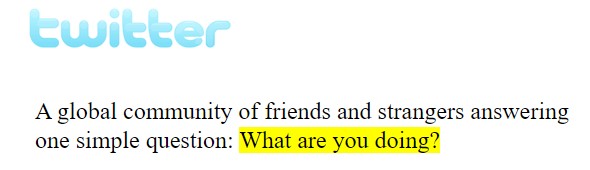
The service's tag line back then was quite clear: "A global community of friends and strangers answering one simple question: What are you doing?"

Twitter in 2006

(Image credit: Future)

The last sentence appears in bright yellow as if Twitter had run a highlighter across it.

That's right. The wording is exactly the same.

Fifteen years ago, I had no idea how to use Twitter, so I followed the platform's instructions and simply listed what I was doing: "Listening to TWiT. Eating a bagel. Drinking my coffee. Typing this note."

See more

It was arguably a terrible post, but it did answer the question, "What are you doing?"

The Twitter of 2022 is, obviously, a far different beast. It asks "What's happening?" It's a place to post what you're thinking, explore ideas, argue, and share a wide array of information, photos, video, and audio. It's a media platform.

Twitter, perhaps sensing that it has moved oceans away from its original intent, is thinking that just a little hint of the past - of its roots - might make Twitter more engaging, fun, and less of a self-serious place.

Instead of an angry tweet about the latest political debate or a pitched battle regarding Android versus iOS, there might just be an old-school status update, one that says the Twitter member is driving, walking, or eating a bagel.

I have no idea if Twitter fully plans to launch "Set a status" (I've asked Twitter directly and am awaiting a response"), but I think it could use this nostalgic feature, especially as it faces the prospect of new ownership (Hi, Elon Musk!) and maybe some significant changes that could, again, change the face of the venerable platform.


April 22, 2022 at 07:52PM from TechRadar - All the latest technology news https://ift.tt/sOi5Ykq
via IFTTT

Thursday, April 21, 2022

CNN streaming service to shut a month after launch

It comes as Netflix has reported a plunge in subscribers in the face of stiff competition from rivals.

source https://www.bbc.co.uk/news/business-61185298?at_medium=RSS&at_campaign=KARANGA

Kardashians deny faking Roblox sex tape scene

Questions are being asked about a scene in The Kardashians, when Kim's son finds a sex tape ad on Roblox.

source https://www.bbc.co.uk/news/technology-61178189?at_medium=RSS&at_campaign=KARANGA

Conserving mangroves to protect local livelihoods and the planet

Apple’s partnership with the Applied Environmental Research Foundation will promote the protection and conservation of mangroves in India.

Apple Fitness+ rolls out curated Dance workouts and a new Dance Collection

Apple Fitness+ is celebrating International Dance Day with curated Dance content.

Wednesday, April 20, 2022

Actors launch campaign against AI 'show stealers'

Equity, the performing arts workers union. says actors need protection from computer-generated substitutes.

source https://www.bbc.co.uk/news/technology-61166272?at_medium=RSS&at_campaign=KARANGA

US bans anti-satellite missile tests

US Vice-President Harris says US will stop testing missiles designed to destroy spacecraft in orbit.

source https://www.bbc.co.uk/news/technology-61151141?at_medium=RSS&at_campaign=KARANGA

Apple expands the use of recycled materials across its products

Company shares new ways for customers to appreciate, learn about, and protect the planet this Earth Day.

Monday, April 18, 2022

New report reveals the fastest mobile Internet - is it your carrier?

Ookla has released its Q1 2022 internet speeds report for the United States and revealed that T-Mobile has the best mobile connectivity among all providers with Verizon being the best in broadband.

Ookla is the company behind Speedtest and they judge on three main categories: speed, latency, and consistency alongside regional and 5G performance.

Top mobile speeds for the US

T-Mobile swept all three major categories for mobile speeds and the 5G subcategories.

According to the report, T-Mobile has a download speed of 117.83 Mbps, up from 90.65 Mbps during Q4 2021. This makes T-Mobile more than twice as fast as AT&T.

For latency, T-Mobile actually tied with Verizon Wireless at 31 ms. And for its Consistency Score, T-Mobile earned a score of 88.3 percent in terms of consistent quality.

Going down the list, T-Mobile has the best performing 5G network at 191.12 Mbps download speed, the most widely available network at 65 percent coverage, and a Consistency Score of 79.9 percent.

Aiding T-Mobile’s domination is the ever-increasing hardware that supports these speeds. Ookla reveals that the fastest chipset among the popular brands is the Snapdragon 8 Gen 1 mobile platform with a median speed of 122.68 Mbps.

It’s a chipset that powers some high-end Android phones, like the OnePlus 10 Pro and the Galaxy S22 Ultra, whose brand has the fastest speeds among cell phone companies.

Top broadband speeds for the US

For home broadband internet speeds, Verizon wins for fastest provider and latency but loses to XFINITY for consistency.

Verizon has a median download speed of 184.36 Mbps and a latency of 8 ms. For the Consistency Score, XFINITY took the top spot with 90.6 percent and Verizon came in third with 89.4 percent. Spectrum took second at 90.3 percent.

However, depending on which US region you look at, these standings change. XFINITY is the fastest in thirteen states while Verizon wins in four.

In case you’re curious, New Jersey is the state with the fastest internet speeds at 195.2 Mbps. This is followed by New York and Rhode Island with speeds of 179.32 and 173.09 Mbps, respectively. Wyoming, according to the study, has the slowest mobile broadband service.


April 19, 2022 at 05:00AM from TechRadar - All the latest technology news https://ift.tt/ht7vmXZ
via IFTTT

Apple staff make bid for first union at a US store

Employees must get signatures from 30% of staff at New York's Grand Central Station for a union election.

source https://www.bbc.co.uk/news/business-61145127?at_medium=RSS&at_campaign=KARANGA

No 10 network targeted with spyware, says group

Researchers say they warned UK officials about being targeted, but the software's makers deny the claims.

source https://www.bbc.co.uk/news/uk-61142687?at_medium=RSS&at_campaign=KARANGA

Saturday, April 16, 2022

Friday, April 15, 2022

MacBook Air (2022): here's everything we know so far

Fans with aging Apple laptops prayed that a new MacBook Air (2022) would make an appearance at the Apple "Peek Performance" event March 8. They were left wanting. Again.

But never fear! Convincing rumors suggest a new MacBook Air will be released alongside a second generation of the M1 silicon, and in a range of bright and cheery colors at that. It has big shoes to fill: The older MacBook Air (M1, 2020) still tops both our best laptop and best Apple laptop guides and has since November of 2020, when it was released alongside other M1-powered devices such as the Mac mini (2020) and 13-inch MacBook Pro (M1, 2020).

The MacBook Air 2022 will most likely keep the silent, fanless design and excellent battery life, which is already the longest in an Apple laptop, even if Apple doesn’t make any adjustments. But we’re expecting some improvements, particularly in the Air’s design, with the 2022 model. Rumors abound of a complete redesign including a plethora of colors to choose from, similar to the classic Mac-inspired ones that you can pick for the 2021 iMac and 4th generation iPad Air

Here's everything we know to date.

MacBook Air (2022): Cut to the chase

  • What is it? Apple's newest ultraportable laptop
  • When is it out? Possibly late 2022
  • What will it cost? Unknown, but likely similar to current pricing (starting at $999/£999)

Latest news

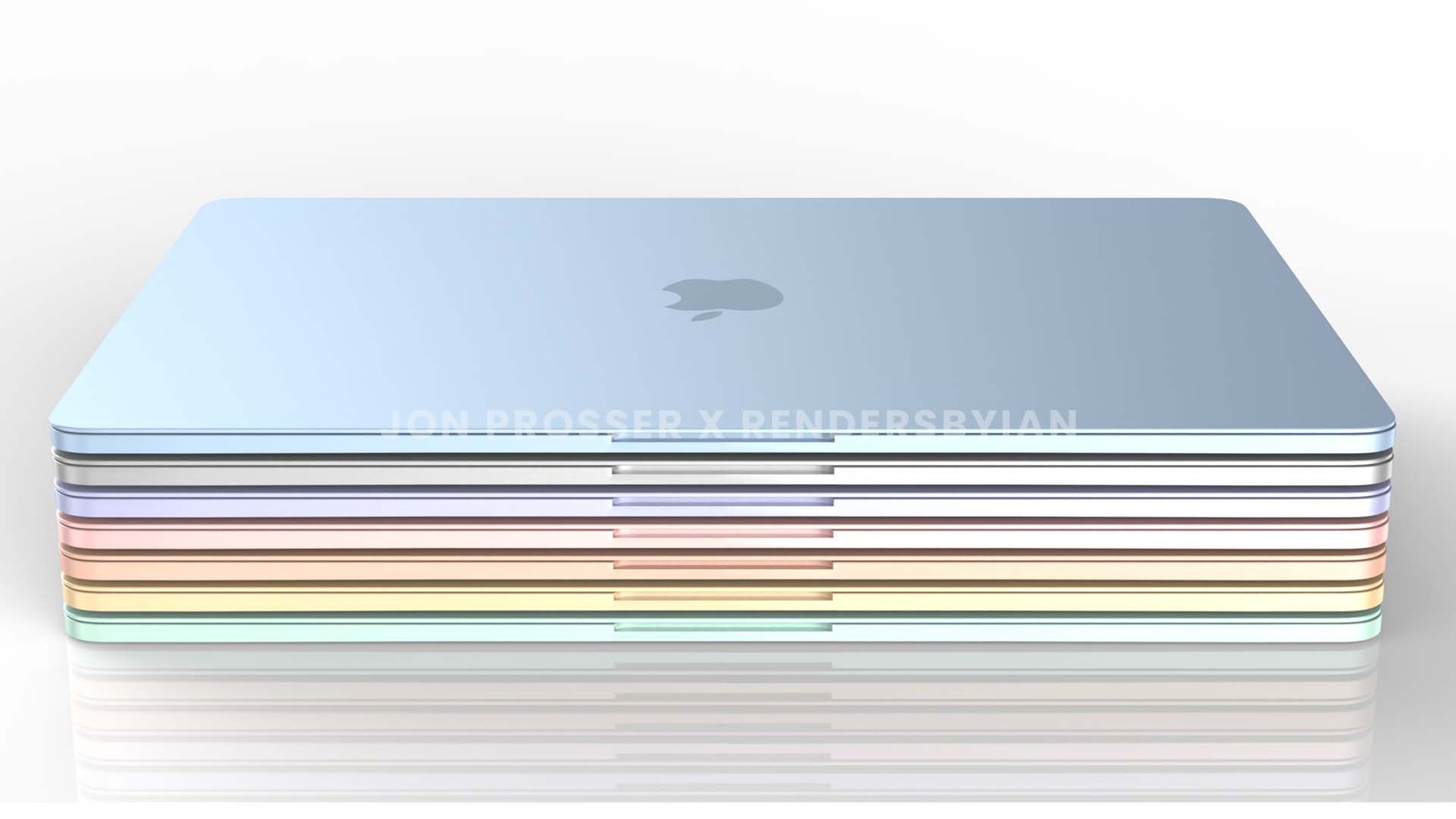
Possible MacBook Air (2021) design

(Image credit: Jon Prosser / RendesByIan)

April 15:  Apple is testing a whole bunch of new Macs that are powered by its next-gen M2 chip -- including a new MacBook Air and multiple MacBook Pro models, according to the laptop grapevine.

April 13:  MacBook production could be affected by current lockdowns in China due to Covid, reports suggestion, meaning potential delays to Apple's new laptops, according to respected Apple source, analyst Ming-Chi Kuo.

April 11: “Apple is gearing up to launch some new Macs in the next few months," writes Mark Gurman. "What better place to do so than WWDC?" And one's likely to be the MacBook Air, he says.

April 2: No April Fool's joke here: DigiTimes says sources from the supply chain – insiders in the firms involved in making parts for Apple’s laptops – are ramping production, anticipating hot sales of forthcoming MacBook Air models.

More of the latest MacBook Air tidbits ▼

March 25: New rumors suggest that Apple could release a new 15-inch MacBook Air in 2023. This could either be the best decision Apple has ever made – or a big mistake, writes TechRadar's computing guru Matt Hanson.

March 22:  Apple meant to launch a redesigned MacBook Air at its recent launch event, but wasn’t been able to stick to its original timeframe, says Mark Gurman. The company now plans on launching the MacBook Air in the second half of 2022, he says.

March 09: At its Spring "Peek Performance" event, Apple unveiled a new M1 Ultra chipset, the iPad Air 2022, the iPhone SE 2022, the fancy Mac Studio, and more! But no MacBook Air, unfortunately. 

Oct. 22, 2021:  Apple’s next MacBook Air might come equipped with a Mini-LED screen like the new MacBook Pros – maybe minus the notch – when it purportedly arrives in mid-2022, as well as an M2 chip, with an off-white color keyboard and bezels.

Aug. 11, 2021: Apple’s next MacBook Air will be landing midway in 2022 complete with plentiful color options and a Mini LED screen, says analyst Ming-Chi Kuo.

Release date and price

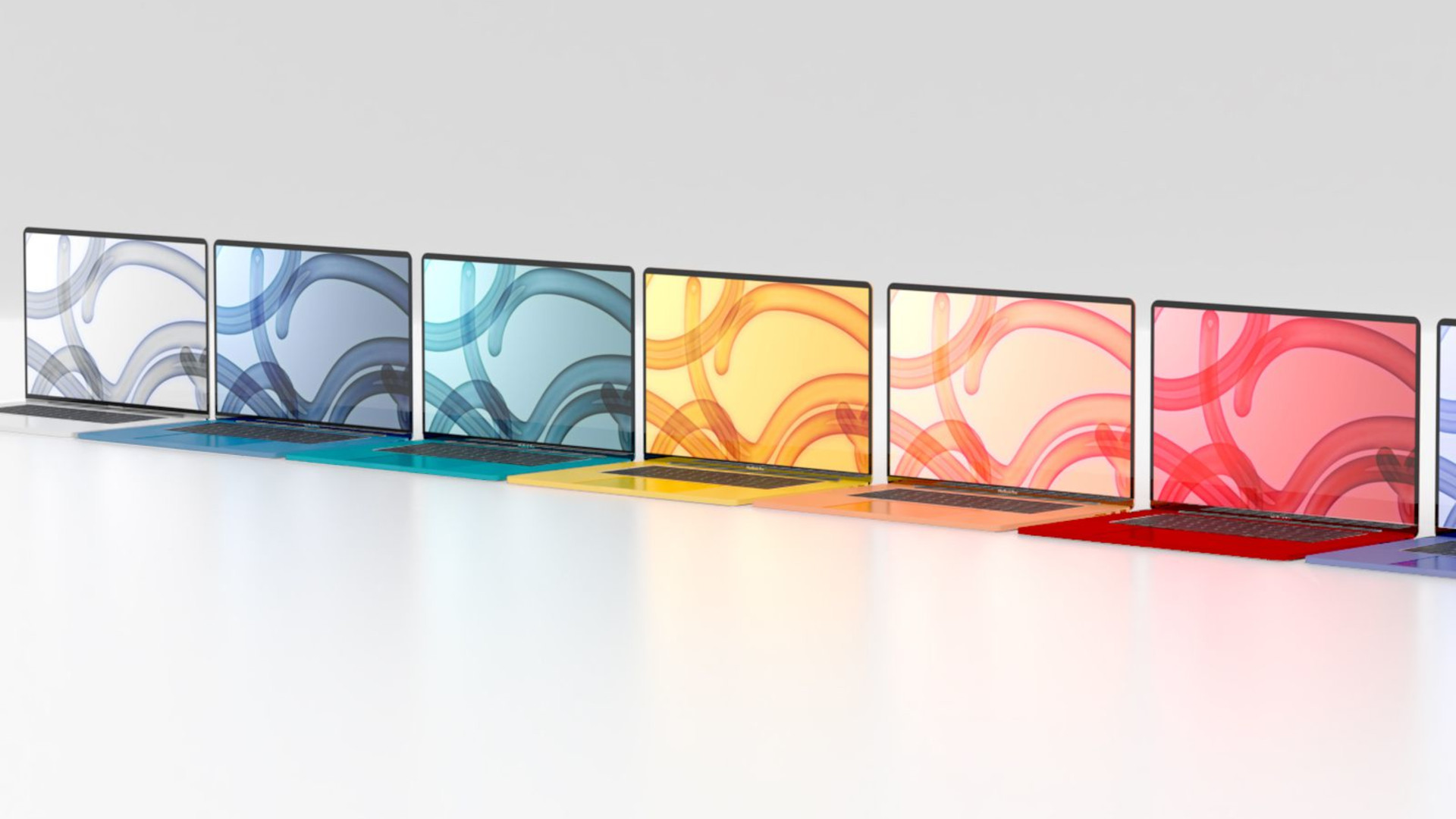
A row of colorful MacBook Air renders against a plain backdrop

(Image credit: Jon Prosser)

We were hoping that Apple would spill some beans at its Peek Performance event on March 8, but now that this slipped by without even a mention, the predicted release date is a little foggy. With so many rumors flying around, it's still likely we could see it announced by the end of 2022, so keep your eyes peeled for any events towards the end of the year.

The latest 24-inch iMac was only released back in May 2021, and given that featured the same M1 SoC as the first wave of Apple silicon, it's anyone's guess as to if this latest MacBook Air will offer the very same M1 with a complete design update, will sport one of the new chips unveiled with the new MacBook Pros, or have an all-new Apple M2 chip.

Given that the two most recent MacBook Pro models contain souped-up versions of the M1 chip (the M1 Pro and M1 Max), it's unlikely that the 2022 MacBook Air would launch with the same, ultra-powerful Soc during the same release window, so an M2 chip debut is more likely.

There's no official murmurings on price yet, but we anticipate the new MacBook Air will start at $999 / £999, just like the current model.

Design

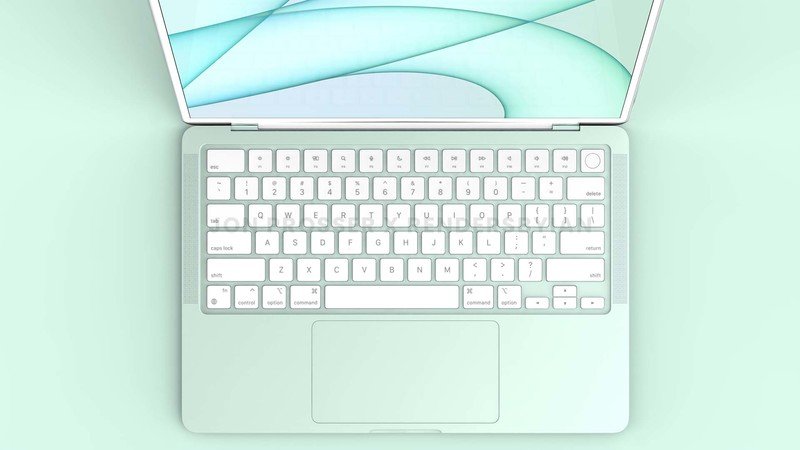
Possible MacBook Air (2021) design

(Image credit: Jon Prosser / RendesByIan)

Regardless of when the new MacBook Air arrives, there's been plenty of leaks and speculation regarding its new design to make it worth the wait. We anticipated back in April that the MacBook Air is overdue for its own colorful redesign following the release of the 24-inch iMac during the Spring Loaded event, when the new models took inspiration from some classic, colorful Mac designs.

This was reinforced when serial Apple leaker John Prosser claimed that the MacBook Air (2021) could launch in the same seven colors as the iMac (2021). These colors are Blue, Green, Pink, Silver, Yellow, Orange, and Purple.

According to renders provided by Prosser, these new MacBook Air laptops could also feature white keycaps, larger function keys, and a slightly smaller trackpad. The chassis is also noticeably slimmer and 'boxier', doing away with the current sloped edges and instead opting for a very modern, blunt edge. With these rumors all collated, it would seem this anticipated redesign will be the thinnest, lightest MacBook Air to date.

Now that the rumors have been proven true with the return of MagSafe charging on the two newest MacBook Pros, we also anticipate that the 2022 MacBook Air will feature a Mini-LED display, something not only suggested by analyst Ming-Chi Kuo but a couple other sources

Specifications

See more

That quote is from popular Twitter leaker Dylandkt, who's profile was deleted in Janary of 2022 -- draw your own conclusions as to why. But a thinner design does suggest that the MacBook Air (2022) will include some variant of the Apple M1 SoC; it's unclear if this will be the same M1 chip featured in the current MacBook Air, or a new all-in-one M2 SoC. 

The current version of the laptop -- the MacBook Air (2020) -- comes with Apple’s M1 SoC or system on a chip, which combines CPU, GPU and other components into an 8-core processor capable of surprisingly stunning performance. The 2020 model is much more powerful than the Intel-powered version it replaced, working 3.5 times faster when it comes to CPU performance and 5 times faster for its GPU performance. What could a new M2 chip bring?

Outside of the chip itself, it's likely that Apple will keep many of the other specifications the same as the current model. This is the 'budget' laptop option after all, so any boost to power could push the price higher and eat into the market for the MacBook Pro.

This means you'll see a choice between 8GB or 16GB of RAM and 256GB or 512GB of SSD, alongside established features like the Magic Keyboard, and Touch ID. We're also anticipating thinner bezels, a 13-inch display (as is currently the standard), and an improved 1080p webcam. Updated webcam tech was featured on the 2021 iMac, with Apple claiming this to be the “best camera ever in a Mac”, so we'd be surprised if this isn't extended across the entire range of MacBook devices given how dire the current 720p webcam performance is.

For context, the last Intel-based MacBook Air could run two 4K external monitors, so we might see this feature return, especially since the newest iMacs and MacBook Pros all sport 1080p webcams.

While the number of ports on the 14-inch and 16-inch MacBook Pro (2021) ended up expanding quite a bit, the same might not happen on the MacBook Air (2021), which will likely remain at two ports.


from TechRadar - All the latest technology news https://ift.tt/9HytiVR
via IFTTT

Apple’s testing a bunch of M2 Macs (including a MacBook Air) that could arrive at WWDC

Apple is testing a whole bunch of new Macs that are powered by its next-gen M2 chip -- including a new MacBook Air and multiple MacBook Pro models, according to the laptop grapevine.

This report comes from one of the more reliable sources for Apple spillage, Mark Gurman, who points out in Bloomberg that tapping info in developer logs suggests no fewer than nine possible Macs using different variations of the incoming M2 chip are being tested.

Obviously, take this with a large pinch of your preferred condiment, although Gurman does clarify that as well as the logs in question, he has spoken to inside sources who have corroborated the info. But remember that there are no guarantees here, nor ever with any nuggets from the rumor mill.

Okay, so the main points of interest here are the new MacBooks, starting with the purported MacBook Air (2022), which has long been rumored as coming in an all-new design with the M2 chip. Gurman asserts that this laptop is codenamed J413 and will offer an 8-core M2 CPU (with a 10-core graphics solution).

There’s also an entry-level MacBook Pro with M2 in testing, which will use the same SoC as the Air. And again this refresh of the base 13-inch model has been floated multiple times via the rumor mill.

Further Apple laptops currently in the testing process purportedly include MacBook Pro 14-inch and 16-inch refreshed models with M2 Pro and M2 Max chips, both running with the same core spec. Supposedly the M2 Max is a 12-core SoC with 38-core graphics (notched up from 10 cores and 32 cores respectively in the current M1 Max). These notebooks will come with up to 64GB of system RAM, the report states.

As you might expect, the much-rumored Mac mini (2022) comes into play with this batch of testing too, and the next-gen model supposedly runs with the same spec as the MacBook Air and its M2 chip – but there’s a further Mac mini variant with the M2 Pro inside also in testing.

Interestingly, Apple has supposedly also tested Mac mini machines with an M1 Pro and M1 Max, but Gurman believes these designs won’t come to fruition, and may well be redundant now that the Mac Studio is on the scene.

Finally, Gurman asserts that there’s a Mac Pro which is built on the follow-up chip to the M1 Ultra currently seen in the Mac Studio.


Analysis: Best laid plans might still go awry…

Apple prototypes and tests bushels of hardware, and not all of it is picked for store shelves. So there are no guarantees that we’ll see anything like all of the Macs talked about here. That said, Gurman does observe that testing is “far along” in some cases, so presumably some of this hardware is close to being finalized for launch.

The leaker believes that two Macs will come out around the middle of the year, and we’ve heard before from Gurman that we may see these unveiled at WWDC (we’re not so sure, as we’ve discussed previously, but hey, we certainly can’t rule it out).

The theory is that one of those models destined for a WWDC reveal is the redesigned MacBook Air, and in this latest rumor deluge, Gurman again mentions that this is one of the Macs that’ll arrive in 2022, along with the low-end MacBook Pro (13-inch) and Mac mini. We’re looking at 2023 for the others, then, or however many of them make the cut (also interesting to note here is that there’s no mention of any new iMac).

Clearly, we need to stay skeptical around these predictions – and any crystal ball gazing for that matter – and what’s more, there could be disruption to MacBook production that throws these potential timeframes into disarray, or at least might cause a delay. As we heard earlier this week, the current lockdowns in China could have a considerable impact on MacBook manufacturing in particular.


from TechRadar - All the latest technology news https://ift.tt/E6qCPlr
via IFTTT

Thursday, April 14, 2022

Apple helps suppliers rapidly accelerate renewable energy use around the world

More than 200 suppliers will be committed to using only clean power, helping bring nearly 16 gigawatts.

Wednesday, April 13, 2022

Apple unveils the best photos from the Shot on iPhone Macro Challenge

Today Apple revealed the 10 winning Shot on iPhone Macro Challenge photographs shot all over the world on iPhone 13 Pro.

Desperate for the new MacBook Air? We’ve got some bad news

MacBook production could be affected by current lockdowns in China due to Covid, and this might mean that Apple’s laptops planned for later this year may be delayed.

Respected Apple source, analyst Ming-Chi Kuo, took to Twitter to highlight a report in the Nikkei Asia, and observed that all this could spell big trouble for the MacBooks due later in 2022.

See more

As Kuo observes, the problem is that Quanta is pretty much the “sole EMS supplier for MacBook”, an acronym for Electronics Manufacturing Services – meaning involvement in design issues (and more) as well as manufacturing – and that Quanta’s disrupted production means the MacBook is the most impacted hardware when it comes to the Chinese lockdowns (in Shanghai and elsewhere).

Apple’s iPhone and iPad will also be affected as you might imagine, with production suspended at Pegatron and Compal, but as Kuo notes this won’t be as big a deal because Foxconn can “partially support” the supply of iOS devices to mitigate the shortfall at least somewhat. (We discussed the impact on Apple’s iOS hardware in more detail here earlier this week, if you’re interested).


Analysis: MacBook Air delay in the cards?

Obviously this is not the news anyone keen to see new MacBooks wants to hear, with these laptops apparently set to take the brunt of Apple’s lockdown-related disruption – at least going by these sources (pinches of condiments to hand, as ever).

So what MacBooks are we talking about? The rumor mill reckons that Apple is planning to push out a redesigned MacBook Air (2022) this year, and perhaps also a refreshed entry-level MacBook Pro 13-inch.

Certainly the next MacBook Air is keenly awaited, with the grapevine consistently floating the idea that it’s set for launch in 2022 – probably in the second half of the year, with production kicking off most likely in Q3. (The most recent rumor theorizes Apple could actually reveal the new Air as early as WWDC in June, but we’re not sure we’re buying such an early appearance for the device).

If we’re looking at, say, a September on-shelf release date for the MacBook Air, or maybe even October, then it’s not difficult to see how any further major slippage in the supply chain and production schedules could push the new notebook out to the very end of the year, maybe – or even 2023?

Apple would certainly want to avoid the latter worst-case scenario, if what we’ve heard from the rumor mill is correct – namely that it was originally the company’s intention to get the revamped MacBook Air out late in 2021, so the device has already theoretically slid a fair distance in terms of launch timeframe. But then there’s not much that can be done, really, if the tale really is playing out as these reports suggest – the MacBook Air will be ready when it’s ready, and obviously enough, not before.

Naturally, these lockdowns won’t just affect Apple, but also other big notebook makers like Dell, HP and Lenovo, companies that’ll doubtless feel similar pressures on their production timelines, too.

Via Digital Trends


from TechRadar - All the latest technology news https://ift.tt/7T1ABlo
via IFTTT

Tuesday, April 12, 2022

Apple introduces new version of iMovie featuring Storyboards and Magic Movie

iMovie 3.0 makes it easier than ever for anyone to share their stories with video.

Microsoft Surface Laptop Go 2 could arrive soon – and there’s good and bad news

Microsoft’s Surface Laptop Go 2 could be here in the next couple of months, according to the latest speculation – and while the rumors on the upgrades aren’t all that exciting, there’s some positive news on the pricing front.

Zac Bowden of Windows Central claims that word from his sources is that Microsoft is getting ready to launch the Surface Laptop Go 2, and that the laptop will ship in the first half of 2022.

That means it could debut possibly in May or June, though Bowden reckons it’s most likely to be the latter – unless the current planned timeframe slips (which is, of course, always a possibility around launch timing).

Rumor has it that Microsoft intends to keep the pricing the same while (obviously) upgrading the hardware. In other words, the Surface Laptop Go 2 should start from $549 for the most basic version, with the pricing for upper-end models also staying the same.

What’s going on with the hardware upgrades, then? Bowden believes that the laptop will shift up a gear to Intel’s 11th-gen silicon (Core i5), with the entry-level model maintaining the same RAM and storage configuration, namely 4GB plus 64GB of eMMC.

The two higher-tier models will have the fingerprint sensor and power-up the RAM to 8GB plus storage to 128GB or 256GB respectively (SSDs, not eMMC drives), with pricing pitched at $699 and $899 just as before. If pricing stays the same in the UK and Australia, that would mean price tags of £549 / £699 / £899 and AU$999 / AU$1,249 / AU$1,549.


Analysis: If it ain’t broke, pep it up a bit

It’s exciting to hear that a next-gen Surface Laptop Go could be on the near horizon, seeing as the original laptop caused quite a splash when it landed back in October 2020. Indeed, in our review we praised it as the best Surface device Microsoft has ever made, delivering all sorts of high-quality elements – particularly that gorgeous display – as part of an affordable portable.

Performance was one of the areas where we were more critical of the original Surface Laptop Go, and stepping up to a 12th-gen Core i5 chip (from an 11th-gen) will help out on this front.

It’s also worth noting that an additional ripple in the rumor pond is that Bowden heard from one source that the entry-level Surface Laptop Go 2 might up its storage game to 128GB, which would be a very useful boost for this cheapest model. Then again, this could possibly be referring to the business-targeted version of the sequel, not the base consumer model, so take it with a particularly heavy pinch of salt.

While this is more of a minor refresh, of course, and nothing much about the overall design is supposedly going to change – save for a new color option (sage) – some pepping up on the hardware front is all that’s needed, really.

As far as the design goes, as they say, if it ain’t broke, there’s no need to fix it (although Bowden observes that a backlit keyboard might be nice, and this could yet be an upgrade Microsoft is implementing – though the low price point may yet preclude this, at the entry-level anyway).


from TechRadar - All the latest technology news https://ift.tt/g9AJfsR
via IFTTT

Monday, April 11, 2022

Streaming is driving a 'golden age' for Indian drama

India's 30 streaming services want to reach 60 million households meaning a lot more work for actors.

source https://www.bbc.co.uk/news/business-60873073?at_medium=RSS&at_campaign=KARANGA

Sunday, April 10, 2022

Elon Musk will now not join Twitter's board, CEO says

The Tesla boss was due to join the social media platform's board after buying a 9.2% stake in the firm.

source https://www.bbc.co.uk/news/business-61063905?at_medium=RSS&at_campaign=KARANGA

Saturday, April 9, 2022

Apple Myeongdong now open in South Korea

Apple Myeongdong opened this Saturday, April 9, in the heart of Seoul’s popular shopping district.

Friday, April 8, 2022

Elon Musk to answer Twitter staff questions

Employees will be able quiz the entrepreneur as he joins the board of Twitter, after share purchase.

source https://www.bbc.co.uk/news/technology-61042412?at_medium=RSS&at_campaign=KARANGA

Thursday, April 7, 2022

The next iPad Pro needs to borrow this one iPad Air feature

I've used my iPad Pro for years now – obviously that means that I do like it, but there are two features that really ruin the experience for me.

The first is the battery life, but I know I can only get so annoyed at that. I've used the thing incessantly for several years, and Apple isn't exactly great with its product battery life anyway – I'm used to this now.

But there's one feature that some Apple fans paint as a positive, that I just hate for the iPad: Face ID.

Face ID sucks on iPads

I know Face ID is popular on iPhones, but I've found it doesn't work well at all. It rarely recognizes my face, and even when it does, it takes loads of rotating and fiddling with the device to angle it right. Oh, and simply picking up the phone is a chore when in-screen fingerprint sensors let me avoid this.

I'm admittedly comparing it to Android phone equivalents, which are a little less secure, but I'm not a secret agent or important celebrity – the odds of someone printing out a 3D copy of my face to hack into my phone is pretty rare.

I also found that Face ID doesn't take into account changes in my face – sometimes I have lots of facial hair and sometimes I don't. Sometimes I wear glasses and sometimes I don't. I've even found my hairstyle affects it, and don't get me started on face masks.

But if it's annoying on iPhones, it's downright bad on iPads.

That's because you need the sensors angled just right in iPhones for Face ID to work. That's not too hard if you're lifting the device up to your face to unlock it. But you're not exactly going to want to do the same on an iPad.

I always find myself craning my neck over my 12.9-inch iPad Pro to try and get it to unlock, or picking it up and twirling it around in my hands. That's not exactly easy given how huge it is.

Apple's Face ID might be great for small portable devices, but tablets are designed to be used on a desktop or work counter – given that Face ID requires you to be perfectly positioned in front of the sensors, the system of facial unlocking just isn't ideal.

Long live Touch ID

Apple iPad Air 5

(Image credit: Future)

I think Apple knows that Face ID is bad on iPad models, because for other tablets, it's begun to avoid it. 

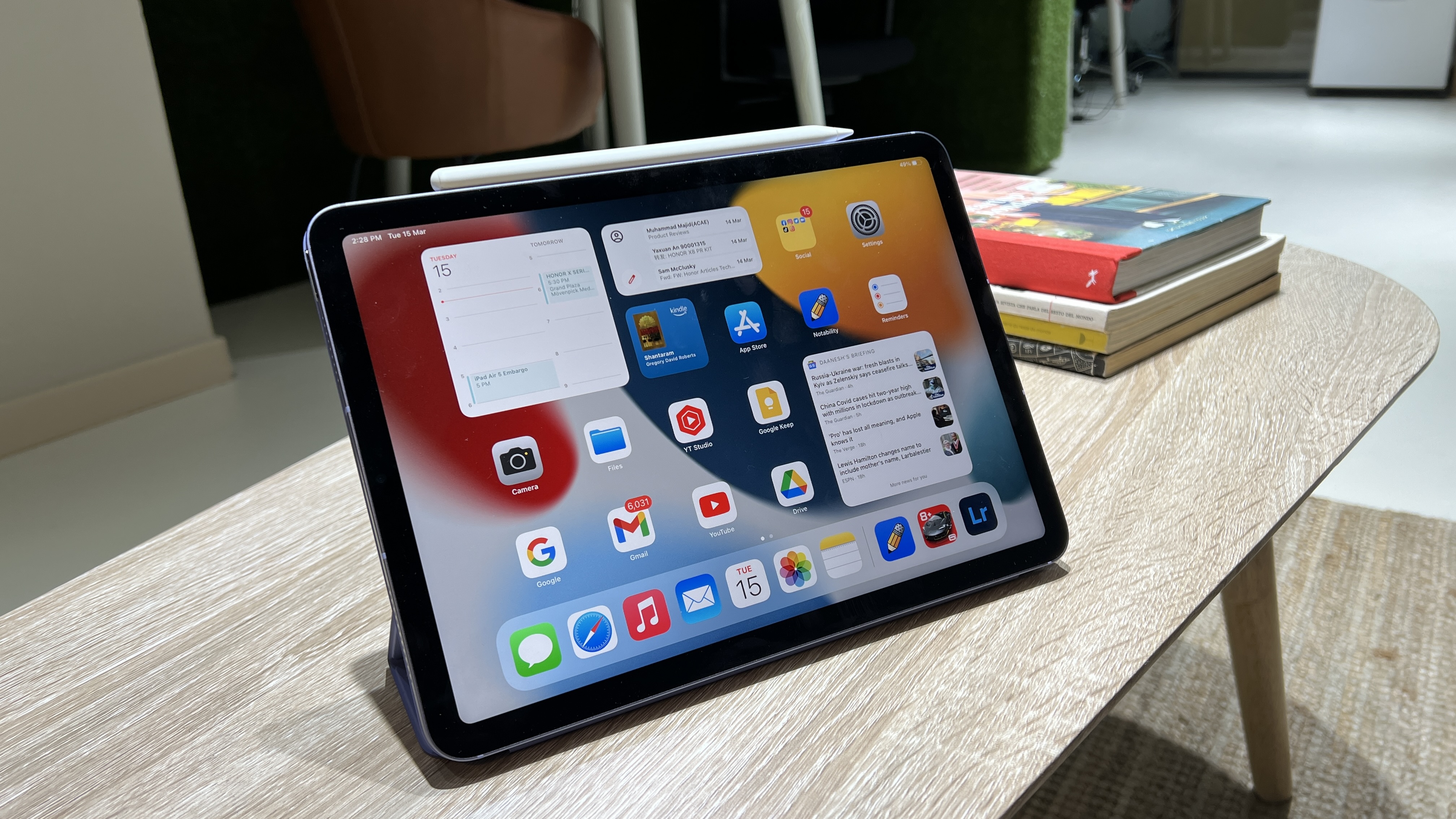
The iPad Air 4 and Air 5, as well as the Mini 6, all use Touch ID embedded on power buttons on the edge of the tablet. A solution like this makes unlocking the slate so, so much easier – you can just reach out, and press the power button to boot it up.

Bear in mind that you have to touch the iPad Pro's power button anyway, to let it know you want to unlock via Face ID, so you're just cutting out a step with the button.

I wish I had this feature on my iPad Pro. It'd stop me having to do circus tricks to get the slate to notice me, and could let me easily boot up my video edit or movie stream without too much effort.

Coming to the iPad Pro?

I don't think Apple will drop Face ID any time soon, even though it's avoided bringing it to its mid-range tablets. That would be an admission that the tech doesn't work well, and Apple wouldn't do that without a new innovation to replace it with.

But I'd love to see the company bring Touch ID for its next iPad Pro models, which we expect to see in 2022. It'd be a consumer-friendly upgrade that would make the tablets much more usable.

iPad Pros are designed for professionals. These tablets are going on desks, or on laps on public transport, or being carried around in the field – using a very directional facial recognition tool just won't cut it.

Perhaps we could see both Face ID and Touch ID used as options for the tablet – if it's a pricey Pro model, Apple could afford to use both. But if it comes down to one or the other, I'm crossing my fingers to see Touch ID used more, not less, for future Apple devices.


from TechRadar - All the latest technology news https://ift.tt/vMXqP9Q
via IFTTT