Chromebook owners can now avail themselves of the ability to quickly and easily put together and edit movies thanks to Google Photos.
As Android Police spotted, this new video editing functionality was revealed by Google last month, but it’s now rolling out to all Chromebook users.
The way it works is that you can choose the option to create a movie in Google Photos, then pick a theme – the example Google shows is ‘friendship’ – then select relevant elements, in this case, the friends you want to star in the clip.
The movie creator will then pull images and videos of those friends from Google Photos, automatically putting together some footage, and even intelligently picking sections out from longer video clips (cutting and trimming itself, basically).
If you prefer, you can put together your own selection, and indeed add clips from local files on the Chromebook too.
(Image credit: Google)
Whatever the case, once you’ve got that initial set of clips combined into a movie, you can then mess about with it in the movie editor. It’s possible to cut down various clips as needed, add filters, play with elements like brightness and so on. Finally, you can throw in a (stock) soundtrack to liven things up.
Most Chromebooks will already have Google Photos installed, but if that isn’t the case, you can hop over to the Play Store and just download the app.
Analysis: A compelling slice of convenience
Video editing on Chromebooks is pretty limited in terms of available software – and not everyone wants to use a web-based editor – so this built-in feature is a very welcome string to the functionality bow with Google’s laptops.
The automation aspect of getting the movie creator to trawl through your media and put together something within your specified guidelines is pretty cool, and takes a lot of the effort out of rooting through your pics and clips collection. Which can be a pretty daunting task if you have a lot of media, of course.
Granted, this may never be quite as good as tailoring something yourself, but it’s a seriously convenient option to have all the legwork done for you. As Google notes, all it takes is a few clicks here and there, and you’ve got yourself a video clip (though you’ll still need to edit it, but even then, you can go with a minimal effort approach, of course).
from TechRadar - All the latest technology news https://ift.tt/J9wVP5E
via IFTTT
Microsoft has seemingly got plans to give Edge users a way of turning off optional features if a fresh development in testing for the browser pans out and makes it to release.
The new option under Settings – in an Optional Features panel – was spotted by Leopeva64 on Twitter, and is present in the Canary channel (the earliest test channel for Edge preview versions).
It looks like Microsoft will let you remove some of Edge's features:https://ift.tt/nCFbfL0 wonder what other features will be included in that section in the future... Games? E-tree? 🤔 pic.twitter.com/9aQC146rJMApril 26, 2023
See more
Not everyone is seeing it in Canary, mind, so it really is very early days for this chunk of functionality.
As seen in testing, the Optional Features area declares that you can ‘Choose your own features with Microsoft Edge’ and lists the possible extras that can be enabled (or disabled).
You can click to turn something on, or off, as needed, although when switching bits on, you’ll have to wait a little while for the feature to be downloaded and installed within the browser.
Analysis: A lean, mean, browsing machine
The idea here is to give the user the ability to streamline Microsoft Edge. With fewer features built-in, the application is obviously leaner, and the browser will run faster, so this is a very welcome choice to exercise.
In recent times, we’ve been seeing quite a lot of evidence of feature creep with Edge. Microsoft appears to be pushing ahead with plenty of extra bits of functionality in an effort to one-up Chrome on the features side of the equation, leading us to be concerned about how performance might be affected in the longer term. Of course, not everyone wants any given new feature – so it’ll be great to have the ability to swerve any additions if needed.
Assuming that this Optional Features panel makes it past testing, that is. It’s still in the very earliest stages of experimentation as noted, so we best not get carried away with the idea. Though hopefully testers will get carried away in feeding back some big thumbs-ups to Microsoft here.
With Chrome being a pretty crammed browser these days in terms of options – and still carrying the perception of being bloated, for sure, even if Google has worked on making the app more streamlined in recent times, certainly for memory usage – this could be a key change for Microsoft to give Edge a compelling advantage.
April 27, 2023 at 02:10PM from TechRadar - All the latest technology news https://ift.tt/IJnNs8O
via IFTTT
A nasty new Gmail scam appears to be doing the rounds, with some users finding emails with the subject line “Online Reward Program” landing in their inboxes – but as with most unsolicited emails, it’s too good to be true.
Despite claiming that the email is from Google and that the recipient has won a prize due to being the person to make the 18.25 billionth search on its search engine, the email is not legitimate.
Users are asked to click on a link to claim their prize, which takes them to a web page asking them to enter personal details. There’s no prize – Google doesn’t offer rewards to people using its search engine – and instead, the victim’s personal information is stolen.
How to avoid email scams
Sadly, email scams like this are commonplace – and they don’t just target Gmail users. No matter what email provider you use, there’s a chance that at some point a scam or spam email could land in your inbox.
However, we’ve got some easy tips to help make sure you don’t fall victim to these kinds of email scams:
The most effective - and easiest - way to avoid email scams is to keep a careful eye on your inbox. Avoid opening emails from contacts you don’t know - and certainly don’t click on any links or open any attachments included with those emails.
Most email services should display the subject of the email and the name of the sender. If those raise any red flags - such as poor spelling, ‘spammy’ wording, and strange user names, avoid opening them and simply delete and block the sender.
This also goes for emails claiming you’ve won competitions you don’t remember participating in, which is how this latest Gmail scam works. Remember, if something seems too good to be true, sadly, that means it could be a scam.
If you do slip up and click a link or download an attachment, use anti-virus software to scan your device to make sure you’ve not been compromised.
The most common email scam is known as ‘phishing’, which involves a malicious user sending you an email made to look like it’s from a legitimate source such as a store or bank. They will ask you to provide personal information and login credentials; by doing so, you’re essentially giving scammers keys to your digital life.
Sadly, phishing scams are becoming increasingly sophisticated, and that can make it hard to determine if it’s a real email or a scam. If you get a suspicious email, check for spelling mistakes, wrong images, and other errors that may suggest that the email is not legitimate. The email address it is sent from can also be a clue, as it won’t be the official address.
Also, bear in mind that institutions such as banks will never ask you to provide personal details or login information via email. To be on the safe side, ring the business or bank the email is apparently from (using a phone number on their real website, not any number included in the email) to confirm.
Most email scams will try to get hold of your password and login credentials, so making sure your passwords are hard to crack is essential. Using the same password for multiple accounts should be avoided because if one password gets compromised, it means scammers could easily gain access to all your other accounts as well.
Password manager tools are worth using, as you may soon find that you have a lot of different, complex, passwords, and remembering them all will be pretty much impossible. These tools will securely store all your passwords so you can enter them quickly when needed, and most will also offer tools for suggesting strong passwords, meaning you can easily come up with new, uncrackable, passwords if one of your accounts gets compromised.
April 27, 2023 at 12:43PM from TechRadar - All the latest technology news https://ift.tt/wT0M2Kf
via IFTTT
A damning new report suggests Google has effectively sentenced old Chromebooks to death by ending support for them – a claim that the company has strenuously denied.
As The Register explains, a report by U.S. PIRG titled Chromebook Churn, alleges that after a spike in sales, mainly spurned on by the COVID-19 pandemic, Chromebooks bought by schools are now beginning to “fail”, causes excess electronic waste and “saddling schools with additional costs.”
According to the report, there are three main reasons why even the best Chromebooks are becoming unusable for schools:
Manufacturers typically do not sell new spare parts or otherwise support repair.
Computers have a built-in “death date,” after which software support ends.
Design choices frustrate repair and reuse.
With points 1 and 3, the report criticises Chromebook manufacturers such as Asus, Acer and HP for creating Chromebook devices that are difficult to repair, and for not offering spare parts or repair services, so when a Chromebook becomes faulty, there’s very little owners can do other than discard the Chromebook. For schools which have heavily invested in Chromebooks, this issue becomes even more problematic due to the scales involved.
The report found that of 11 Chromebooks which U.S. PIRG had repairability scores (which are required in France), the Chromebooks all scored noticeably lower when it came to repairability and parts availability compared to standard laptops.
According to the report, “Acer does not directly sell spare parts for their devices,” while “HP claims to offer parts for Chromebooks at parts.hp.com, but searching reveals huge gaps in its practical use.” In this case, while HP claimed to offer parts for its Chromebook 11a, those parts were in fact the power adaptor and cord – not much use if the Chromebook needed internal repairs.
Asus, the other major Chromebook manufacturer singled out in the report, “offers a ‘Customer Self Repair’ program which claims to offer, “speedy, convenient option for notebook repair,” which is slightly better, but which the report notes may be of use to individuals, but not much use to schools and institutions that could have hundreds of units to repair.
(Image credit: Konstantin Savusia / Shutterstock)
Death date
While the report takes aim at Chromebook manufacturers, Google, the company behind the Chrome OS operating system they use, also gets flack for adding what PIRG calls a “death date”, but which Google calls “Automatic Update Expiration (AUE) dates.” Essentially, every Chromebook is apparently given a set date when it will no longer receive updates for Chrome OS.
While this doesn’t mean that the Chromebook will stop working on that date, it does mean it no longer gets security and feature updates, leaving it vulnerable to internet threats such as viruses. This is particularly worrying for schools whose Chromebooks are used primarily by children.
Also, PIRG claims there’s been reports of expired Chromebooks no longer being able to access certain websites due to not being able to pass a security check – a pretty major problem for Chromebooks, considering they rely so much on online services.
Hardware and software reaching ‘end of life’ phases is commonplace – Microsoft, for example, has stopped supporting older versions of Windows, such as Windows 7 and Windows 8. However, as the report suggests, those end of life dates came about after a much longer time than the ChomeOS AUE dates occurred.
For example, Windows 7’s end of life was 14 January 2020, 10 years after the operating system launched. Some Chromebook’s AUE are seven years after the model has launched – and due to how schools purchase Chromebooks, they might get the unit two or more years into the product’s life – which means the time before the AUE arrives is dramatically shorter. This could also impact individual users as well.
Crucially, you can upgrade a laptop or PC to a newer version of Windows when the current version reaches its end-of-life – as long as the device meets the minimum hardware requirements. However, with Chromebooks, there is less clarity about why a Chromebook cannot be updated to a new version of Chrome OS, and its difficult – if not impossible – to switch to a different operating system.
This leads to a situation where schools, institutions and even individuals may find that they have a non-functional Chromebook, despite its hardware being perfectly fine. This, again, is incredibly wasteful.
(Image credit: Future)
Google’s response
We contacted Google after reading the report, and were given the following statement:
“We’ve worked diligently with our hardware partners to increase the years of guaranteed support Chromebooks receive, and since 2020, we now provide eight years of automatic updates, up from five years in 2016. We also are always working with our device manufacturing partners to increasingly build devices across segments with post-consumer recycled and certified materials that are more repairable, and over time use manufacturing processes that reduce emissions.
Regular Chromebook software updates add new features and improve device security every four weeks, allowing us to continuously iterate on the software experience while ensuring that older devices continue to function in a secure and reliable manner until their hardware limitations make it extremely difficult to provide updates.”
Google’s move to extend support for Chromebooks is to be welcomed – however, the report claims that this extension shows that “AUE dates are a choice.”
I think that’s being a bit unfair – Chromebooks by their nature rely on internet services, rather than locally-installed applications, so keeping them updated with security features is incredibly important, and at some point Google does need to limit the number of devices it can keep supporting before things get unmanageable.
However, more transparency on when AUE dates are and why they are implemented would certainly help. It also doesn’t help if you bought a Chromebook in 2016 only to find it no longer supported, and therefore lacking features, after just five years.
Recommendations
The report is quite painful reading for Google and Chromebook manufacturers, as it undermines the main selling points of Chromebooks: their affordability, environmentally friendly nature and benefits as educational devices.
Chromebooks remain some of the best laptops for students in the world, and are devices I often recommend to people who are looking for a more affordable alternative to laptops and MacBooks.
The report suggests that “Chromebooks aren’t designed to last, but Google has the power to change that,” and lays out five ways to address its concerns.
The first is to “Extend expiration dates for Chromebooks” to 10 years after the model’s launch date. This, the report claims, will “allow school districts to greatly extend use, potentially allowing students to use the same Chromebook throughout the majority of their K-12 attendance. Decommissioned laptops could also be resold or refurbished to extend their life.”
The second is that “manufacturers should produce spare parts based on 10% of their stock,” and that this “will increase availability and keep prices low for institutions buying common parts in bulk such as keyboards, screens, and chargers.”
The third suggestion is that “Parts should be standardized across models and manufacturers” which would allow parts from broken Chromebooks to be used to repair others – even from different manufacturers.
The fourth is that “Refurbishers should be able to unenroll devices from remote management,” as certain Chromebooks can be locked down if it’s tied to an earlier user. This is an important security feature for individuals, but could cause issues for schools and institutions that expect many users to use one device over its lifespan.
The final suggestion is that “Google should make it easy to install alternative operating systems,” such as Linux.
(Image credit: Google)
These are admirable suggestions and would certainly increase the lifespan of Chromebooks – however, sadly I really can’t see many of them being adopted.
Extending the AUE would have financial and operational implications for Google that I can’t see the company being keen on, especially in the current climate. I also can’t really envision Google being keen on allowing users to install other operating systems.
Demanding manufacturers to produce spare parts of 10% of their stock also seems optimistic and doesn’t seem to factor in legitimate financial reasons why the manufacturers would do this. If they were, expect Chromebook prices to rise.
Also, as much as I’d love to see it, I struggle to imagine HP, Acer, Asus and other rivals putting aside their differences and standardising parts. Not only is there a rivalry, but they could also argue that this standardisation reduces product uniqueness.
The quick obsolescence of Chromebooks is a very important and concerning matter, especially if it is being artificially hastened by decisions Google and manufacturers are taking. I’m certainly glad that this report has highlighted such issues. However, I don’t think the suggestions it comes up with are particularly realistic, even though I wish they were.
Regardless, this is an issue that needs addressing, and I want Google and manufacturers to continue to give me good reasons to recommend Chromebooks to people.
from TechRadar - All the latest technology news https://ift.tt/HAXDOKI
via IFTTT
Any tablet brand is going to have a hard time competing with Apple’s iPad range, but one potential approach is to undercut Apple’s slates. It doesn’t seem like this will be Google’s approach with its forthcoming Pixel Tablet though, as a price leak suggests it will cost more than the iPad 10.9 (2022), which is the cheapest iPad model Apple currently sells.
According to Roland Quandt – a leaker with a good track record – the Google Pixel Tablet will retail for between €600 and €650 (around $660 / £530 / AU$980 to $715 / £575 / AU$1,060). That’s a mid-range price, but it’s higher than the €589 starting price of the iPad 10.9 (2022) in France.
That said, you only get 64GB of storage with the iPad for that money, whereas the Pixel Tablet starts at 128GB, according to Quandt; with a 256GB model also apparently being made.
Google Pixel Tablet: 128 or 256GB, "Porcelain" or "Haze", pricing looks like 600-650 Euros.April 19, 2023
See more
Quandt additionally says that the tablet’s colors will be called Haze and Porcelain. We’ve already seen official images showing green and white/beige colorways, so we can assume Haze is the former and Porcelain the latter.
Back on the subject of price though, there are some other details not included in Quandt’s tweet which could make the Pixel Tablet a bit more palatable, as 9to5Google recently claimed to have learned that a Charging Speaker Dock will come with the slate.
Google has already shown this accessory off, but it wasn’t previously clear whether it would be sold separately or come included with the tablet.
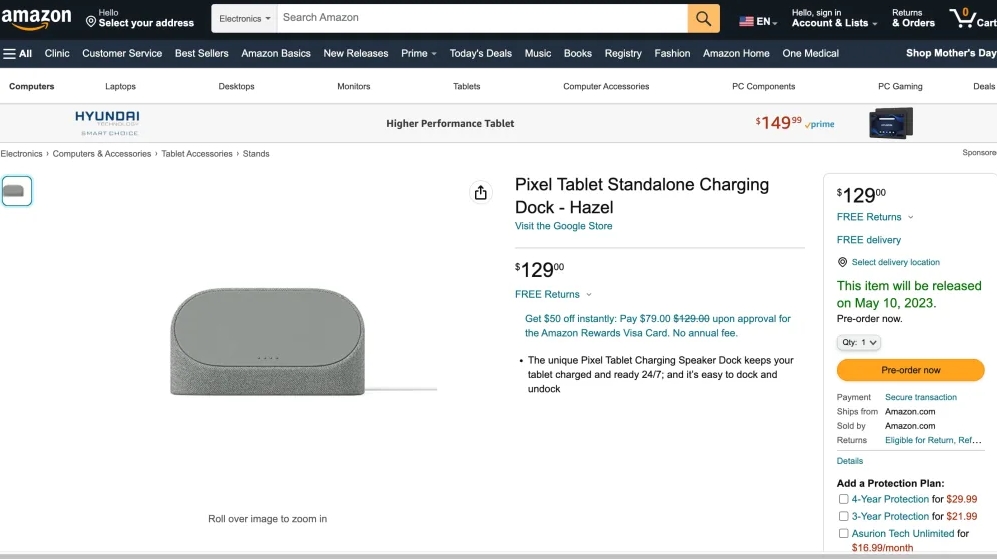
The answer might be both, as while 9to5Google says it will be included in the Pixel Tablet price, an Amazon listing suggests it might be sold separately too (presumably in case you want more than one to have multiple docking points around your house, or break yours).
(Image credit: Amazon / 9to5Google)
The listing has since been removed, but not before being spotted by 9to5Google and 9to5Toys, and it included a price of $129 (around £105 / AU$190). That’s quite expensive, but makes the rumored price of the Pixel Tablet much more enticing if you’re getting both the slate and this dock for that money.
It would seem odd not to be able to buy the Pixel Tablet without the dock though, so we’d take the claim that the two come together as standard with a pinch of salt. If you can also buy the tablet separately though, then it’s still possible that Quandt’s price leak is for the bundle.
As much a smart display as a tablet
So there are some unanswered questions there. Either way, that dock could be the main reason buyers might consider this over an iPad. It turns Google’s tablet into a smart display, with presumably better speakers than the tablet has, while also keeping it charged.
As such, for anyone who wants a slate that also functions as a smart display, this could be a tempting buy, but it remains to be seen how many people that will be.
We should have a clearer idea soon, as most leaks suggest the Pixel Tablet will be announced at Google IO 2023 on May 10, alongside the Pixel 7a and Pixel Fold, both of which are also rumored to have higher prices than you might have hoped.
from TechRadar - All the latest technology news https://ift.tt/QfWqpVK
via IFTTT
Apple’s MacBook Air 15-inch is looking ever more likely to arrive soon, but it may do so without the much-rumored new M3 chipset.
This fresh leak comes from one of the better known sources for Apple gossip, Mark Gurman, who reports via Bloomberg that new Macs are being tested with macOS 14, and that one of those is a device that's “likely to be the 15-inch MacBook Air”.
However, Gurman goes on to say that the mysterious new machine is equipped with a processor that’s “on par” with the current M2, and that has the same loadout of cores (8 for the CPU and 10 for the GPU). We’re further informed that the M3 SoC will be “coming later”, although not how much later.
There's better news about the new machine's possibly display specs, with Gurman claiming that it could run with a display resolution of 3024 x 1964, as seen with the MacBook Pro 14-inch. Bear in mind, though, that with a slightly bigger panel it wouldn’t look quite as sharp (but to be fair, still plenty sharp enough).
The launch date is also touched on, with the theory floated that with the MacBook Air 15-inch seemingly now being tested, the obvious timeframe for an unveiling could be WWDC, Apple’s big developer conference in June.
That potential launch timing chimes with another rumor about the MacBook Air 15's launch date from a prominent Apple leaker, display analyst Ross Young. He claimed last week that panel production for the MacBook Air 15-inch is currently being ramped up ahead of an expected launch in the near future. While Young believes the new Air might be released as soon as next month, WWDC in June would arguably make more sense for the big reveal.
Analysis: Disappointment in some quarters – but is that fair?
There’s now quite a hefty weight of rumors that the MacBook Air 15-inch is indeed inbound, and likely to land in the near future, most probably within the next couple of months. At this point, we’d be surprised if it doesn’t, but you never know – even if this is Apple’s plan right now, there could still be a last-minute change.
If Gurman is correct in thinking that the new MacBook Air will have an M2 chip of some kind, rather than an M3, that's likely to disappoint some folk - not least because previous rumors from Gurman and the likes of DigiTimes has suggested that the MacBook Air 2023 would come with an M3 chip. However, that speculation was pinned on the Air 15-inch pitching up later this year, rather than it arriving imminently.
Other sources have also recently claimed that Apple will stick with the M2 chip in the larger inbound MacBook Air, and that makes some sense in terms of the company’s overall laptop range.
By which we mean, imagine if the MacBook Air 15-inch did turn up with an M3 inside. Wouldn’t that upset those who just bought Apple’s freshly launched MacBook Pro models earlier this year with M2 silicon inside them? We'd think so. Plus, it’s not like an M2 chip wouldn’t still be powerful enough for a MacBook Air.
All of the above is mere speculation, of course, but the weight of evidence does suggest a new MacBook Air 15 is coming before long. We'll be watching with interest to see what happens next.
When the time comes to create a new resume, countless online services are available to assist you. Many of these tools rely heavily on artificial intelligence (AI) to take you through the process. As rapidly as AI has improved, relying solely on it for resume writing might be a mistake. There’s still a human element in the process that should be embraced.
Instead of just relying on AI to create your next resume, combining the two is best, as one is often better at performing specific tasks.
When searching for "resume writing" online, you'll find a long list of available services. Some, like TopResume, have a team of experienced writers ready to help you make the perfect resume. Others, such as Kickresume, are powered by AI. In this case, OpenAI's GPT-3 NLP model.
Here's a look at when you should use AI for resume writing and when you should get a human expert involved.
When choosing a resume writing solution that AI heavily powers, you're putting your professional life in computer Xs and O's hands. However, that isn't necessarily bad because there is much AI can do to streamline the process.
Most AI-power services work the same. After you add some personal information, the AI tool will ask questions focusing on your work experience, education, skills, and hobbies. It will then show you a resume based on this information. From there, you can customize the final design by changing the template, adding or removing personal details, reordering sections, and more.
If you don't feel like having your entire resume developed by a bot, that's okay too. Some sites focus on creating the best bullet points for each job listed under your resume work experience and leave the creative stuff to you.
At a pure micro level, there are a few things AI does better than humans when creating a resume, including:
Using a template to match the industry: Document templates sometimes get a bad rap. However, in terms of resume writing, templates are indeed your friend. Not only does AI have the ability to spit out hundreds of high-quality resume templates, but it can also identify which ones are best suited for which industries. This probably isn't the type of information you're an expert on, so it's nice that AI can help you get past this point quickly.
All about keywords: You can create the perfect resume, but it will mean very little if no one can find it online. This is where keywords come in. Just as businesses want to rank at the top of a Google search page, so do job hunters. AI is very good at identifying which keywords are most important about the appropriate job or industry, then makes resume writing recommendations based on that data.
The proof is in words: If you've ever been on the receiving end of resumes, you probably already know how bad it looks when a summary has a typo. While real editors do a great job of finding those annoyances, AI is even better. It can proofread your resume carefully before it's submitted.
Time is precious: AI-powered resume writing services are also beneficial because they can save you time to do other things. For example, instead of spending hours creating a new resume draft, AI can create one (or many) in seconds once it has your personal information.
(Image credit: Unsplash )
Working only with AI-powered resume services, however, does come with some challenges and weaknesses, including:
Flawed collection system: Today's AI can spit out information in just a matter of seconds. However, if the website collecting that information is cumbersome, you could quickly get into a garbage-in garbage-out scenario. Therefore, be sure to select one of the best AI resume builders.
Limitations: It's also important to understand that Al-powered resume writing solutions are only as good as the designs, templates, and fonts they can recommend. The choices across the board are getting better almost every month. And yes, customization tools are still much more limited than if you worked with an actual writer.
Where's my tone? Depending on the type of position you are applying for; your general tone must seep out onto the digital page. Al might have a problem doing this. Yes, it will correct the grammar, but the result might read too dull for some.
How humans can (and can't) help with resume writing
(Image credit: Amy Hirschi via Unsplash)
As you can see above, AI gets many things right regarding resume writing. And yet, there are certain aspects to the process where it's still important to rely on an actual person. Among the benefits of using a human include:
Understanding: At least for now, Al programs haven't been able to understand the nuances that come with human language ultimately. As such, they cannot recommend subtle details that might benefit you when placed on your resume. Only humans can do this.
Creatively shines through AI-powered programs that still don't have a creative side. As such, they might propose language for your resume that may sound repetitive or generic. Professional resume writers, by contrast, can make your resume text unique and sound human.
Best foot forward: Human writers can dig deeper and ask the right questions to highlight your best qualities.
There are some negatives to using a real person to complete your resume.
Time-consuming: Meeting with someone in person or online takes time. This includes prep time and the meeting itself. Then, you must wait until the person gets back to you with their recommendations.
Higher cost: Real resume writers typically charge more than Al-powered solutions. Whether this cost difference is significant will depend on the size of your wallet.
What trends? Resume needs have changed considerably in recent years thanks to the rise of job search tools that use algorithms and keywords to match would-be candidates with employers. An actual writer could put you at a disadvantage if they aren't computer savvy or know the latest trends.
Unique requirements: There's also the possibility the writer you hire isn't an expert in your specific industry, and this could shine through in the finished product. Where Al-powered solutions might produce dry content, they can still identify which resume templates and design work best for your job search.
Take a combination approach
As you can see, there are benefits and negatives for both Al-powered solutions and real resume writers. This means that your best solution might be to use both kinds of resources. Start with an online Al solution and find the perfect templates for the job you're seeking. Add lots of personal data so Al can make placement recommendations for the text. Once you've created an awesome-looking resume, have an expert take a look. Allow them to know more about you so they can put a creative spin on the finished product.
A new Google Pixel Tablet leak appears to reveal that the incoming iPad rival will have a privacy switch, which means it could be as much a home smart display as it is a tablet.
The new images, published by the leaker SnoopyTech on Twitter, show a switch on the edge of the tablet next to its camera, which hasn't been visible in the photos we've previously seen from Google.
Given that the Pixel Tablet is expected to be a smart display that sits in its dock at home, this toggle is most likely a privacy switch like the ones we've previously seen on devices like the Google Nest Hub Max. Those switches let you quickly disable the microphone and camera when you're at home.
Still not sure if this was the best design pic.twitter.com/o9e7iBBnR9April 13, 2023
See more
We already knew that the Pixel Tablet would be something of a successor to Google's smart displays, given that Google has already released images of it sitting on tables for home video calls.
But this leak comes just a few days after news broke that Google has effectively killed third-party smart displays that use its voice Assistant, suggesting that the search giant is now quite keen to claim that market for itself.
The Pixel Tablet, though, may be a next-gen example of what Google wants a smart display to be, rather than simply a slap in the face to anyone who bought a now-unsupported Lenovo Smart Display. And with the expected inclusion of a Tensor G2 chipset and a version of Android called Android 12L, it will likely make previous smart displays look quite dated.
But the Pixel Tablet's expected arrival at Google IO 2023 in May could also be greeted with a slow clap by anyone who's previously invested in one of those now effectively defunct third-party displays.
Analysis: a tablet without a cause?
(Image credit: Google)
Google previewed the Google Pixel Tablet almost a year ago at Google IO 2022, so suspicions had been growing that it was either vaporware, or had been sent on a fast-track to the increasingly-crowded Google Graveyard.
These new leaks do at least suggest that the tablet is nearing its launch, most likely at Google IO 2023. But it remains something of a confusing device, particularly given that recent news about Google abandoning third-party smart displays.
One of the biggest weaknesses of these home devices hasn't been hardware, but poor software integration and stagnating voice assistants. For example, we found the Google Nest Hub Max to have patchy connectivity to Google's own Next cameras.
Our expectations for voice assistants are also changing given the incredible conversational powers of ChatGPT and Google Bard. The slow and disjointed process of talking to Siri, Alexa and Google Assistant now feels a lot less appealing, and there's evidence that both Google and Amazon have drastically reduced investment in the voice assistants that would power devices like the Pixel Tablet.
Still, perhaps the slowly-improving Matter smart home standard could present fresh opportunities for home-based controllers like the Pixel Tablet – and that's one of the many things we're looking forward to finding out at Google IO 2023.
from TechRadar - All the latest technology news https://ift.tt/cjDY32p
via IFTTT
There have been a few rumblings about the Samsung Galaxy Tab S9 in recent weeks, and it seems as though the Android tablet series could arrive with two cheaper FE (Fan Edition) models as part of the range – which would be something of a surprise.
The team at SamMobile has been joining the dots and comparing the model numbers posting Geekbench benchmarks. Two of those models, SM-X516B and SM-X616B, could relate to budget-level versions of the Tab S9.
Based on previous convention, the Tab S9, Tab S9 Plus and Tab S9 Ultra should have the model numbers SM-X716, SM-X816 and SM-X916 respectively. That means the two extra models that have turned up are something of a mystery.
The FE returns
You may remember that a Samsung Galaxy Tab S7 FE was launched in 2021, but we didn't get an FE tablet with the Galaxy Tab S8 the year after. The signs now are that the FE model might be making a comeback – as it might well for Samsung's phone line too.
The FE version of the Galaxy S22 phone didn't materialise – matching the tablet series – but there has been plenty of talk that there will in fact be a Samsung Galaxy S23 FE this year. It would seem that the Fan Edition is back in favor.
According to the benchmarks, these tablets are going to be fitted with a mid-range Exynos 1380 chipset and either 6GB or 8GB of RAM. They should appear alongside the main Tab S9 tablets around August or September time (following the schedule of the Galaxy Tab S8).
Analysis: covering the price points
In previous years – except last year – Samsung has used FE tablets and phones to appeal to people who don't want to spend flagship-level prices but do want devices they can rely on. All the best mid-range phones and tablets make compromises, but the right ones.
It's not clear exactly why the FE models didn't appear alongside the Galaxy Tab S8 or the Galaxy S22, but the ongoing effects of a global pandemic and economic uncertainty probably had something to do with it.
Another possibility is that sales weren't great for devices like the Samsung Galaxy S21 FE, so it's going to be interesting to see if that changes, should Samsung decide to produce two Galaxy Tab S9 FE models (possibly with different sizes or configuration options).
In theory, these FE devices should be the perfect balance of price and performance, but it can be a difficult sweet spot to hit. For inspiration, Samsung need only look to Apple, which covers a whole range of price points with its iPads.
Whether it's your computer, smartphone, or tablet, there's a lot of personal information on devices you don't want to lose. That's why the best cloud services have become so popular in recent years. Today's services are compatible with various devices and available at low monthly prices, depending on how much data you have that needs to be backed up. Better still, some of the cloud service options are even available for free.
There are many reasons to back up your data to the cloud. Some of these have less to do with peace of mind and more to do with organization. Here at the top reasons to consider a cloud backup service.
1. Peace of mind
(Image credit: Jared Rice on Unsplash)
Imagine losing forever your tax documents, precious photos, and much more. There's no doubt about it; losing your digital data would become a significant headache. However, those items are better protected by using a cloud service for backup.
Cloud services like iDrive, Internxt, and pCloud work together. With remote servers, you can store data and access it from various devices—the one requirement is an internet connection.
Three types of services on the market are under the cloud moniker: cloud storage, cloud computing, and cloud networking. The first is most beneficial if you're looking for an external backup solution. With cloud storage, you don't have to worry about backing up your files locally. Instead, you send them automatically to the cloud, accessible across all your devices.
If your digital documents are stored locally on a personal computer (and not backed up), a hardware problem could quickly lead to data loss. With cloud storage, your data is kept on multiple devices at various locations that a third party maintains. Therefore, your data is protected if one server crashes since it's located in different physical areas. In addition, regardless of location, the data is protected physically and digitally using various barriers such as facility security and two-factor authentication.
2. Organizing your thoughts and sharing data
(Image credit: Scott Graham on Unsplash)
Better organization is another reason to consider backing up your data to the cloud. The very act of storing your data offsite and in various locations is a form of organization. Drilling down, you can use multiple software tools to organize better, including cloud-based management and productivity software.
Sharing is another significant benefit. Recall that cloud-based storage makes it possible to access your data from anywhere with an internet connection. Now imagine collaborating with others for some of those documents. Collaborating on projects, regardless of someone's location, allows sharing files and staying organized in real-time.
You can use a long list of unique online collaboration tools to create, share, and edit documents and other digital items with others. These include Microsoft 365, Slack, Asana, and more. While each tends to have different strengths, they each have one thing in common: the data is online.
3. Save some money
(Image credit: NATNN / Shutterstock)
Another important reason to turn to cloud storage is cost. The most popular platforms charge just pennies each day. Better still, you only have to pay more when your needs scale upward. For example, in the United States, Google One currently offers users 100GB of data for $2 per month. However, that number can climb to as high as $159/month for access to 30TB of storage.
Sure, you can purchase one of the best external hard drives for Mac and otherwise and forgo a cloud storage solution. However, going the local route comes with many disadvantages, even if the price for the device seems like a deal.
For example, our favorite cloud storage provider, iDrive, charges as little as $4 per year for 10TB of data storage for the first year of service. A well-reviewed Seagate Backup Plus Portable hard drive could set you back $200 or more for the same amount of storage.
On the surface, that number might seem worth it since you'll own the device. However, the information on that device will be less protected since it's physically only one device. Additionally, the weather, a would-be thief, or even an accidental push of a computer key could either move or destroy the device or cause its contents to become inoperable. You won't have these issues with cloud storage.
4. Protection from malware
(Image credit: Shutterstock)
Malware comes in many forms, from viruses to ransomware. Today's computers, those local and "in the cloud," can be affected by malware. However, it's much easier to protect your data when it's stored offsite in the cloud.
Today, it's much easier to update computer software and download much-needed security fixes to combat the latest virus. However, we're all human and live busy lives, and forgetting to install the latest update on Windows or macOS happens. It's during those times malware could take control of your data or expose it to others.
Using a cloud storage provider makes it more likely your data is protected from the latest malware attack. Reasons range from your data being stored on more than one computer to a third-party having effective software upgrade policies.
5. Comply with regulations
(Image credit: Kyle Glenn on Unsplash)
Cloud backup regulations are a set of rules and guidelines that businesses must follow to protect customer data that is stored in the cloud. These regulations vary from country to country, but they typically require companies to implement specific security measures, such as encryption and access controls. They may also need businesses to keep customer data for a certain period or to delete it upon request.
The world's most comprehensive data protection regulation, Europe's General Data Protection Regulation, or GDPR, outlines rules on everything from access controls to encryption to what happens when a data breach occurs. And it doesn't end there. GDPR applies to a wide range of information, including names, email addresses, images, bank details, posts on social networking websites, medical information, or even a computer IP address.
Though current government cloud backup regulations mainly target businesses, individuals aren't immune to the rules. After all, the data covered by the laws is owned by people who don't want to lose it — or see it fall into someone else's hands.
Resumes remain the top tool when it comes to getting a new job. You can write a new resume by yourself, which will cost you nothing. However, it might be wiser to get some assistance from a pro. Today, many terrific online professional resume builders are worth checking out, and there are reasons you should do so. Here are five reasons you should hire a pro to write your resume.
1. Experience and expertise
(Image credit: jose aljovin on Unsplash)
The best professional resume builders have at least two things you do not: experience and expertise. So even if you consider yourself a great writer, the odds are pretty high that you don't often have to write a new resume. Unfortunately, this constraint means you're almost certainly missing out on the latest resume trends experts provide to make resumes stand out.
This starts with accessing a lengthy list of templates and design options. Regardless of the service, these templates tend to be more robust and cutting-edge and include all the information companies find most important when selecting a candidate. This attention to detail isn't found in basic resume templates, such as those offered in Microsoft Word, Apple Pages, or other word-processing apps.
In addition, the templates provided by professional resume builders are proven and have already worked for others looking for a new job. For example, in creating its templates, Resume.com regularly speaks to thousands of employees and employees to find out what folks are looking for in a would-be hire.
The selection of templates also considers the many jobs most likely to be found in the marketplace. Nurses, for example, will need to use templates utterly different than those who seek a career in education.
Beyond templates, choosing a professional resume builder makes it more likely that the finished product is well-written, compelling, error-free, and correctly highlights your skills and experience. Once the process is completed, you can submit your information to the best job sites.
2. Save yourself some time for little money
(Image credit: Mitchell Hollander on Unsplash)
Finding a new job can be an exhilarating process — once one is offered to you. Before this can happen, however, it can be exhausting. From working on a fresh resume to finding jobs to apply for to eventual interviews, seeking a new job, regardless of the reason, takes a lot of time. Working with a professional resume builder can at least take some of that work off your hands.
A resume builder will take the guesswork out of drafting this critical document. It will do so by helping you better organize your work experience, skills, and education. From there, it will show you the type of resume you need based on the jobs you plan to apply to.
Perhaps most importantly, the professional resume builder will show you how to present the content in the resume—suggesting keywords, telling you what words to avoid, etc.
There are paid and free professional resume builders. Even those that cost money are reasonably priced. Better still, most services offer free trials and charge by the month, not the year. There's also the question of document format. Once you create a resume, you can print it or download it to your computer. Most builders allow you to save documents in various forms, including PDF and Microsoft Word. The choice is ultimately yours.
3. Better chance to stand out
(Image credit: Slim Emcee on Unsplash)
Countless people apply for new jobs each year. That number grows even higher during economic downturns. Inevitably, you aren't the only person who wants a specific job. You could have the same experience as someone else, but if you don't stand out in various ways, they might get an interview while you do not.
Professional resume builders know what employers are looking for and know the best ways for you to stand out compared to others. For example, after understanding your skills and how they match the job requirements, the service can help create a document emphasizing those skills. It will also highlight your unique selling points that you probably couldn't do alone.
One fresh way to stand out is by creating a personal website with your resume and other information. Most professional resume builders now include this option, making converting your resume into a mobile-friendly website seamless. Once your website is created, you can add the address to your application documents for additional exposure.
4. Get help with cover letters too
(Image credit: Steve Johnson on Unsplash)
A resume isn't the only required document when applying for a new job. So is a cover letter, which is your chance to tell a recruiter why you want to be considered for a position. Unfortunately, drafting a cover letter sometimes feels like an afterthought for many. A professional resume builder uses the information it already knows about you to help create a powerful cover letter. Along the way, it will present a series of templates to help you stand out.
The one-page document has one purpose: to better explain to a recruiter how your skills and background match the job. This starts with a solid opening paragraph that's clear, concise — and free of typos. From there, highlight your relevant skills and experience, tying them to the job. Don't simply list these critical points, however. Instead, give specific examples of how you gained these skills and experience. In other words, personalize the letter.
5. Get the feedback you need
(Image credit: Afif Ramdhasuma on Unsplash)
Feedback is an essential part of the resume-building process. Professional resume builders will carefully analyze your resume and cover letter, look for errors, and offer ways to improve the finished product. Services will also make template suggestions so your design correctly matches the job. This includes recommending different formats, font styles, and sections.
The job search process doesn't have to be a difficult one. However, hiring a professional resume builder makes sense if you're serious about finding your dream job. These services know what recruiters are looking for and have the tools to make your resume and cover letter stand out.
A new global study found that Iceland is leading the way in creative activity online.
Of the top 30 countries web hosting provider Hostinger analyzed that ranked highest in online creativity activity, the data shows that 23 can be found in Europe.
In terms of website and app creation and GitHub commits, Cyprus leads the way in terms of mobile app creation; Singapore and Hong Kong are the frontrunners for Github commits; and the USA ranks first for most websites created (generic TLDs).
Creative websites in Europe
With the continuing growth of the internet, the report marks Cyprus’ app creation as one of the economy’s strengths, even from an income perspective.
Hostinger says that Fintech powerhouses, like Switzerland, Netherlands, and Denmark, have among the highest number of website launches on the continent, indicating that website design and development are still substantial economic drivers on the continent.
Commenting on the study, a spokesperson for Hostinger noted: “We often don’t stop and think about what online creativity is or how it can be measured. It’s been fascinating to see just how different economies are shaped by different types of web development endeavors.
“This study also opened our eyes to some emerging economies where the online revolution has just started, and it’s exciting to be in the forefront of all these new technologies.”
Overall online creativity frontrunners include Iceland, Switzerland and the Netherlands, while leaders in mobile app development include Cyprus, Israel, and Singapore.
When it comes to leaders in website development, the USA, Malta and Iceland take the lead for generic TLDs, as the Netherlands, Switzerland, and Denmark sit at the top of the table for country-code TLDs.
The top three countries taking the lead in GitHub activity include Singapore, Hong Kong, and Switzerland.
Google’s upcoming Pixel Tablet is set to arrive packing the latest connectivity tech, including ultra-wideband support (UWB), based on a regulatory listing spotted online.
An FCC (US Federal Communications Commission) listing for a ‘Google-made hand-held device’ was spotted by 9to5Google, which speculates that UWB support could be used to enable features like digital handoff for audio; that is, tapping your phone to transfer the audio stream via a supported app or enabling it to tap into Google’s reported Find My network rival.
For clarification, the listing doesn’t say that the device in question is a Pixel Tablet – rather it identifies a ‘Google-made hand-held device that doesn’t support cellular capabilities’. That’s either a hint that Google’s planning on building the next iPod, or it's the Pixel Tablet the company already announced a year ago which should be.
Building a rival ecosystem
More than just being considered simply a Nest Hub replacement, Google could be considering the tablet form factor as the center of your digital life. In other words, the Nest Hub features are simply additions to further this goal, rather than its entire raison d’etre.
With its Android 12L and Android 13 updates, Google began investing heavily in Android device interconnectivity. Partly due to this, we got a small trickle of Android tablets that highlighted this Apple handoff-style interconnectivity (enabled by UWB), as part of their appeal – the upcoming OnePlus Pad stands out as an example of an Android manufacturer jumping into the tablet market for that reason.
The key question remains whether Google can go further than Apple, rather than simply copying this key feature. The company’s most ambitious cross-device features hint at a significant deviation, with Chromebooks set to soon gain the ability to stream apps from Android phones (albeit a year later than Google’s 2022 announcement implied). That’s also a feature the as-yet-unreleased OnePlus Pad boasts, and one that Google could highlight with its Pixel Tablet.
Combine that with a Nest Hub-style dock, a large screen that lets you locate all your devices, and powerful speakers – so your music can shine, and you get a feel for the potential a Pixel Tablet could have.
We’ll learn more about Google’s cross-device plans at Google I/O in May 2023, but we’re already excited for the potential, as more information trickles out.
from TechRadar - All the latest technology news https://ift.tt/SqtdBbl
via IFTTT